

Waterproof Car Speakers: IP Ratings, Uses and Installation

You've got the top off, the sky looks fine, and then a Delaware downpour hits before you can find an overpass. Your rear speakers get soaked, sound fine that day, and start crackling a week later. That delay is what confuses most buyers. Water rarely kills a speaker instantly. It gets in, sits, corrodes, and then the damage shows up.
Table of Contents
- Waterproof Car Speakers Explained in Plain Terms
- Reading IP Ratings on Car Speakers
- Waterproof, Water-Resistant and Marine Speakers Compared
- Matching Waterproof Speakers to Your Vehicle
- Mounting, Wiring and Enclosures That Keep Water Out
- Caring for Waterproof Speakers Season by Season
- Frequently Asked Questions About Waterproof Car Speakers
- Confirm the Rating and Book Your Installation
Waterproof Car Speakers Explained in Plain Terms
A speaker pod clamped to a motorcycle crash bar lives outside full time. It takes rain at highway speed, sits in a wet parking lot overnight, then bakes in the sun the next morning. The surround stays damp long after the ride ends, and that lingering moisture is where corrosion gets its start.
Waterproof car speakers are built for exactly that exposure. Sealed surrounds and gaskets keep water away from the voice coil gap, treated cones shed moisture instead of absorbing it, and corrosion resistant hardware keeps the terminals from pitting. The result is a speaker that keeps working through rain, road spray, hose washing and brief submersion.
A Simple Way to Picture the Levels
A standard speaker behaves like a paper umbrella: it looks protective until it gets wet. A water resistant speaker works like a rain jacket, fine for drizzle and splashes. A waterproof speaker is closer to a dry suit, sealed at the seams and rated for real immersion.
The word waterproof on a box covers a very wide range of real performance, and two boxes that both say it can promise completely different things. The tested rating is what turns the word into a measurable claim.
How the Labels Got Here
Outer Audio's guide to next generation waterproofing traces the move from splash-only IPX4 products in the mid-2010s, to IPX7 immersion ratings that certify 30 minutes underwater at 15 centimeters to 1 meter of depth, and then to IP67 combinations around 2020 to 2021 that pair full dust sealing with that same immersion requirement. Each step added a different kind of promise, shedding spray, then surviving measured immersion, then sealing out dust on top of it.
Survival comes down to three parts working together: the rating the speaker earned, the materials in the cone, grille and hardware, and the mount that seals it to the vehicle. A sealed cone set into an unsealed hole, or a gasket compressed over a warped panel, still leaves water a straight path to the terminals. When the rating, the materials and the installation all agree, the wording on the box stops being the part you have to guess at.
Reading IP Ratings on Car Speakers
Start with one worked example and the rest gets easy. Take IP67. The 6 means the enclosure is dust tight. The 7 means it survived temporary immersion in water under defined test conditions. Two digits, two separate promises.
The International Electrotechnical Commission guide to IP ratings explains that the first edition of IEC 60529 was published in 1976, and that the first digit measures protection against solids such as dust on a scale from 0 to 6, while the second measures liquid protection on a scale from 0 to 9. When you see an X instead of a number, that half wasn't rated. IPX7 tells you about water and says nothing tested about dust.
What Each Code Certifies
The water digit is where buyers get tripped up, because each step describes a different kind of exposure, not just more of the same. Spray and submersion stress a speaker in different ways: moving water searches for weak seams under pressure, while still water tests whether the whole assembly can stay sealed over time.
| Rating | What It Certifies | Typical Car Use |
|---|---|---|
| IPX4 | Splashes from any direction; no immersion | Enclosed cabin, door panels in dry climates |
| IPX5 | Low-pressure water jets | Door speakers exposed to rain and road spray |
| IPX6 | Powerful water jets | Exterior Jeep pods and anything hosed down |
| IPX7 | Temporary immersion, 15 cm to 1 m deep, up to 30 minutes | Low-mounted speakers, motorcycle pods, UTV footwells |
| IPX8 | Deeper or longer immersion, defined by the manufacturer | Check the stated depth and time before buying |
| IP65 | Dust-tight plus water jets | Exposed truck and Jeep mounts |
| IP66 | Dust-tight plus powerful water jets | Off-road and washed exteriors |
| IP67 | Dust-tight plus temporary immersion | UTVs, boats, and most exposed motorcycle installs |
| IP68 | Dust-tight plus manufacturer-specified immersion | Deep-immersion needs, verified by the test sheet |
The IPX8 Trap and the Missing Rating
IPX8 is the code to read slowly. It means extended immersion under conditions the manufacturer specifies, so two products can both carry IPX8 while using different depths and durations. If the depth and duration are not printed, the number alone is incomplete.
Practical rule: Match the rating to the worst water exposure the speaker will meet, and treat any product that names no code as unverified.
A rating also applies to the tested assembly, not a bare speaker on a shelf. Cone material, grille design, drainage paths, fasteners, gasket surfaces, and the final mount all help decide whether the rated result survives in the vehicle. A listing such as the 2 Pair Of Polk MM692 6x9 Coaxial Speakers for Marine and Powersports any Vehicle can show the 6x9 coaxial pair and its available variants while leaving the ingress code off the sales copy, so check the product test sheet or manufacturer page before counting it as jet- or immersion-rated. If a listing gives you neither, you're guessing.
Waterproof, Water-Resistant and Marine Speakers Compared
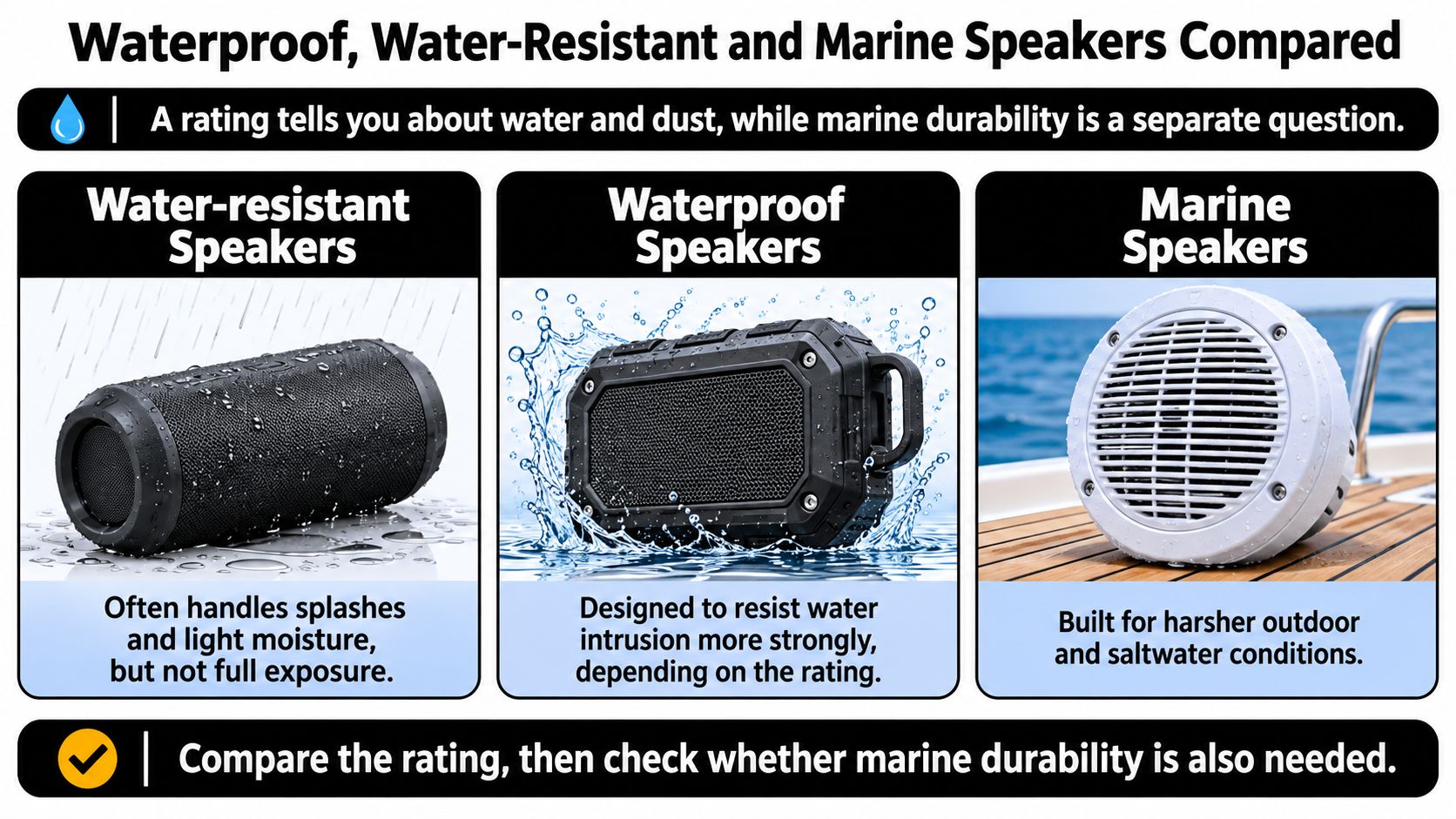
Two speakers on the same shelf can carry an identical rating and still age very differently outdoors. One survives several seasons on a boat. The other pits, fades, and rattles apart in months. The labels below explain why, and comparing them side by side helps before you look at any single product.
| Category | Typical Rating | Protects Against | Gap to Check |
|---|---|---|---|
| Water-resistant (unspecified) | No verified code | Light moisture and drizzle | No test evidence for jets or immersion |
| Splash-resistant | IPX4 | Splashes from any direction | Not certified for hose spray or immersion |
| Waterproof | IPX5 to IPX7 | Jets or temporary immersion | No salt-fog or UV testing stated |
| Marine-grade | IP65 to IP67 with salt and UV evidence | Salt, UV, humidity, jets | Confirm test reports and hardware materials |
Why a Higher Number Isn't the Whole Answer
West Marine's guide to choosing marine speakers shows what ratings leave out: long term salt corrosion, ultraviolet exposure, humidity, temperature cycling, and connector deterioration. A speaker can keep water out during a spray test and still corrode or lose seal integrity in saltwater and strong sun.
So shop on two axes, not one. Check the code first, then ask for separate salt fog and UV test evidence, stainless or coated hardware, UV tolerant cones, and corrosion resistant terminals. Survival near the coast is a system property: the rating, the materials, and the way the speaker is mounted all decide together whether water gets in. Even a marine-rated cone fails fast when a screw hole is left unsealed, because the protection belongs to the whole assembly and the installation is part of it. The same logic applies to the rest of the system, which is why a waterproof subwoofer needs its own checking rather than borrowing the speaker's rating.
This short video walks through how those categories differ in practice.
A head unit shows the two axes clearly. The manufacturer's listing for the AQ-WR-5F Marine Audio Receiver – Waterproof Bluetooth Boat Stereo cites an IP66 rated front panel alongside UV resistant construction and anti corrosion internal PCB coating. One claim covers water entry; the others cover sun and salt. Don't transfer a portable poolside speaker's waterproof label to a boat hull or a permanently mounted vehicle system, because the exposure never stops.
Matching Waterproof Speakers to Your Vehicle
Exposure sets the rating, not the biggest number on the box. A waterproof speaker works like a raincoat: the fabric rating matters, but so do the seams and how it's fastened. Three things decide whether water stays out: the rating on the speaker, the materials it's built from, and how it gets mounted. Write down the worst thing that will realistically hit that mounting spot, pick the minimum rating below, and put the rest of your budget toward the other two.
The EU document on IEC 60529 protection degrees explains that IPX8 isn't a universal depth or time rating, because the manufacturer must specify conditions more severe than IPX7. The ratings table earlier in this guide covers what each splash and jet digit certifies. In practical terms, a normally enclosed cabin can run a lower code, while Jeep tailgates, motorcycle fairings, UTV pods, and marine adjacent spots generally need jet or immersion protection.
| Vehicle Type | Minimum Rating | Materials and Hardware | Extra Check Before Buying |
|---|---|---|---|
| Convertible or soft-top | IPX5 on door speakers | Coated cone, stainless clips | Dry time and drain path on rear panels |
| Jeep or truck exterior pods | IP66 to IP67 | UV-tolerant cone, stainless hardware | Tailgate or pod drain path |
| UTV or ATV | IP67 | Sealed surrounds, corrosion-resistant terminals | Mud clearing and washing routine |
| Motorcycle | IPX5 to IPX6 upper, IPX7 low pods | Vibration-rated mounts, sealed harness | Fairing vibration and wind-driven rain |
| Boat or marine | IP66 to IP67 with salt and UV evidence | Stainless hardware, marine-grade wire | Salt-fog and UV test report |
Reading the Table by Position
Height matters as much as vehicle type. An upper fairing speaker on a motorcycle mostly meets wind driven rain, so jet protection with a sealed harness does the job. A low pod near the road meets standing water and spray thrown upward, which is why it needs the stronger immersion rating.
Fit comes before any of this, so confirm the cutout and depth for your model using a speaker size by vehicle guide before you order. A speaker that's a quarter inch too deep will either not seat on its gasket or push against something behind the panel, and a gasket that can't compress turns a rated speaker into an unrated one.
Vehicle specific kits make these tradeoffs visible. The image below shows a Jeep system built around factory locations rather than universal pods.
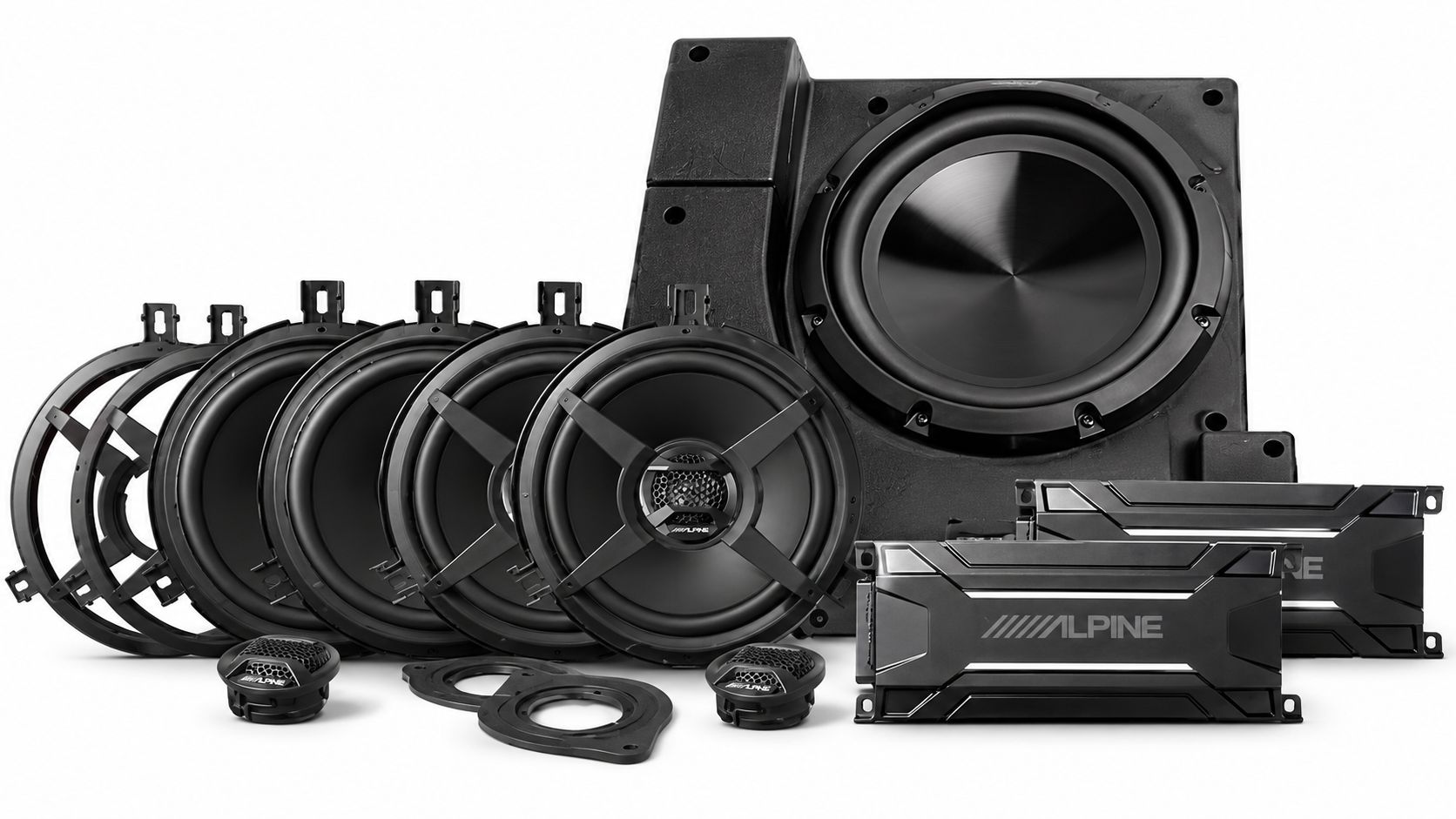
The Alpine PSS-22WRA – Jeep JK Speaker System With Subwoofer and Amp combines weather resistant components, UV and water resistant enclosures, and plug and play harnesses that use factory mounting locations. It's a sensible match for open air driving and trail spray, and it shows why each position earns its own rating: a tailgate pod facing direct spray needs stronger protection than a footwell speaker shielded by the dash. Treat the table as your starting point, then confirm the manufacturer's test sheet covers the full assembly you plan to install.
Mounting, Wiring and Enclosures That Keep Water Out
A speaker's rating can be undone by its installation. The test was done on a specific assembly with a specific gasket and mounting surface. Change those, and you've built something untested.
The four failure points below appear in the order you'll meet them during an install.
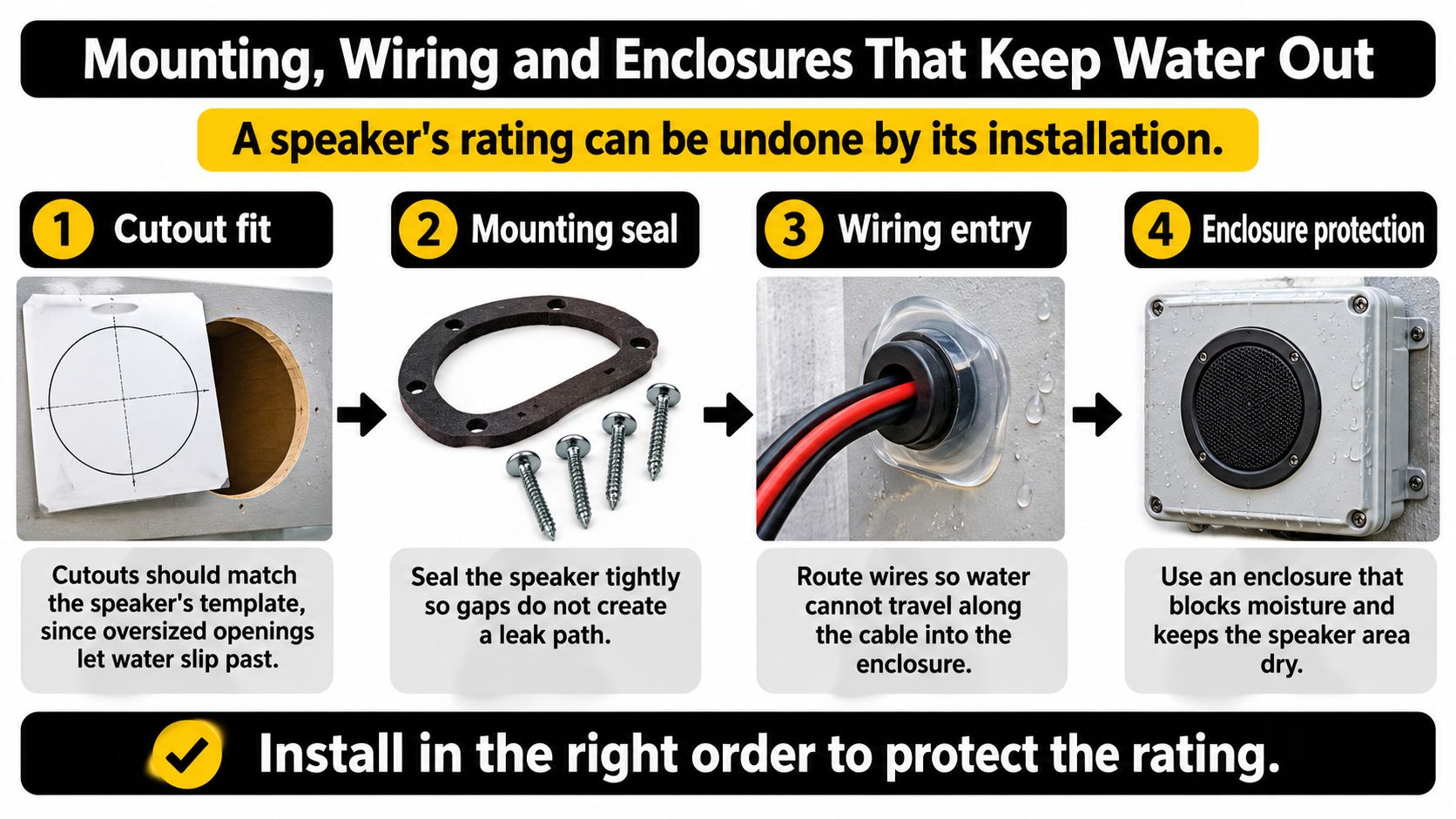
Cutout, Gasket and Drainage
Cutout fit comes first. Cut to the speaker's template, because an oversized opening leaves gaps the gasket can't bridge and water walks straight past. Test fit dry before you wire anything.
Mounting seal is next. Use a new gasket rather than reusing the flattened one you removed, then tighten screws evenly in a cross pattern until the gasket compresses without warping the frame. Overtightening one corner lifts the opposite corner.
Then think about where water goes after it arrives. Orient weep holes and drain paths downward, and check that water can't pool behind the panel. A door that holds water at the bottom will keep the back of the speaker wet for days.
Wiring Entry and Enclosures
Route cable so it approaches the connector with a drip loop, a low sag that lets water run off the wire instead of along it into the terminal. Seal every junction with adhesive lined heat shrink or sealed connectors, add strain relief where wires leave the housing, and put a light film of dielectric grease on electrical contacts.
Magnadyne's guide to choosing waterproof speakers makes the underlying point that protection depends not only on the speaker housing but also on the gasket, mounting surface, fasteners, cable routing, strain relief, connector sealing, and whether water can pool behind the panel, so an IP65 or IP67 speaker can still fail when a gasket is reused or wiring enters from a water trapping direction. Durability is a system property, not a single specification. Our own notes on marine audio installation apply the same thinking to boats.
If you drill a new hole, remove a grille, or leave a terminal unsealed, you've created a leak path the original test never covered.
For subwoofer and amplifier enclosures, use a sealed design or a vented one with a small breathable vent that equalises pressure without admitting spray. Use stainless or coated fasteners throughout.
Driveway checklist
- Template check: Cutout matches, speaker seats flat with no rocking.
- Seal check: New gasket, even compression, no gaps at corners.
- Drain check: Weep holes face down and the panel drains freely.
- Wire check: Drip loop, sealed junctions, strain relief fitted.
- Hardware check: Stainless or coated fasteners, grease on contacts.
Caring for Waterproof Speakers Season by Season
Waterproof doesn't mean maintenance free. Seals degrade with salt and sun, fasteners loosen with vibration, and trapped water is the most common hidden failure. This routine takes about fifteen minutes and protects the rating you paid for.
- Rinse after salt exposure. Wash the grille, surround, and mounting hardware with fresh water after any saltwater or road salt exposure. Salt left in place keeps corroding between trips, so this single step does more than any other.
- Wash gently. Use mild soap and a soft brush on the exterior. Keep a pressure washer wand well back and never aim it directly at the cone surround or the seal edge, because that pressure exceeds what jet testing assumes.
- Inspect surrounds monthly. Look for cracking, lifting edges, or debris wedged under the grille. Catching a lifting seal early is a gasket replacement, while catching it late is a speaker replacement.
- Check terminals for corrosion. Green or white crust on connectors raises resistance and heats the joint. Clean contacts with contact cleaner and a small brush, then reseal the connection.
- Retighten fasteners. Recheck mounting screws after the first month of use and again each season. Vibration backs screws out slowly, and a loose corner is a leak.
- Dry out after storms. After a major storm or a water crossing, check inside the cabin or pod for dampness and let the space dry fully before closing it up. Sealed in moisture does the damage, not the brief wetting.
- Prepare for storage. Before storing a boat or motorcycle for winter, clear trapped water from drain paths and cover exposed speakers. Water left sitting in a pod all winter will find every seam.
If sound turns muffled or one side drops out intermittently, check the connector and drain path before assuming the speaker failed. Most of the time it's corrosion or pooled water, and both are fixable.
Frequently Asked Questions About Waterproof Car Speakers
Do Waterproof Speakers Sound Different From Standard Ones
They can. Sealed surrounds, treated cones, and protective grilles all change how a cone moves and how high frequencies disperse, so tonal balance can shift slightly. Compare the published frequency response and sensitivity, then listen to the actual model if you can, because two speakers with similar specs can still present vocals differently.
Are They Worth the Extra Cost on a Daily Driver
Only where the speaker is exposed. Say your sedan's door speakers sit behind intact moisture barriers in a closed cabin and you rarely drive with windows down in rain. A cheaper splash rated speaker is a rational buy there. Spend the extra money on the positions that get wet, such as a soft top's rear panels or a truck's exterior pods.
Can an IP67 Speaker Replace a Factory Speaker Without Changing the Panel
Only if mounting depth, cutout diameter, and screw pattern all match. If you have to enlarge the hole, trim a grille, or skip the supplied gasket to make it fit, you've modified the tested assembly and the rating no longer describes what you installed. Measure first, including the space behind the panel for the magnet and terminals.
Does Cold Weather Affect Waterproof Speakers
Yes, mainly through the seals. Rubber and foam gaskets stiffen in freezing temperatures and conform less well to an uneven mounting surface. Check the operating temperature range on the manufacturer's test sheet, and avoid mounting positions where ice can form and pry at the seal edge.
Does a Waterproof Rating Cover the Amplifier or Subwoofer Enclosure
No. The rating covers the speaker assembly that was tested, nothing downstream of it. Your amplifier and subwoofer enclosure need their own protection, whether that's a sealed enclosure, a breathable vent, conformal coated boards, or a mounting location out of the splash zone. Plan each component's exposure separately.
Confirm the Rating and Book Your Installation
You don't need to memorise every code. You need four steps in the right order, done before money changes hands.
- Name the worst exposure. Write down what that mounting spot will meet, whether it's rain through an open top, hose washing, salt air, mud, or genuine submersion.
- Pick the minimum code for it. Take the rating from the vehicle table and confirm the manufacturer applied it to the full assembly, not just a bare driver on a test bench.
- Ask for the test reports. Request the documentation behind any IP claim, and separate evidence for salt fog or UV resistance if the speaker will live on a boat or an off road vehicle.
- Agree the install plan first. Settle the mounting surface, gasket, wiring route, and drain path with your installer before work starts, and ask them to show you how each seal will be made.
That last conversation is where most failures get prevented. When Audio Jam Inc first opened, it was known for expert installation of car speakers, subwoofers, and amplifiers, and the shop handles all vehicle types, from compact sedans and trucks to SUVs and luxury cars. Bring the vehicle and your honest exposure list, including where you wash it and whether it sits outside near the coast.
We'll plan the rating, mounting, and wiring together so the speaker stays sealed after installation, not just on the test bench. If a cheaper splash rated speaker is enough for your door location, we'll tell you that instead.
Bring your vehicle and a clear picture of how wet it really gets, and we'll match waterproof car speakers, hardware, and mounting so the seal survives the install. Visit Audio Jam Inc to book a consultation and plan the rating, gasket, wiring, and drain path before any panel comes off.