

Speaker and Amp Combo: A Matching Guide

The most popular advice for buying a speaker and amp combo is to match the wattage numbers on the boxes. That's only part of the job. An amplifier can match the speakers on paper and still overwhelm the vehicle's charging system, run into an unsafe wiring load, or sound harsh because it wasn't integrated correctly.
Start with the vehicle, not the biggest power rating. A good match gives the speakers usable clean power, stays within the amplifier's impedance limits, and leaves the electrical system enough capacity to do its regular work.
Table of Contents
- Why a Matched Combo Beats Head Unit Power
- How Much Amp Power Your Speakers Need
- Will Your Car Electrically Support This Combo
- Wiring Loads Bridging and Speaker Phase
- Packaged Kits or a Custom Build
- Why a Rated Match Can Still Sound Weak
- Order or Book Your Combo in Bear
Why a Matched Combo Beats Head Unit Power
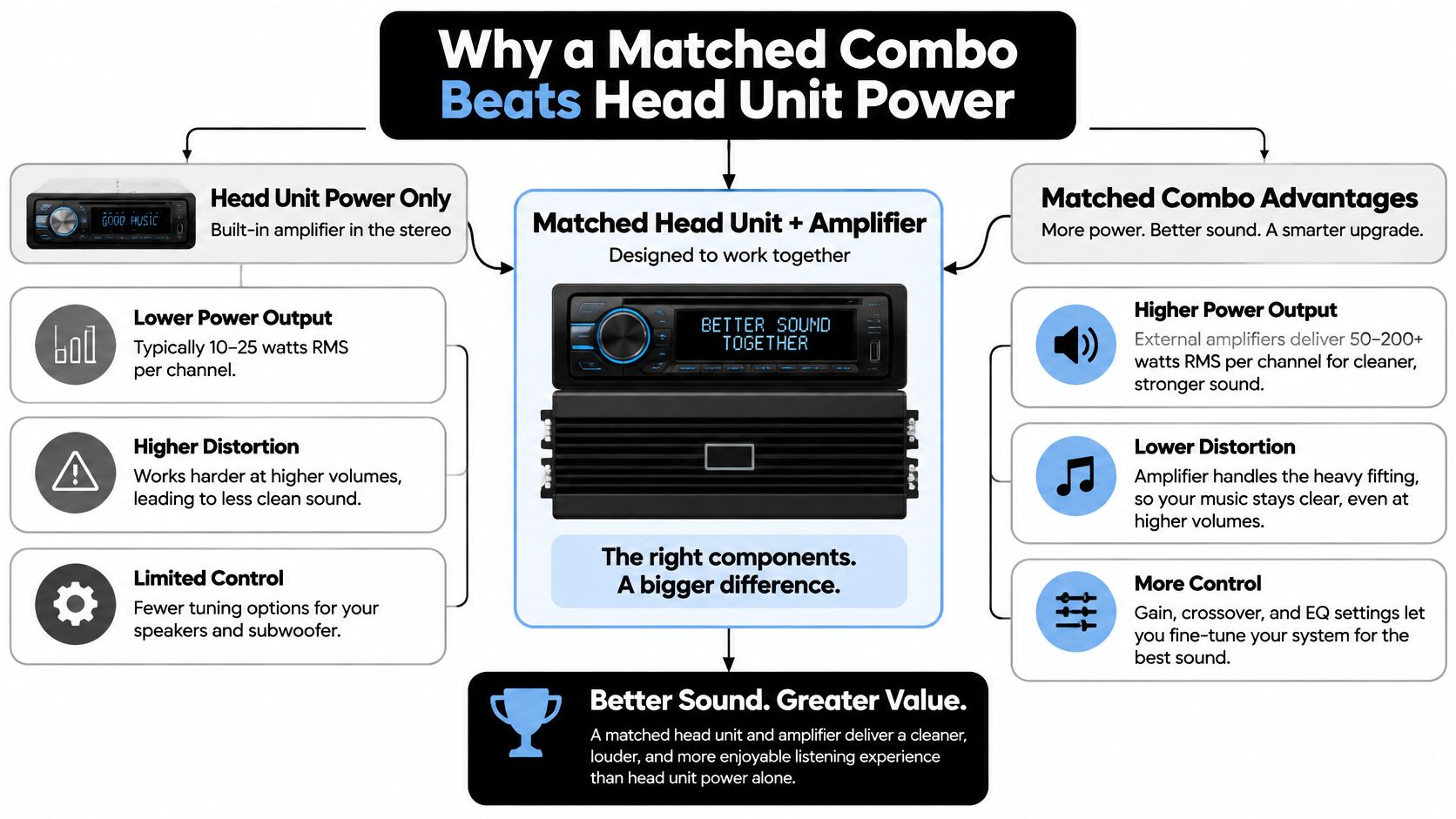
Replace worn door speakers, keep the existing radio, and you may hear clearer vocals at low volume. Turn it up, though, and the sound can still become harsh instead of gaining impact. The new speakers may be reaching the radio's clean-output limit.
A speaker and amp combo pairs speakers with an external amplifier selected for their continuous power handling, electrical load, and channel requirements. The speakers convert electrical energy into sound; the amplifier supplies the signal and power that drive them.
More power needs a capable source
In a typical upgrade, the radio provides the signal while the amplifier supplies additional power to the speakers. That can give music more headroom, or room for brief peaks before the output clips. Once an amplifier clips, turning up the volume adds distortion rather than clean output.
The amplifier also draws current from the vehicle's electrical system. Its output depends on both a clean signal and adequate electrical supply. More amplifier power alone cannot fix distortion coming from the radio or compensate for limited vehicle power.
This illustration shows how the components work together.
Choose components for the problem you hear
Ask what you want the system to improve, then choose components that address that need. Clearer vocals, stronger bass, and better coverage can call for different layouts.
Practical rule: Describe what's missing before choosing equipment. A system that lacks bass doesn't automatically need more power sent to its door speakers.
Record each speaker's continuous rating, nominal impedance, and intended role. Those details help narrow the amplifier choice; a peak-power figure on the packaging does not describe the speaker's sustained power handling.
How Much Amp Power Your Speakers Need
Compare continuous RMS ratings, not peak ratings. Then read the amplifier's output at the actual load you intend to connect. A power specification without its impedance and channel conditions isn't enough to make a buying decision.
There isn't a universal percentage that guarantees a safe match. Speaker manufacturers may specify a recommended amplifier range, and that guidance is more useful than forcing every product into the same formula. Available clean output, crossover settings, and listening habits all affect the result.
Turn the specification sheet into a shopping list
Use the following layouts as starting points, not promises that a particular speaker size needs a particular wattage. The amplifier target comes from the selected speaker's documentation.
Speaker and amp RMS targets by role
| Speaker role | Nominal load | Amp power target | Usual amp layout |
|---|---|---|---|
| 6.5-inch coaxial | 4 ohms | Within the speaker maker's recommended RMS amplifier range | 4-channel |
| 6.5-inch component set | 4 ohms | Match the complete set's recommended RMS range through its supplied crossover | 4-channel or front channels of a 5-channel |
| 6x9 component or coaxial | 4 ohms | Choose by documented continuous handling, not cone size | 4-channel |
| Four full-range speakers plus one sub | 4 ohms speakers, 2 or 4 ohms sub | Full-range channels plus one sub channel, each matched to its driver | 5-channel |
| 10- or 12-inch subwoofer alone | 2 or 4 ohms | Mono channel near the subwoofer's documented RMS rating at the final load | Mono Class D |
For coaxials, check the rating for each speaker rather than assuming the package total applies to every channel. With a component set, confirm whether the rating describes the complete woofer, tweeter, and crossover assembly. Don't assign the full set's power rating separately to its tweeter.
Larger oval speakers don't automatically require a different amplifier type. Their intended frequency range and documented power handling matter more than their shape.
Assign channels before comparing brands
A conventional multi-channel amplifier suits independently driven full-range speakers. An amplifier with a dedicated subwoofer channel can simplify a system that also needs bass, while a separate mono amplifier offers more flexibility for a subwoofer-focused build.
That layout is well established: Dataintelo reports that four-channel amplifiers held approximately 38.2% of the global SUV-amplifier market in 2025. The figure describes that market, not the correct choice for every SUV.
Before ordering, check these details:
- Rating conditions: Compare continuous output at the intended impedance and with the relevant channels operating.
- Crossover support: Confirm the amplifier can filter frequencies appropriately for the speakers and subwoofer.
- Sensitivity: A more sensitive speaker can produce greater output from the same input power, although specifications need comparable measurement conditions.
- Future layout: Decide whether you're keeping rear speakers, adding a subwoofer, or building around a front component set.
Our guide to car stereo amplifiers can help you distinguish amplifier layouts before narrowing the shopping list. Don't pay for channels you won't use, but don't leave an intended speaker without a suitable signal path.
Will Your Car Electrically Support This Combo
A 1,000-watt amplifier on a 12-volt system can require more than 80 amps under heavy load, an example discussed in the Electrical Flux impedance-matching guide. That's why a power match isn't automatically a vehicle match.
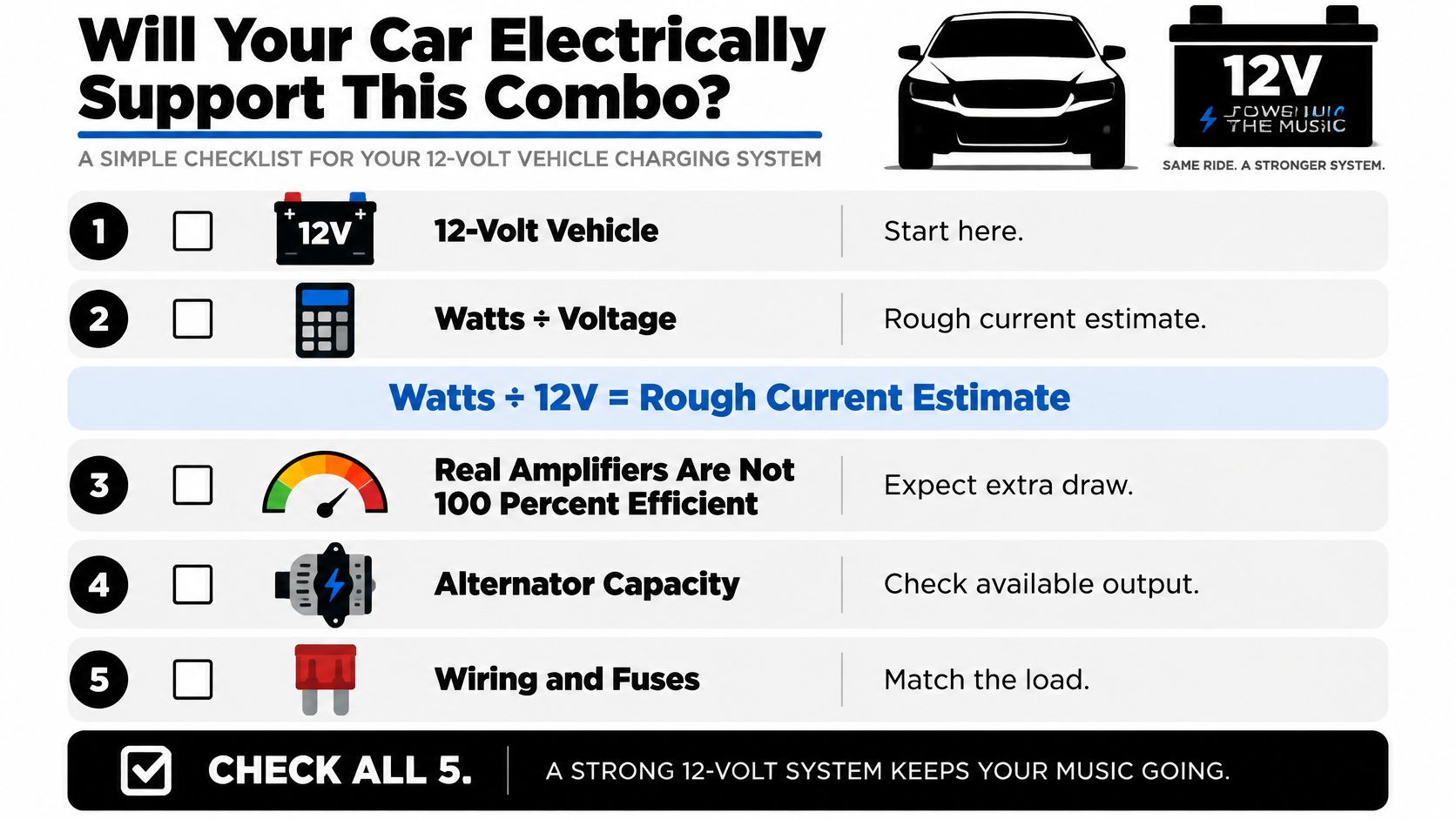
Output power divided by supply voltage gives only a rough starting estimate. The amplifier also consumes energy as heat, and music doesn't demand maximum output continuously. Actual draw depends on efficiency, supply voltage, load, and listening level.
Use this checklist before committing to amplifier power.
Check available capacity rather than alternator size alone
Find the alternator specification using vehicle service information or the installed unit's identification. Its rated output isn't all spare audio capacity. Lighting, cooling fans, vehicle electronics, and accessories already need part of it, and charging output changes with operating conditions.
Will the vehicle feed this amp
| Amp or system | Current clue | Where it usually fits |
|---|---|---|
| Modest four-channel system | Assess manufacturer current requirements alongside lights, fans, and vehicle electronics | Compact daily drivers after checking charging capacity |
| Five-channel or a separate sub amp | Greater combined demand when bass output rises | Trucks and Jeeps when winches, light bars, and fridges are included in the assessment |
| High-output bass amplifier | Check documented input requirements and voltage under load | Only where alternator, cable, fuse, and battery support the installation |
| Marine or powersports combo | Account for charging limits, cable length, and exposure | Marine-rated equipment with protected mounting and suitable wiring |
A truck isn't automatically ready for a large system, and a compact car isn't automatically unsuitable for an amplifier. Verify the specific vehicle.
Inspect the complete power path
- Check charging health: Test the battery and charging system before treating existing voltage problems as an audio-upgrade requirement.
- Size the conductors: Follow the amplifier manufacturer's cable guidance, accounting for current, cable material, and run length.
- Protect the cable: Install correctly rated battery-side protection and follow the equipment instructions for additional fusing.
- Verify the ground: Use a secure, suitable connection and measure voltage drop under load.
- Test while playing: Investigate dimming lights, overheating, or protection shutdown rather than accepting them as normal.
For broader electrical background, Access Electrical and Lighting explains how to calculate single-phase load current. That resource concerns AC calculations; automotive amplifier supply wiring uses DC, so don't apply an AC formula unchanged.
A wiring upgrade can address a restrictive current path, but it doesn't create alternator output. Our Big 3 wire upgrade guide explains the relevant connections.
This video provides an additional visual reference for planning the electrical side.
Don't add a battery by default. Diagnose the limitation first, because extra storage won't correct an ongoing charging deficit.
Wiring Loads Bridging and Speaker Phase
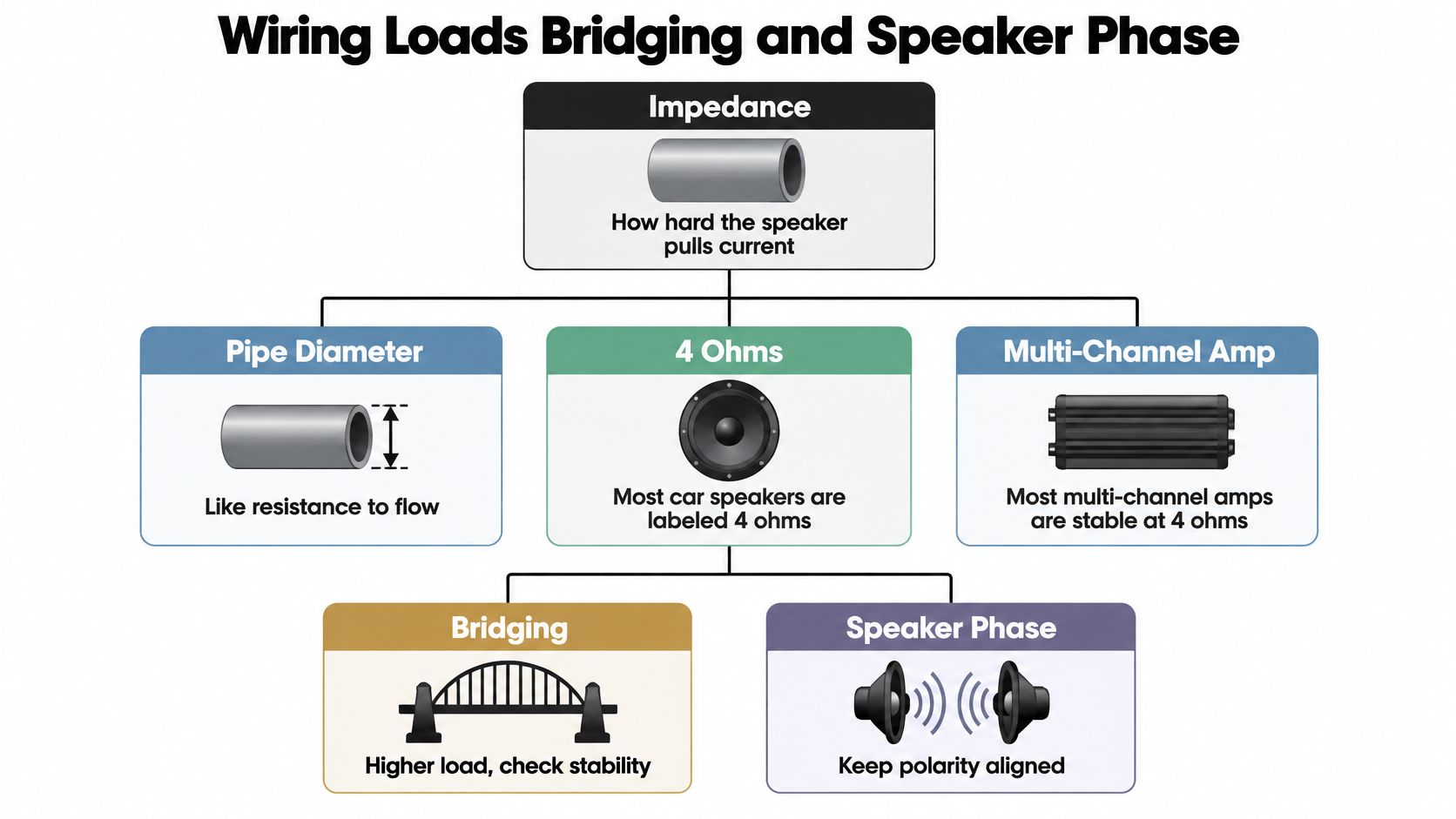
Impedance describes the electrical load a speaker presents to an amplifier. It changes with frequency, so the nominal rating on the label is a useful guide, not a fixed resistance at every musical note.
Calculate the final connected load
With two 4-ohm speakers, parallel wiring produces a 2-ohm load, while series wiring produces an 8-ohm load. In parallel, both speakers connect across the same amplifier terminals. In series, the signal passes through one speaker and then the other. Check that the amplifier supports the resulting load before connecting them.
The Bass Electronics impedance guide explains these wiring relationships.
Dual-voice-coil subwoofers need the same load check. Count each coil, map the proposed connections, and calculate the final impedance before choosing an amplifier. The rating of an individual coil does not tell you the completed system's load.
Treat bridging as a separate operating mode
Bridging combines amplifier channels to drive a speaker through designated terminals. Each channel then handles a greater share of the load, so check the amplifier's minimum impedance rating for bridged operation. A per-channel stability rating does not automatically apply when the amp is bridged.
Follow the amp's terminal diagram and bridging specifications. A bridged connection is safe only when the terminal arrangement and speaker load meet the manufacturer's requirements.
Use an amplifier wiring diagram to label channel assignments, speaker leads, and the final load before routing wires behind trim.
Polarity needs a separate check. If one speaker is connected backward relative to its partner, their sound can partially cancel, weakening bass and shifting the apparent position of vocals. Keep positive and negative connections consistent through adapters, crossovers, and factory wiring.
Before replacing factory speakers, check whether the vehicle has a factory amplifier, processed signals, or unusual speaker loads. Those details affect which connections and replacement equipment will work with the system.
Packaged Kits or a Custom Build
A packaged speaker and amp combo reduces the number of separate choices. A custom build gives you more control over placement, integration, and tuning. Neither path excuses skipping the vehicle checks.
A kit makes sense when its intended application closely matches your vehicle and goal. Custom selection becomes more useful when the factory system, speaker locations, environmental exposure, or listening priorities require something different.
Choose by the job the system must do
Combo path by vehicle and goal
| Vehicle or use | Goal | Better path | Core layout |
|---|---|---|---|
| Compact daily driver | Clearer music at moderate volume | Packaged | Door-size coaxials plus a four-channel amp |
| Sedan or crossover | Full range plus some bass | Packaged or light custom | Components up front, multi-channel amplification, dedicated sub channel |
| Truck or Jeep | Several cabin zones and stronger bass | Custom | Components or pods, multi-channel amp, separate sub if needed |
| Boat or powersports | Weather-ready volume | Custom marine-rated | Marine coaxial or tower speakers plus a suitably protected multi-channel amp |
| Bass-first build | Subwoofer is the priority | Custom | Full-range speakers on modest channels, mono Class D on the sub |
The distinction is easiest to see side by side.
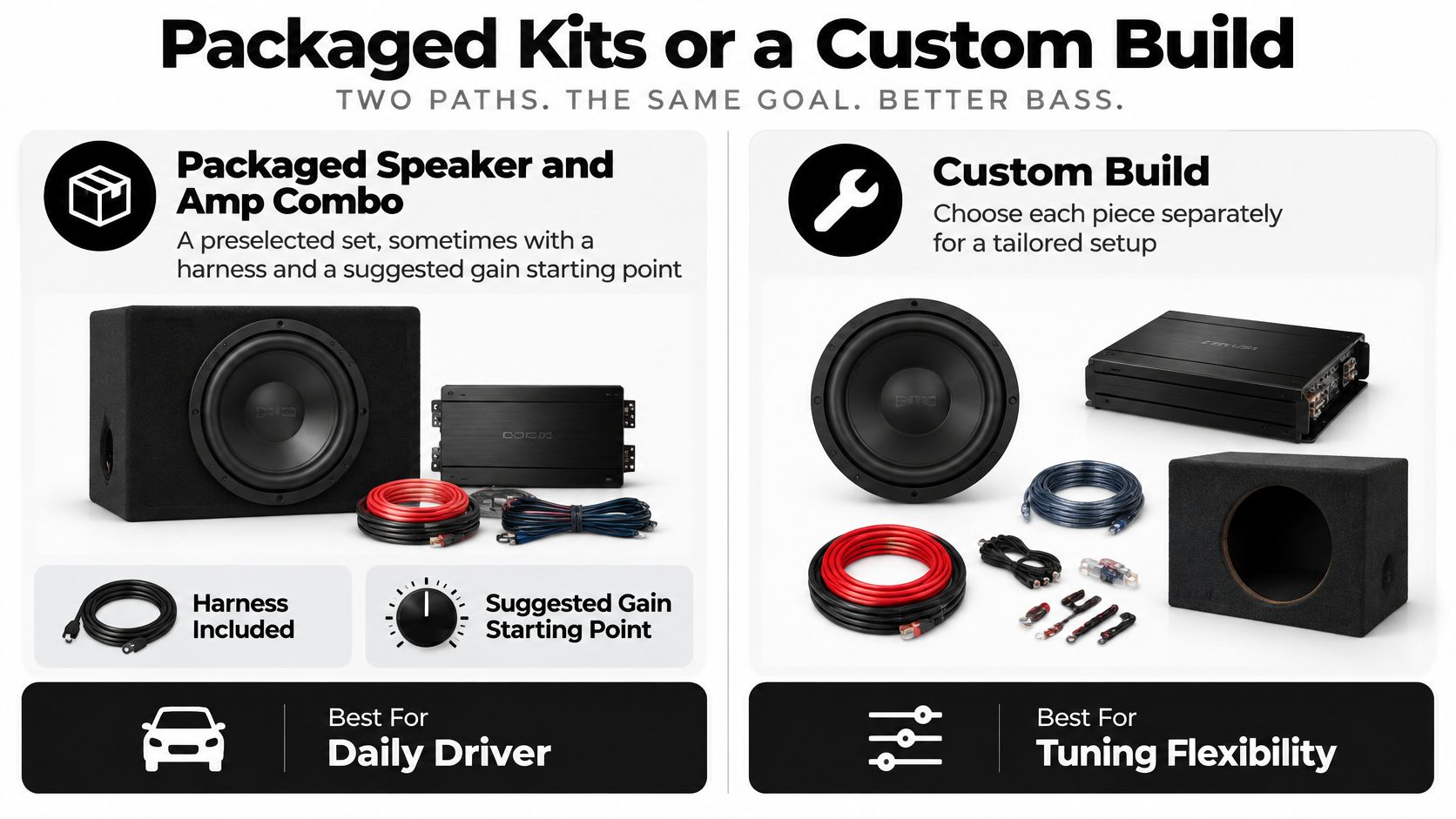
For a commuter, a compatible package can keep the project focused on understandable speech and music rather than unused output. Check exactly what the bundle includes. Speaker adapters, signal interfaces, power wiring, and installation hardware shouldn't be assumed from a photograph.
A suggested gain position is only a starting point. Source voltage and integration hardware can change the appropriate setting, even when the speakers and amplifier arrive in the same box.
Pay for fit and control where they matter
A custom front stage lets you choose tweeter placement, speaker mounting, and signal processing together. That flexibility is valuable when factory processing needs correction or when a truck's rear seating and cargo area require different coverage.
Open vehicles present another kind of challenge. A motorcycle, UTV, or boat needs equipment and mounting suited to its exposure, not merely car components with higher advertised output. Marine certification also has a scope, so check whether the product is intended for the actual environment.
- Package advantage: Fewer component decisions and a clearer starting layout.
- Package limitation: A general-purpose bundle may not solve an amplified factory system's integration requirements.
- Custom advantage: You can address the vehicle's mounting, signal, and environmental needs individually.
- Custom limitation: More decisions create more opportunities for an installation mismatch.
Spend on the part that removes the bottleneck, not the part with the largest specification.
For a listener who values vocals, secure front-speaker installation may deserve priority over rear-speaker upgrades. For missing low bass, a correctly selected subwoofer and enclosure may be the better investment. Sound treatment and signal processing can refine a capable system, but neither should be purchased as a substitute for identifying the actual problem.
Why a Rated Match Can Still Sound Weak
The watt and ohm ratings match, but the system sounds thin, gritty, or strangely quiet. Don't order a larger amplifier yet. Those symptoms can come from signal setup, installation, acoustics, or a supply problem rather than insufficient rated output.
Start by identifying what changes when the problem appears. Harshness that develops as volume rises calls for a different investigation than bass that's missing even at modest listening levels.
Diagnose the signal before replacing hardware
Gain isn't a volume control. It matches the amplifier's input sensitivity to the incoming signal. Setting it too high can make the system reach clipping earlier without increasing its maximum clean capability.
Begin with a clean source, neutral tone settings, and disabled loudness or bass boost. Establish a repeatable source volume and set amplifier gain using appropriate test signals and measurement equipment. An oscilloscope or distortion detector is more reliable than assuming a knob position is correct.
- Harsh vocals: Check source clipping, amplifier gain, aggressive equalization, and whether the speakers are receiving frequencies they can't reproduce cleanly.
- Weak subwoofer output: Verify the driver's enclosure requirements, box construction, leaks, filtering, and placement.
- Thin door-speaker bass: Inspect mounting rigidity, gasket sealing, panel openings, and acoustic cancellation.
- Rear-heavy sound: Adjust channel levels and processing rather than assuming every speaker should play equally loudly.
Separate acoustic limits from electrical faults
A subwoofer needs the enclosure arrangement its manufacturer specifies. A driver designed for an enclosure shouldn't be expected to perform correctly in an unsuitable open mounting, and an infinite-baffle application requires a suitable driver and installation.
Door speakers also depend on their mounting. A loose adapter, missing gasket, or poorly controlled opening can undermine bass even when the amplifier is working properly. Secure the installation before applying more equalization.
On a boat or open vehicle, wind and the lack of an enclosed cabin change what reaches your ears. Speaker efficiency, aiming, and location may help more than additional amplifier output.
Finally, measure supply voltage at the amplifier while reproducing the fault. Compare it with the manufacturer's operating requirements and check voltage drop along the power and ground paths.
If the amplifier enters protection, inspect the connected load, wiring, ventilation, and supply condition. If bass disappears when speakers play together, test relative polarity. More power is a reasonable next step only after the existing system is operating correctly.
Order or Book Your Combo in Bear
Bring a short equipment brief to your installation appointment: the vehicle, speaker dimensions, continuous power ratings, final connected impedance, channel layout, and whether a subwoofer is included. Add a description of what you want to hear differently, such as clearer vocals at road speed or bass that doesn't dominate conversation.
Make the product listing a starting point
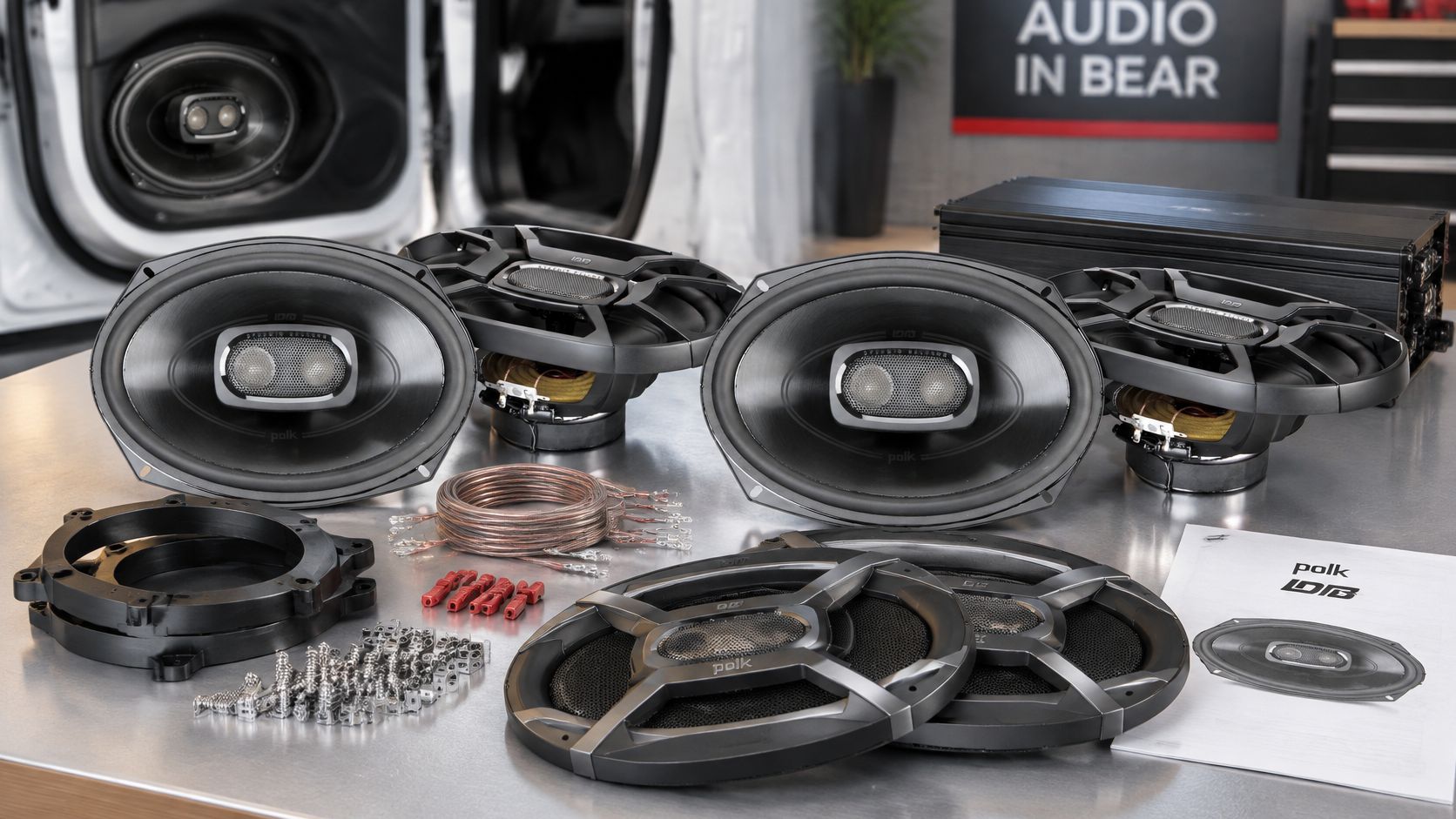
One catalog example is the 2 Pair Of Polk Audio DB692 DB+ 6x9-inch (DB 692) 900W Peak (300W RMS) 6"x9" DB+ Series 3-way Car & Marine Coaxial Speakers. Confirm the per-speaker rating and package contents before assigning amplifier channels, rather than treating the bundle title as an individual speaker specification.
- Bring vehicle details: Include factory audio options and accessories that place substantial demands on the electrical system.
- Bring installation details: Note available mounting space, existing wiring, and any equipment you intend to retain.
- Define the acceptance check: Ask for a demonstration of clean playback, balanced channels, and stable operation at your intended listening level.
Our Bear, Delaware, team can help turn those details into an installation plan. Choose the layout only after the vehicle requirements are clear.
Audio Jam Inc sells and installs speakers, amplifiers, subwoofers, and source units, with vehicle integration included in the planning. Visit Audio Jam Inc to explore a speaker and amp combo or arrange an installation discussion in Bear, and bring your vehicle details and RMS notes so we can help identify a suitable match.