

Coaxial vs Component Car Speakers: Which Sounds Better

You're on the highway, you turn the volume up to hear a vocal over road noise, and your factory speakers start to sound strained, thin, and a little harsh. That moment sends most drivers shopping, and the first fork in the road is Coaxial vs Component Car Speakers. Most advice you'll find declares a winner before it asks what car you drive. I won't do that. In my bay, the right answer depends on your factory locations, your head unit power, and whether your vehicle uses factory processing that'll fight a simple swap. Get those three things right and either format can sound great. Get them wrong and the more expensive box will disappoint you.
Table of Contents
- How Coaxial and Component Speakers Are Built Differently
- What Actually Changes in the Sound
- Installation and Fitment Compared
- Why Your Vehicle Matters More Than the Speaker Box
- Power, Sensitivity, and Factory System Compatibility
- Cost, Tiers, and What Your Money Actually Buys
- Which Type to Choose for Your Vehicle and Listening Style
How Coaxial and Component Speakers Are Built Differently
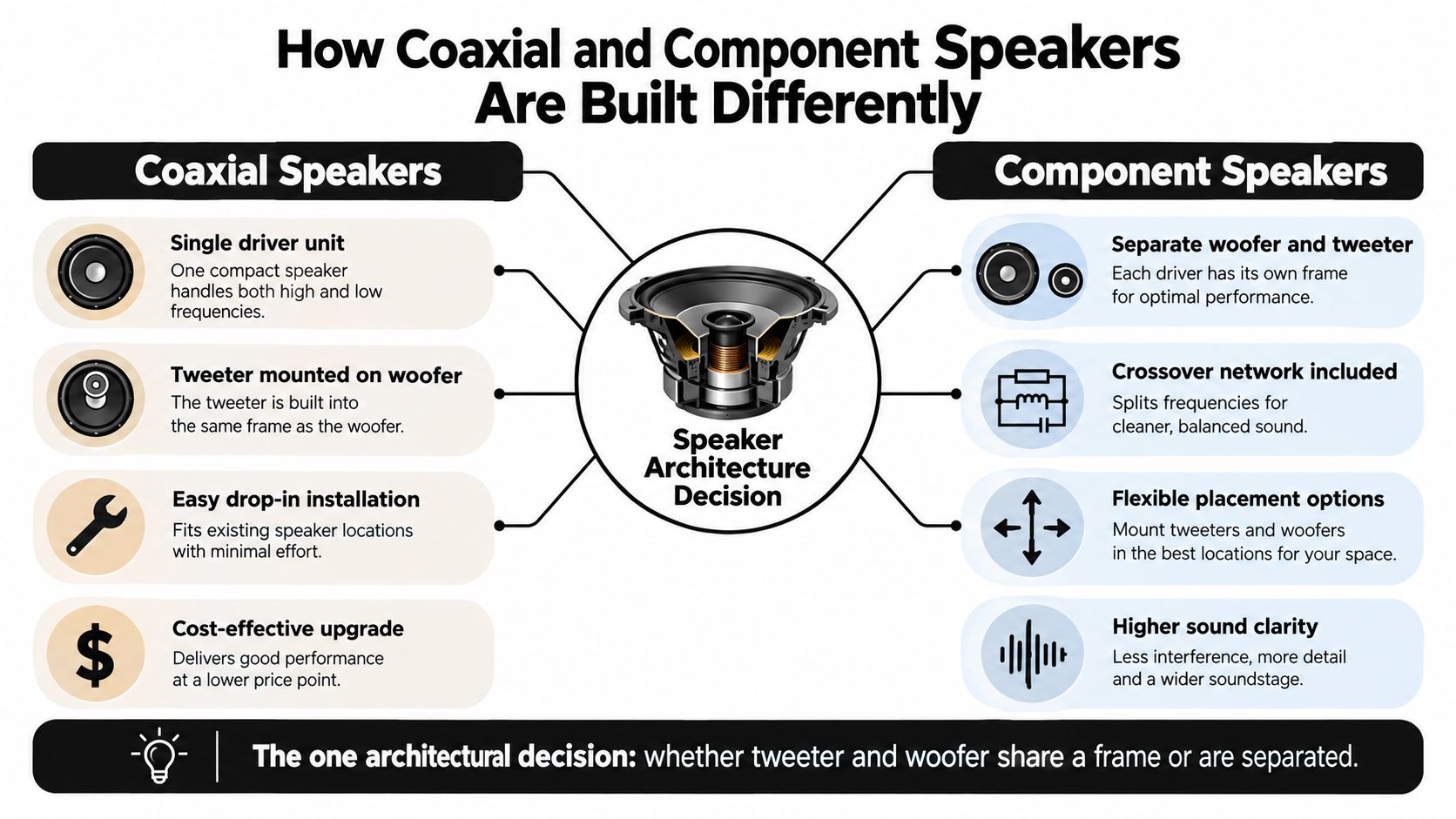
Strip away the marketing and there's one architectural decision. A coaxial speaker mounts a small tweeter at or near the center of a larger woofer, inside one basket, on one wiring connection. A component system splits that job into three separate pieces, a woofer, a separate tweeter, and an external crossover that sends low frequencies to the woofer and high frequencies to the tweeter.
Think of a coaxial as a flashlight with one focused beam from a single spot. Think of components as a floor lamp and a reading lamp you can place in different corners of the same room. Both light the room. One is simple and unified, the other gives you placement control if you're willing to run the extra cord.
This Debate Is Older Than Car Audio
Neither idea is a modern gimmick. By the 1930s, makers were combining two or three drivers, each optimized for a different frequency range, to improve response and output, a lineage traced in the history of multi-driver loudspeakers and the Altec Lansing Duplex. Altec's 601 in 1941 put a high-frequency driver behind a 12-inch woofer. Its 604 Duplex in 1943 used a 15-inch woofer, a 3-inch voice coil, an Alnico V magnet, and a six-cell horn, and became a studio standard despite handling only 30 watts.
That history matters because it busts a myth I hear weekly. Coaxial isn't the cheap, compromised format and component isn't the serious one. They're two established engineering strategies, compact point-source integration versus physically separated drivers optimized through placement.
How to Tell What You Have Now
Look at your door or dash before you buy anything. If you see one speaker grille per side and no separate small tweeter higher up, you're almost certainly listening to a coaxial or a simple full-range factory driver. If there's a small separate grille in the sail panel, upper door, dash corner, or A-pillar, your car already separates the tweeter from the woofer.
That single observation should shape your shortlist. A car built around one location rewards a speaker built for one location. A car with a usable factory tweeter spot gives a component set a real chance to earn its keep.
What Actually Changes in the Sound
The consequential difference isn't a universal quality gap. It's acoustic geometry, where the sound originates and how it reaches your ears from an off-center seat. A coaxial puts high frequencies at nearly the same point as low frequencies, creating a symmetric radiation pattern around the speaker axis. That unified origin can hold together well across a broad listening area, which matters when neither front occupant sits on axis.
Components trade that unity for placement freedom. Put the tweeter higher in a door, dash, or pillar and aim it sensibly, and you can lift the perceived soundstage height and widen the stereo image. Vocals stop sounding like they're coming from your ankles. Instruments separate across the dash instead of stacking in the footwell.
The Tradeoffs Nobody Puts on the Box
Coaxials carry real engineering compromises. The tweeter sitting in front of a moving woofer can contribute to intermodulation distortion and diffraction, and the interaction between the two drivers can restrict maximum output or frequency response, tradeoffs detailed in this technical discussion of coaxial loudspeaker design and summation. At moderate volume in a daily driver, many listeners never notice. Push a small coaxial hard and you'll hear the strain first in busy passages.
Components have the opposite failure mode. Separate drivers only help if the crossover design, mounting, aiming, and cabin acoustics cooperate. A tweeter buried low in a door, firing into a seat bolster or a passenger's leg, doesn't create staging. It creates a bright spot down low and a disconnected top end.
A component set doesn't buy you a soundstage. It buys you the opportunity to build one, if the placement and tuning are right.
Frequency Separation in Plain Terms
Both formats divide frequencies between drivers. The difference is where that division happens and how much control you get. A coaxial typically uses a simpler built-in network because everything must fit in one assembly. A component set's external crossover gives the designer more room to shape the handoff and, on better sets, gives you some level adjustment for the tweeter.
That control is useful, but it isn't magic. If your factory system already sends a filtered signal to each location, adding another crossover without understanding the signal can make the handoff worse, not better. That's a vehicle question, not a speaker question, and it's where most disappointing upgrades start.
Installation and Fitment Compared
A coaxial swap is the job I recommend to a first-time owner with basic tools. You remove the door panel, unbolt the factory speaker, connect the replacement with the correct harness, and mount it in the same location, often with an adapter ring. No new holes for a tweeter. No hunting for a dry, secure spot to hide a crossover where a window regulator won't crush it.
A component install asks more of you and your car. You're mounting a woofer low, a tweeter somewhere higher, and a crossover somewhere protected, then running wire between all three without pinching it in the door jamb. In a newer sedan or SUV with factory tweeter locations, that's straightforward for a competent installer. In an older truck with shallow doors and no tweeter provision, it can turn into cutting trim you'd rather not cut.
Coaxial vs Component Installation Requirements
| Install Factor | Coaxial Speakers | Component Speakers |
|---|---|---|
| Mounting locations | One factory location | Woofer, tweeter, and crossover separately |
| Wiring | Factory connection with harness adapter | Additional runs to tweeter and crossover |
| Trim modification | Rarely needed | Possible if no factory tweeter location exists |
| Fitment risk | Mainly depth and basket diameter | Depth plus tweeter and crossover clearance |
| Best fit | Factory-location replacement | Planned front stage with usable tweeter placement |
Where Each Format Fits Best
Choose a coaxial when your door depth is tight, your factory location is your only sensible location, or you want the car back together the same afternoon. That's not settling. That's matching the product to the vehicle.
Choose components when the car already gives you a tweeter location worth using, or when you're paying for proper mounting in sail panels or pillars and the aiming will be checked from the driver's seat. If a quote for components doesn't mention where the tweeters and crossovers will live, ask before you approve it. Placement is the product you're buying.
One more fitment warning from the counter. Speaker size on a box doesn't guarantee clearance behind the panel. Window travel, door braces, and factory adapter shapes vary by vehicle. Measure depth, confirm the adapter, and test the window before the panel goes back on. That habit saves more installs than any brand choice.
Why Your Vehicle Matters More Than the Speaker Box
Before I sold you either type, I would sit in the driver's seat and look at where sound can come from. Door mounting, trim reflections, speaker orientation, cavity volume, and your off-axis seating position all shape frequency response and imaging before brand or cone material enters the conversation.
That's not shop opinion dressed up as science. Work on vibro-acoustic simulation of vehicle audio design models door-installation effects, cabin acoustics, trim vibration, and alternative mounting positions, and that vehicle-integration research found mounting position and radiation direction can create left-right level differences of up to 10 dB in one vehicle application. A difference that large will swamp a modest difference between two speakers on a display wall.

Run This Vehicle Check First
- Factory height and aiming: Are the speakers low and firing across the footwells, or higher and closer to ear level?
- Available tweeter location: Is there a sail panel, dash corner, or pillar spot that aims toward occupants, not into glass or trim?
- Door condition: Is the mounting surface solid, and would damping and a proper adapter stop the door itself from becoming part of the sound?
- Factory processing: Does the head unit apply equalization that was tuned for the factory drivers you're removing?
- Listening position: How far off axis are you from each side, and will one side dominate at high frequencies?
A Worked Example I See Often
A driver buys components for better staging, but the only easy tweeter spot is low in the door, aimed at the center console. The woofer and tweeter end up separated in distance but not improved in direction, and the image stays low and smeared. In that same car, a well-aimed coaxial in a solid, damped mount can sound more coherent because its output arrives from one point and behaves predictably off axis.
Reverse the vehicle and the answer flips. Give me factory pillar locations that aim well, solid doors, and clean signal, and I'll recommend components without hesitation. The vehicle decides. The speaker box just follows.
Power, Sensitivity, and Factory System Compatibility
If you're keeping a factory head unit, stop shopping by peak wattage. Sensitivity is the number that predicts whether a speaker will play cleanly on limited power, because it's the sound-pressure level produced from a defined electrical input. As a practical threshold in this guide to sensitivity and low-power speaker matching, speakers rated around 90 dB or higher are generally better suited to systems delivering approximately 15 watts RMS or less per channel.
Match RMS power handling, not peak power, against an amplifier's continuous output. Then verify nominal impedance before anything is installed. Automotive speakers commonly use 2 to 4 ohms, and a lower-impedance replacement can demand more current than a factory head unit was designed to supply. The amplifier's stable load rating takes priority over a tempting spec on a speaker carton.
Practical rule: On factory power, buy sensitivity first. On amplifier power, buy the speaker whose staging and tuning you can actually support.
Modern Cars Add a Processing Layer
Newer vehicles increasingly use networked amplifiers, digital equalization, active noise control, and tightly integrated infotainment. Market coverage in this car audio market analysis of connected vehicle audio puts wired protocols such as MOST and A2B at 51.97% of the 2025 market, and projects wireless ultra-wideband connectivity to grow at a 15.48% CAGR through 2030. That direction means compatibility and tuning now matter as much as the driver itself.
In a car with factory DSP, a component set can expose equalization that was hiding behind dull factory speakers. You may hear a midrange peak or a rolled-off top end that no tweeter placement will fix. Sometimes the correct first purchase is an interface or processor that gives you a clean, correctable signal, and speakers come second.
The EV Wrinkle
Battery-electric vehicles change the listening room. With less engine noise masking everything, road, tire, door, and panel noise become more noticeable, and active noise control systems interact with cabin acoustics in ways a blind speaker swap can disturb. In that environment, a high-sensitivity coaxial on a retained low-power factory amplifier is often the safer improvement. Components still make sense, but only with level matching and tuning planned from the start, not added after you hear a problem.
Cost, Tiers, and What Your Money Actually Buys
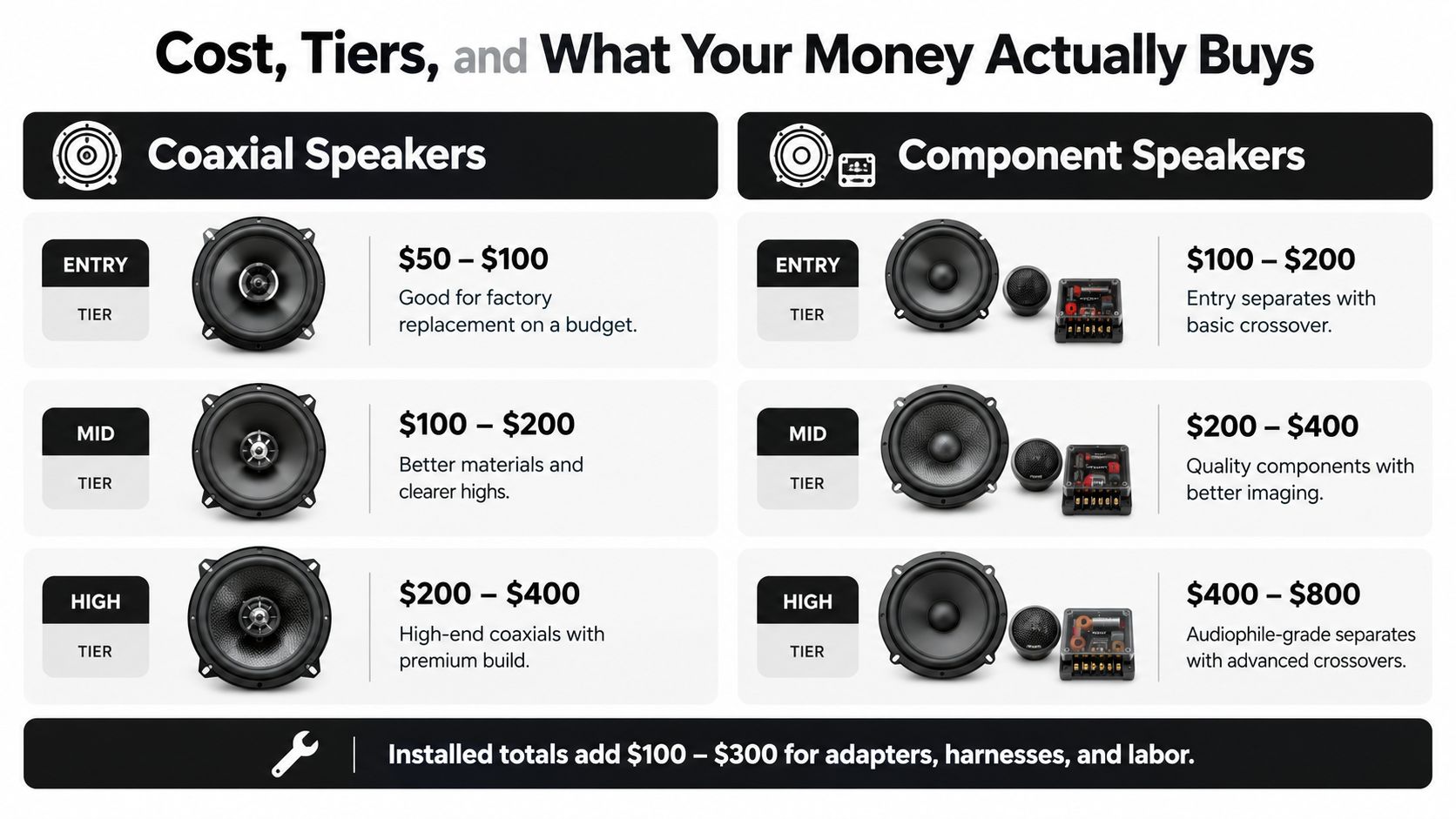
Compare installed totals, not shelf prices. A coaxial pair usually needs the speakers, harness adapters, and mounting rings. A component set adds tweeter mounting, crossover placement, extra wire runs, and more labor time, so the gap between the two formats grows once the door panels come off. If you're paying a shop, ask for the parts and labor broken out by location. That one request prevents most budget surprises.
What Each Tier Actually Delivers
At the entry tier, you're paying for a competent replacement for worn factory drivers. Expect simpler cone and tweeter materials and, on components, a basic crossover with little adjustment. That can still be a satisfying upgrade if the factory speakers are tired and the install is solid.
Move to the middle and your money starts buying engineering you'll hear. Better cone materials hold their shape more cleanly, tweeter materials change the character of the top end, and component crossovers get more capable, sometimes with tweeter level options that help tame a reflective cabin. This is the tier where I steer most daily drivers who plan to keep the car.
At the high end, you're paying for refinement, power handling, and tuning flexibility that only pay off with amplifier power, sound treatment, and time spent aiming and equalizing. Without that supporting work, a premium set installed casually can sound remarkably ordinary. I've heard mid-tier speakers in damped, well-aimed doors embarrass expensive sets dropped into rattling factory holes.
Where Price Stops Helping
Spend first on the things that protect any speaker's performance. Correct adapters, secure mounting, door damping where it's needed, and clean power will follow you to the next upgrade. A famous logo on a grille won't fix a flexing mount or a clipped factory signal.
My honest ordering for a limited budget is simple. Buy the format your vehicle can place correctly, fund the installation hardware properly, and keep what's left for amplification or a subwoofer later. The most expensive option in the catalog is frequently not the right option in your door.
Which Type to Choose for Your Vehicle and Listening Style
Here's my direct recommendation by situation. If you're in a sedan on factory power and you want cleaner sound this week, buy a high-sensitivity coaxial that fits correctly and spend on adapters and door treatment. You'll get the improvement you came for without rewiring your front stage around a head unit that can't exploit it.
This side-by-side view shows why the door itself shapes the decision before brand or tier does.
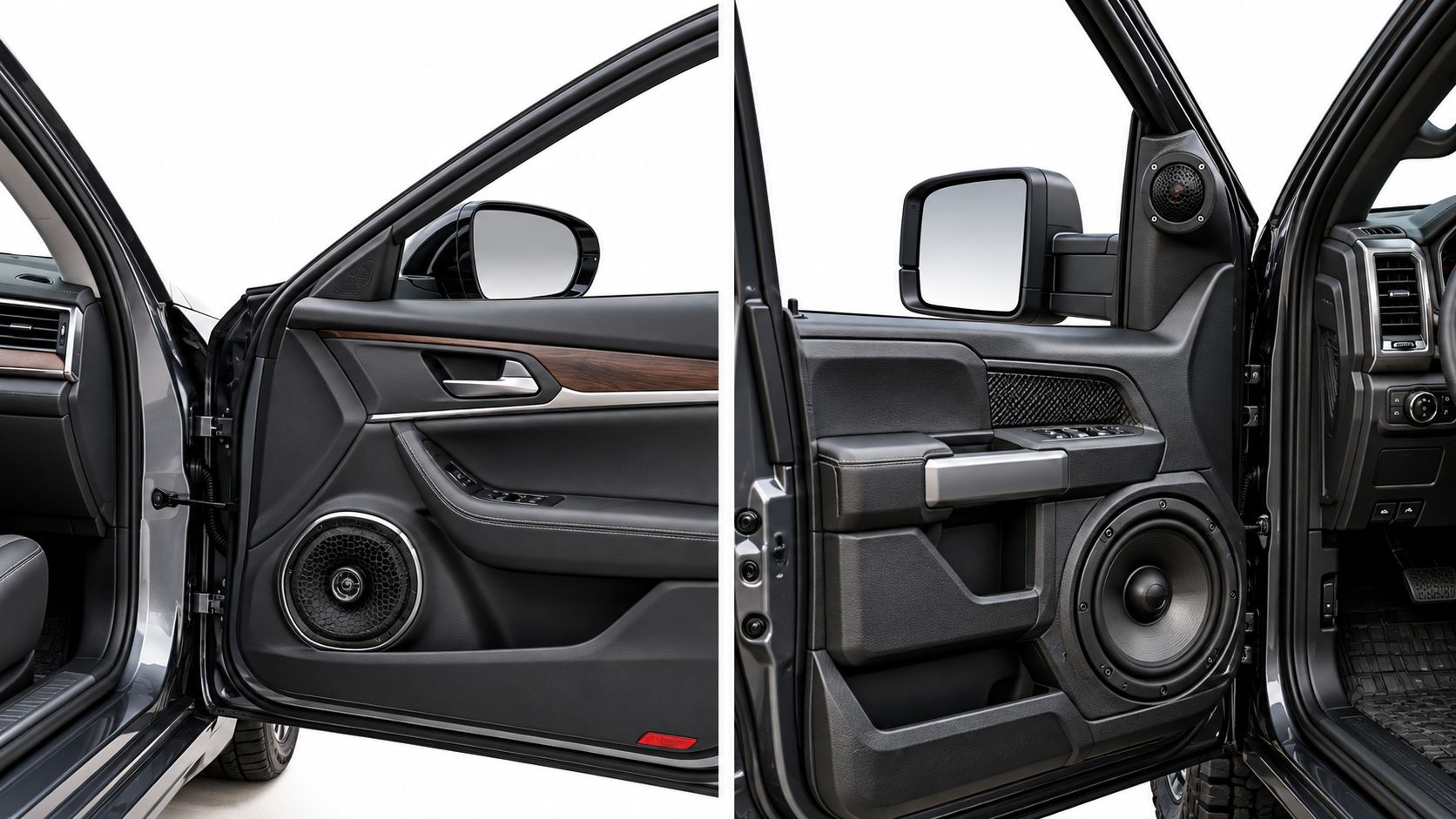
Truck and Jeep owners who listen loud with tops off or windows down should prioritize durability, output on available power, and placement that survives the cabin they drive in. That's often a coaxial design, unless the vehicle offers a tweeter location that stays effective in open-air use. Don't pay for delicate staging that disappears at speed.
If you're adding an aftermarket amplifier, your car has usable tweeter locations, and you're willing to fund aiming and tuning, buy components. That's the combination where separated drivers earn their money, with a higher, wider image and cleaner separation at volume. Audiophiles with proper DSP and a tuning budget shouldn't compromise here either. Components plus correction is the correct tool for that job.
The walkthrough below is useful for visualizing how the two layouts occupy a door differently before you commit to either path.
The One-Minute Decision Checklist
- Factory power only: Favor a sensitive coaxial that matches your impedance and fits your depth.
- Usable factory tweeter locations: Components become a genuine contender, not just an upsell.
- Factory DSP or active noise control: Solve signal and integration first, then choose the format.
- Amplifier and tuning planned: Components, installed and aimed deliberately.
- No good tweeter placement: Don't force it. A coherent coaxial beats a scattered component set.
If you're unsure which situation describes your car, bring the vehicle, not just a parts list, to a shop that sells and installs both formats. Audio Jam Inc is one Delaware option where installers can inspect factory locations and match coaxial or component sets to the vehicle in front of them. That inspection, done before money changes hands, is the cheapest performance upgrade in this entire comparison.
Bring your vehicle to Audio Jam in Bear, Delaware, and let an installer check your factory locations, head unit power, and processing before you spend a dollar on coaxial or component speakers, amplifiers, or integration parts. You can browse speakers and book installation through Audio Jam Inc, then leave with a front stage that was chosen for your car, not for a generic internet ranking.