

Ported Subwoofer Box Explained for Louder Clean Bass

You've added an amplifier, upgraded the subwoofer, and still find yourself turning the volume up when your favorite bass-heavy track starts. At a stoplight, the system sounds impressive. Once you're moving, the bass can feel weaker, boomier, or strangely disconnected from the rest of the music. The problem may not be the wattage. It may be the enclosure behind the subwoofer.
A ported subwoofer box, also called a bass-reflex enclosure, uses a tuned opening to move air and reinforce bass around a chosen frequency. That design can produce more output than a sealed box in the right range, but it also needs more space, careful port dimensions, and protection below its tuning frequency.
This guide is for a first-time builder comparing sealed and ported designs, a daily driver trying to improve musical bass, or a truck, Jeep, or compact-car owner working around difficult packaging. You'll learn what the port does, how tuning and volume interact, why a bigger port isn't always better, and when a sealed or hybrid design makes more sense.
By the end, you should be able to judge a box by more than its loudness claim. You'll have a practical way to choose a design, check its construction, set up the system, and recognize when a professional installer can save you from an expensive cut-and-rebuild cycle.
Table of Contents
- Introduction to Ported Subwoofer Boxes and Why They Matter
- How a Ported Subwoofer Box Works in Simple Terms
- Ported vs Sealed and Other Enclosure Types Compared
- Tuning Frequency Enclosure Volume and Port Design Explained
- Sizing and Building a Ported Box for Cars Trucks and Jeeps
- Installation Troubleshooting and Maintenance Tips
- When to Hire a Pro and How Audio Jam Can Help
Introduction to Ported Subwoofer Boxes and Why They Matter
A ported enclosure is a speaker cabinet with an opening, usually a round tube or rectangular slot, designed to work with the subwoofer driver. The opening isn't just a vent for heat or pressure. It forms an acoustic system with the air inside the cabinet, and its dimensions determine how the enclosure behaves.
The easiest way to understand the choice is to think about your drive. You want a kick drum to sound full, a bass guitar to remain recognizable, and electronic low-end to reach below the cabin's usual road noise. A ported box can add useful output in its tuned range, so the system may feel more effortless than the same driver in a sealed box. That benefit depends on the enclosure matching the driver, the music, the vehicle, and the available space.
A ported box also creates compromises that product listings often minimize. It generally takes more room than a sealed enclosure, and it loses output more quickly below tuning. If the design is too small, too low-tuned, or fitted with an undersized port, the result can be noisy airflow, weak low bass, or excessive cone movement.
Who should consider one
Daily drivers often benefit from a moderate, music-focused alignment rather than a design aimed only at maximum sound-pressure output. Truck and Jeep owners may have more vertical or irregular cargo space, but they still need to account for port clearance, mounting security, and weather exposure. Compact-car and EV owners face a different problem, because the required enclosure volume and port length may compete directly with cargo capacity.
The right question isn't, "Which box is louder?" Ask instead:
- What music do you play? Bass-heavy tracks can reward output around the tuning region, while acoustic and mixed recordings may expose a boomy alignment.
- How much space can you lose? A ported design may need a larger cabinet and a longer internal port.
- How hard will the system be driven? Strong low-frequency signals below tuning require appropriate filtering.
- Can the enclosure fit without blocking equipment or cargo? A theoretical design is useless if it can't be installed securely.
A properly designed ported subwoofer box can be an excellent daily-driving solution. It isn't automatically the best solution, especially when packaging leaves no room for the volume and airflow the design requires.
How a Ported Subwoofer Box Works in Simple Terms
Start with a sealed box. The air trapped behind the cone acts like a spring. As the subwoofer moves inward, that air resists the motion. As it moves outward, the air pulls it back. The enclosure controls the driver and helps produce a predictable response.
A ported box adds a second moving-air system. The driver moves air inside the cabinet, and the air in the port moves back and forth through the opening. A useful analogy is breathing through a bottle. The bottle's neck changes how the air resonates, and the enclosure's port does something similar for low-frequency sound.
The port doesn't produce equal reinforcement at every frequency. It works most strongly around a selected tuning frequency, where the air inside the port resonates with the air in the enclosure. Near that point, the port contributes output and reduces some of the work the driver must do, which is why a ported design can produce higher output in its intended range.
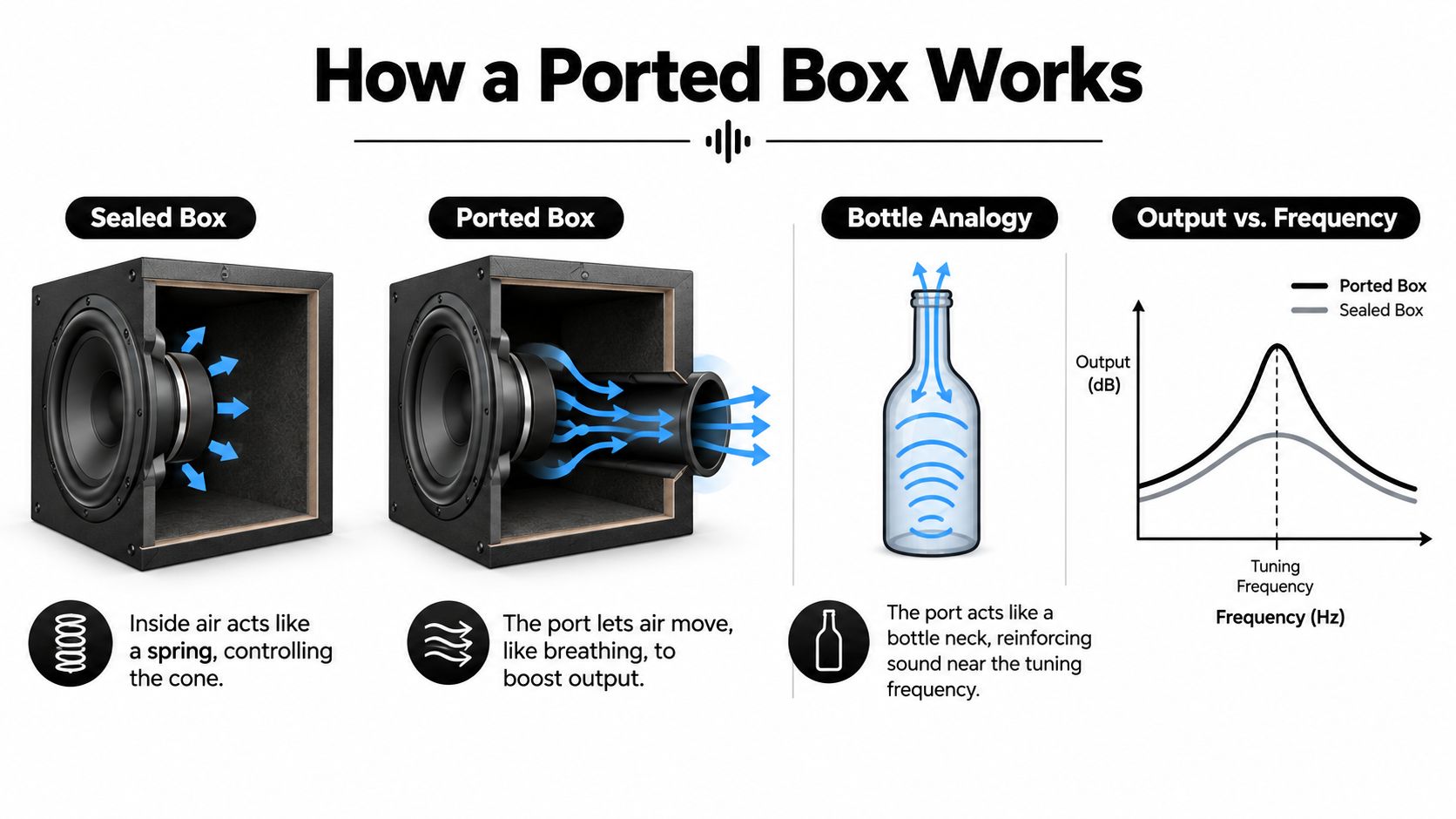
Core idea: A sealed box controls the cone with trapped air. A ported box adds a tuned air column that reinforces bass near its resonance.
The front wave and rear wave
The front of the cone pushes sound into the cabin. The rear of the cone pushes sound into the enclosure. In a sealed cabinet, the rear wave stays contained. In a ported cabinet, the rear energy influences the air in the port, and the port releases that energy in phase with the driver's useful output around tuning.
That timing matters. If the port and enclosure aren't designed as a pair, the opening won't provide the intended reinforcement. A port can be physically present and still perform poorly if its area, length, or internal volume is wrong.
The basic theory became more predictable during the early 1960s, when analyses by A. N. Thiele, J. E. Benson, and Richard H. Small established foundations for low-frequency enclosure design and tuning. The history and technical background are summarized in the bass-reflex enclosure reference.
Why the port has limits
The port is an air passage, not a magic output button. Air moving too quickly through it creates turbulence, often heard as chuffing. A long, narrow passage can also take up valuable internal volume and become difficult to fold into a vehicle-friendly cabinet.
The system also changes character below tuning. The port stops supporting the driver in the same way, and the cone can move farther with less acoustic control. That's why ported designs need more careful filtering and gain settings than many beginners expect.
Ported vs Sealed and Other Enclosure Types Compared
Choosing an enclosure gets easier when you compare the traits that affect daily use. A sealed box is usually compact and forgiving. It gives the driver a controlled air spring and tends to produce a smoother, more gradual low-frequency behavior. A ported design trades some of that simplicity for stronger output around its tuning region and greater low-bass extension potential.
A bandpass enclosure places the driver inside one or more chambers and sends sound through a ported chamber. It can be very efficient over a narrower range, but the output may sound less natural when the design doesn't match the vehicle, music, or crossover settings. It also makes troubleshooting harder because the driver is hidden inside the cabinet.
| Criteria | Ported Box | Sealed Box | Bandpass |
|---|---|---|---|
| Output near tuning | Strong | More moderate | Very strong over a narrower range |
| Low-frequency behavior | Extended response with a steep drop below tuning | Smoother, more controlled decline | Focused response shaped by the chambers |
| Cabinet size | Typically larger | Typically smaller | Can be bulky and complex |
| Musical character | Full and forceful when correctly tuned | Tight and predictable | Powerful in its intended band |
| Build difficulty | Requires port calculations and careful net volume | Simpler construction | Requires more complex chamber design |
| Space tolerance | Needs room for enclosure and port | Easier to package | Often difficult to package |
The ported, sealed, and bandpass enclosure comparison describes the central tradeoff clearly. Ported systems can extend low-frequency output and add output around tuning, but they also roll off sharply below resonance and can show more distortion there. Sealed systems generally remain flatter and cleaner across more of the bass range.
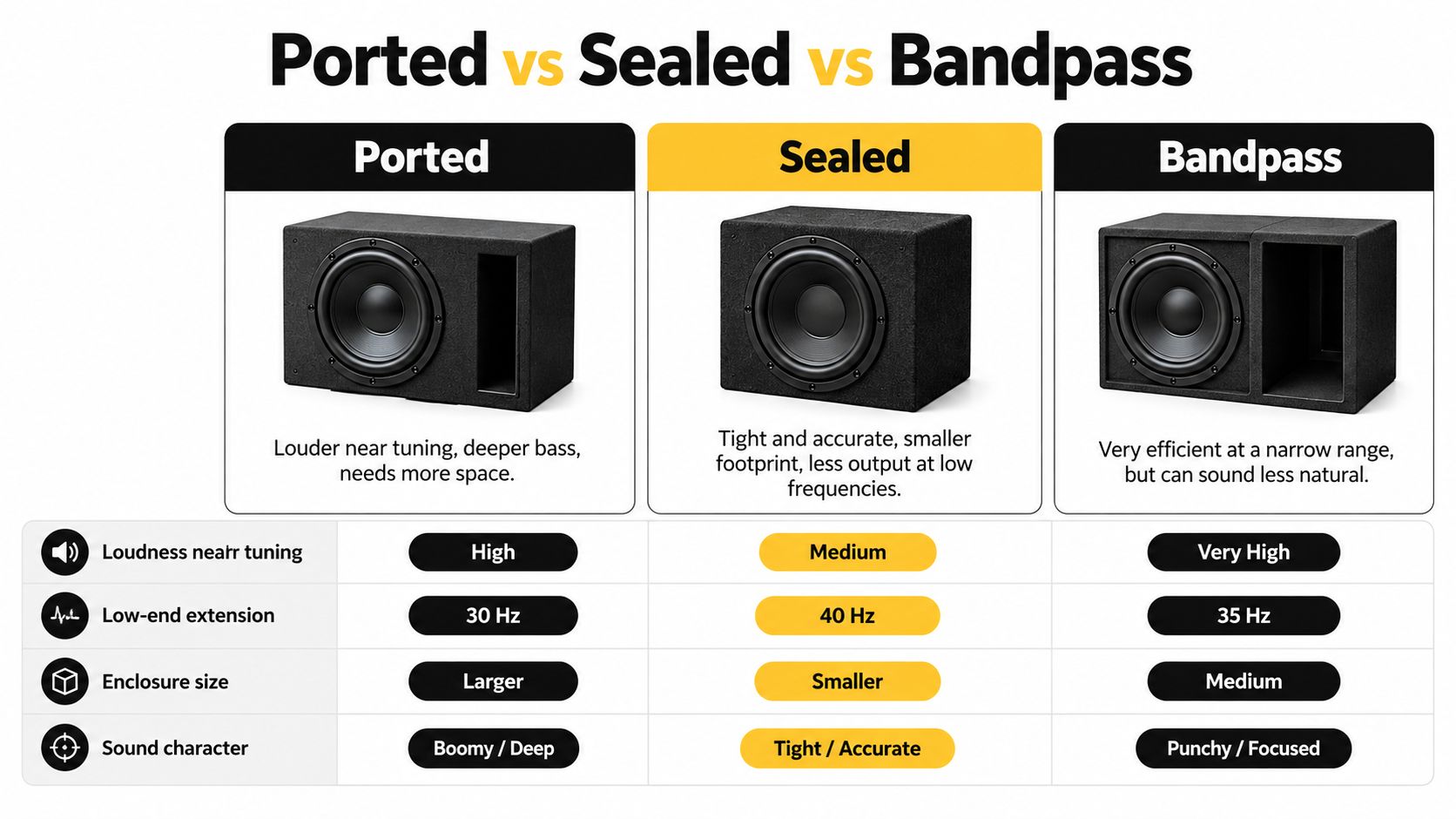
Match the enclosure to the driver's job
For music in a daily driver, ported tuning in the low 30s Hz is commonly discussed because it balances usable depth with strong output. That doesn't mean every vehicle or driver should use the same target. Cabin gain, listening habits, available volume, and the subwoofer's specifications all affect the result.
Sealed is often the safer choice when you value compact dimensions, broad musical consistency, or a forgiving installation. Ported is more compelling when you want additional output in a defined range and can provide enough cabinet volume for a properly sized port.
A louder enclosure isn't automatically a better enclosure. The useful choice is the one that fits your music, vehicle, and tolerance for design complexity.
Tuning Frequency Enclosure Volume and Port Design Explained
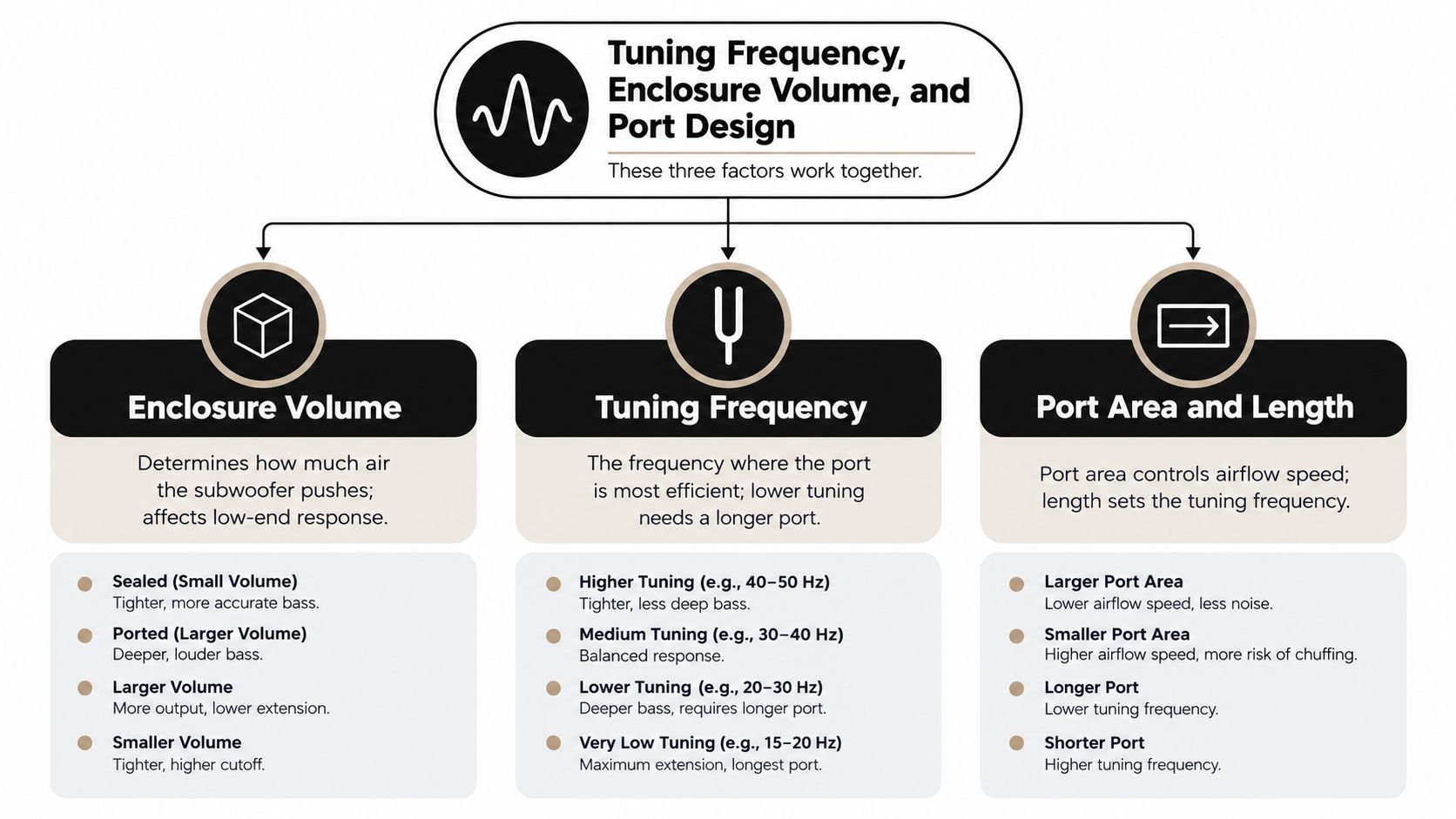
A ported design works as an interdependent system. Enclosure volume, tuning frequency, port area, and port length can't be selected independently and expected to behave correctly. Change one part, and the others may need to change with it.
Enclosure volume describes the usable air space behind the driver. Designers must use the net volume, not just the outside dimensions of the finished cabinet. The driver, port, bracing, and other internal structures occupy space, so each displacement must be subtracted from the gross cabinet volume.
How tuning changes the design
A lower tuning frequency generally demands a longer port, and that port may also require more internal volume to fit without sharp bends or poor clearances. Lower tuning can support deeper bass, but it can make the enclosure much harder to package. A higher tuning can shorten the port and emphasize a more accessible output region, though it may sacrifice some deep-bass extension.
Port area controls how quickly air must travel through the opening. Practical enclosure guidance commonly targets 12 to 16 square inches of port area per cubic foot of box volume, while keeping port air speed below about 0.2 Mach, or 68.6 meters per second, to reduce audible turbulence. These design figures and the related tradeoffs are covered in subwoofer enclosure design guidance.
A small port may fit easily, but it forces air through a restricted passage. That increases the risk of chuffing, especially when the amplifier drives the system hard. A larger port reduces airflow speed, but it consumes more enclosure space and usually needs additional length to preserve the chosen tuning.
Why filtering below tuning matters
Below the tuning frequency, a ported enclosure provides less control over cone movement. A subsonic filter limits very low signals that the system isn't designed to reproduce safely. The correct setting depends on the enclosure design and the subwoofer manufacturer's guidance, so use the specified tuning information rather than guessing from the port's visible length alone.
A useful design workflow is to model the driver and enclosure together, calculate every displacement, inspect the predicted response, and then verify the finished cabinet with measurement. Simulation can expose a port that won't fit before material is cut. An impedance sweep can help confirm that the finished enclosure behaves near its intended tuning instead of relying only on a ruler and a calculator.
Sizing and Building a Ported Box for Cars Trucks and Jeeps
Begin with the vehicle, not the subwoofer catalog. Measure the actual installation area, including wheel wells, seat brackets, cargo covers, amplifier locations, hatch movement, and the space needed for wiring. A box that fits on paper may fail when the port faces a panel or the enclosure can't be secured against movement.
The driver's specifications should determine the target net volume and tuning. A common ten-inch driver and a common twelve-inch driver may need different alignments, but the printed cone diameter alone doesn't provide enough information for a reliable ported design. Use the manufacturer's enclosure recommendation or model the specific driver before choosing dimensions.
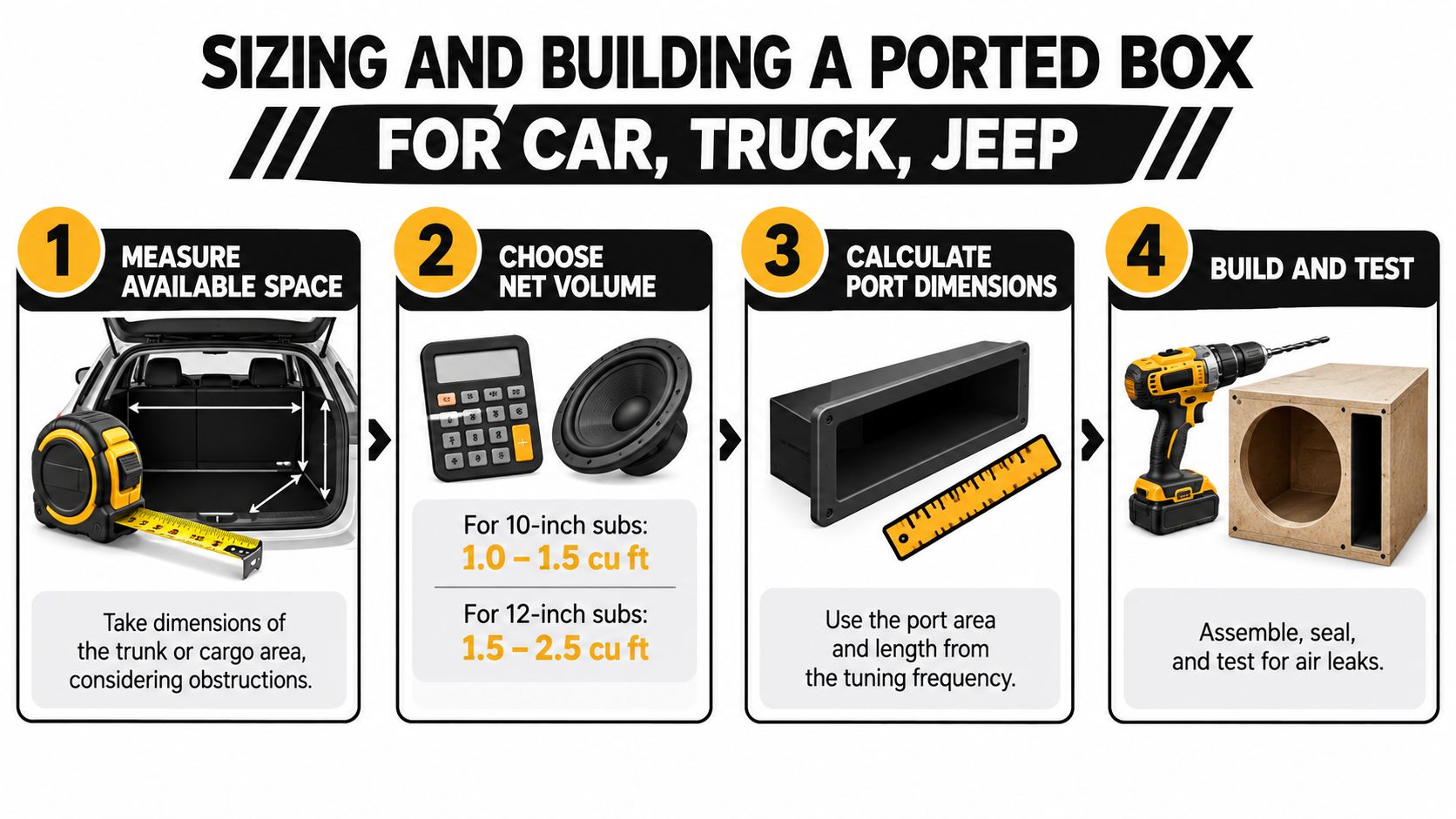
Build around the real vehicle
A sedan trunk may allow a conventional rectangular enclosure, while a truck behind the seat may require a shallow cabinet with a carefully folded slot port. Jeep cargo areas often make port direction and load restraint especially important. Under-seat installations are even less forgiving because the enclosure height, port bends, and driver clearance compete for the same limited space.
Compact vehicles and EVs highlight the central limitation of vented designs. If the available cavity can't provide enough net volume and a practical port, forcing a ported layout may create a small opening, a very long folded passage, or an inconvenient tuning compromise. In those cases, a sealed or hybrid approach can deliver more reliable results in the space available, even if a ported design would offer higher output under ideal conditions.
Use this pre-build checklist
- Measure twice: Record usable width, height, and depth, then account for trim and access.
- Confirm net volume: Subtract driver, port, and brace displacement from gross internal volume.
- Plan the port path: Check bends, internal clearance, and the port mouth's distance from nearby surfaces.
- Choose rigid materials: Use sufficiently thick panels and add bracing where large surfaces could flex.
- Seal every joint: Air leaks can create noise and change the enclosure's behavior.
- Protect the driver: Use a grille or other protection where cargo can strike the cone.
- Model before cutting: Simulation can test volume, tuning, and port dimensions for the selected driver.
- Verify afterward: An impedance sweep can help identify whether the finished enclosure is tuned as intended.
A daily-driving design should favor predictable response and practical installation over an impressive specification that can't survive the vehicle's space constraints.
Installation Troubleshooting and Maintenance Tips
A correctly built enclosure can still sound poor if the installation is loose or the controls are misadjusted. Bolt the box securely so it can't slide during braking, keep wiring away from moving hardware, and check polarity at the amplifier and subwoofer. A reversed connection can weaken the blend with the vehicle's other speakers even when the driver and enclosure are working.
Set the amplifier gain as a matching control, not as a volume knob. Use the low-pass crossover to keep unwanted higher frequencies out of the subwoofer, and use the subsonic filter according to the enclosure's tuning and the equipment manufacturer's recommendations. The driver should produce strong bass without dramatic uncontrolled cone movement.
Follow the symptom
- Port noise: Check for an undersized port, excessive air speed, sharp edges, or an obstruction near the port mouth.
- Boomy bass: Inspect tuning, placement, crossover settings, and cabin interaction. Excessive output around one region can sound impressive briefly but tiring over a full drive.
- Weak bass: Check polarity, leaks, amplifier settings, and whether the port is blocked or aimed into a restrictive space.
- Rattles: Test the enclosure, trim, hatch, license plate, and loose tools separately. Vehicle panels often become the noisiest part of a powerful installation.
- Excessive excursion: Reduce low-frequency boost and output, then verify the subsonic filter and enclosure tuning before playing demanding material again.
The JL Audio installation example provides a visual reference for how amplifier and enclosure work can fit into a vehicle installation.
Inspect the cabinet periodically. Look for loose fasteners, damaged seals, shifted internal bracing, blocked ports, and moisture exposure in trucks, Jeeps, marine-adjacent spaces, or open cargo areas. Keep the port clear of clothing, tools, and cargo, because even partial blockage can alter airflow and reduce the intended performance.
When to Hire a Pro and How Audio Jam Can Help
DIY makes sense when you can measure accurately, model the enclosure, cut panels cleanly, seal every joint, and test the finished system. It becomes less attractive when the vehicle has unusual geometry, limited mounting points, factory integration, or expensive trim that can be damaged during installation.
A professional installer adds value in the places a diagram can't cover. They can design a vehicle-specific enclosure, preserve usable cargo space, route wiring safely, integrate with the factory audio system, and tune the amplifier after installation. They can also identify when a sealed or hybrid enclosure will provide a better result than forcing a ported box into an undersized cavity.
Audio Jam Inc in Bear, Delaware, and through its online store, offers subwoofers, amplifiers, custom boxes, and vehicle integration services. Its product range includes options such as the SPL SB362-210V-BL dual ten-inch ported box for Ford SuperCrew, the Memphis SRXE212VP bass package with a vented enclosure, and the JL Audio HO110-W6v3 optimized slot-ported enclosure. The team also handles related integration, including CarPlay, cameras, safety technology, and other vehicle upgrades.
Before booking, bring the vehicle details, the subwoofer or amplifier model, your preferred music, and a clear description of how much cargo space you can give up. That information lets an installer recommend a practical enclosure and tune the system around daily use rather than peak output alone.
Audio Jam Inc can help you choose a ported subwoofer box, match it with the right amplifier, and handle custom enclosure design or complete vehicle integration. Visit Audio Jam Inc to shop compatible car audio equipment, request installation support, or book a consultation in Bear, Delaware.