

Jeep Aftermarket Rims: A Buyer's Guide to Fitment

You're at the parts counter with two sets of Jeep aftermarket rims in front of you. One has the aggressive stance you want, the other costs less, and both appear to match your Jeep's five-lug pattern. Then the installer turns the wheel to full lock and shows you where the cheaper rim would let the tire touch the fender flare. That's the moment a visual upgrade becomes a fitment problem.
A wheel can bolt onto the hub and still fail the practical test. The wrong backspacing can put the tire against a control arm, an unsuitable center bore can create vibration, and an inadequate load rating can leave a heavy trail build with less structural margin than it needs. The global off-road wheels market, a close proxy for Jeep aftermarket rims, was valued at about USD 9 billion in 2025 and is projected to reach USD 15.02 billion by 2035, with a projected 5.26% CAGR, according to Statifacts' off-road wheels market outlook. That crowded market gives buyers plenty of choice, but it also makes verification more important than a discount sticker.
Table of Contents
- Why Jeep Aftermarket Rims Are Worth Getting Right
- The Fitment Specs You Need to Understand First
- Stock vs Aftermarket Dimensions on Popular Jeeps
- Sizing Up Diameter, Width, and Tire Compatibility
- Matching Rims to How You Actually Use Your Jeep
- Safety, Load Ratings, and Certification You Should Not Skip
- Installation, Lift Considerations, and Buying With Audio Jam
Why Jeep Aftermarket Rims Are Worth Getting Right
At the parts counter, appearance usually comes first. An owner wants a wider stance, fuller wheel wells, or a more capable look before the Jeep reaches a trail. Those goals are reasonable, but the wheel must first clear the brakes, suspension, fenders, steering components, and sensors throughout the suspension's movement.
A poor choice often appears during ordinary driving. The tire can rub the fender liner at full steering lock, contact a control arm as the suspension articulates, or develop uneven wear after a wheel and tire change alters steering geometry. A dealer may also question a warranty claim if an aftermarket wheel, tire, lift, or spacer is connected to the failed component. That does not make aftermarket rims a bad choice. It means the parts need to be selected and installed as one system.
Shop-floor rule: A wheel that looks right in a product photo has not passed a fitment check.
Why one listing cannot cover every Jeep
A general “fits Jeep” label conceals important differences. The 2007 model year introduced a major Wrangler bolt-pattern change. Earlier YJ and TJ Wranglers used 5×4.5 inches, while JK and JL generations use 5×5 inches, or 5×127 mm, as documented in this Wrangler bolt-pattern reference. The newer pattern remains consistent through recent Wrangler model years, but that does not make every modern Jeep wheel interchangeable.
A JK Wrangler, JL Wrangler, Gladiator, and Grand Cherokee may share a bolt pattern while differing in brake clearance, hub fitment, offset requirements, vehicle weight, and suspension geometry. A rim that clears a standard Wrangler may not clear a larger brake package or carry the load required by a Gladiator loaded with equipment. A wheel can bolt onto the hub and still fail in everyday driving.
The off-road wheel market includes substantial Jeep demand, particularly in North America, according to this off-road wheel market analysis. That range of products gives buyers more choices, while making model-specific verification more important than a discount sticker.
Before paying, confirm the bolt pattern, wheel width, diameter, offset, backspacing, hub bore, brake clearance, lug-seat type, and load rating. Ask the installer to verify full-lock clearance, suspension articulation, and spare-tire fitment. That conversation costs less than correcting a rubbing tire, replacing damaged hardware, or discovering that the spare no longer fits its carrier.
The Fitment Specs You Need to Understand First
A rim can have the correct bolt pattern and still be wrong for the Jeep. Fitment depends on how the wheel sits against the hub, where its inner edge lands near the suspension and brakes, and whether its construction can carry the vehicle's load. Learn those measurements before comparing finishes or prices.
Bolt pattern is the mounting interface
The bolt pattern identifies the number of lug holes and the diameter of the circle they form. Modern Wrangler generations from 2007 onward use 5×5 inches, or 5×127 mm. The 1987–1995 YJ and 1997–2006 TJ generations use 5×4.5 inches. A mismatch cannot be corrected with an alignment adjustment. The wheel has the wrong mounting interface.
Bolt pattern alone does not confirm fitment. A JK Wrangler, JL Wrangler, Gladiator, and Grand Cherokee can share the same pattern while differing in brake clearance, hub fitment, offset needs, vehicle weight, and suspension geometry. Verify the exact model, trim, brake package, and intended tire before ordering.
Backspacing and offset set the wheel's position
Backspacing measures from the wheel's mounting surface to its inner lip. More backspacing places that inner edge closer to suspension, steering, and brake components. Less backspacing moves the wheel outward, increasing space on the inside while changing the Jeep's stance and the forces carried by related components.
Offset describes wheel placement from the centerline and uses millimeters. Positive offset moves the mounting surface toward the wheel's outer face, pulling the wheel inward. Negative offset shifts the wheel outward. Quadratec's guide to offset and backspacing explains how the two measurements relate.
Check both numbers on the wheel listing. A seller may publish offset, backspacing, or both, and a comparison is difficult if the specifications use different references.
Hub bore keeps the wheel centered
The hub bore is the opening through the wheel's center. A hub-centric wheel fits closely over the vehicle hub. A lug-centric wheel depends on the lug hardware to center itself during installation. If the aftermarket wheel has a larger bore, the correct hub-centric ring can close the gap.
Center the wheel carefully and torque the lugs to the vehicle's specification. A poorly centered wheel can contribute to vibration even when the bolt pattern matches.
Diameter and width determine tire placement
Wheel diameter limits which tire diameter can mount. Width controls how the tire bead sits and influences sidewall shape, fender clearance, and scrub behavior. A wider rim may suit a wider tire, yet it can also bring the tire closer to suspension parts or farther outside the fender. Offset, backspacing, tire size, and steering travel must be considered together.
Load rating sets the safety floor
Load rating states how much weight the wheel is designed to carry. A capable tire does not make an under-rated rim suitable. Compare the wheel rating with the Jeep's weight, passengers, cargo, and intended use, especially on a Gladiator that regularly carries equipment.
Use this checklist before paying:
- Bolt pattern: Match the Jeep's lug-hole arrangement.
- Backspacing: Confirm the distance from the mounting face to the inner lip.
- Offset: Check the mounting face's position against the wheel centerline.
- Hub bore: Verify hub fitment or the required centering ring.
- Load rating: Confirm the wheel can carry the vehicle and its expected load.
- Brake clearance, lug-seat type, full-lock clearance, suspension articulation, and spare-tire fitment also require confirmation.
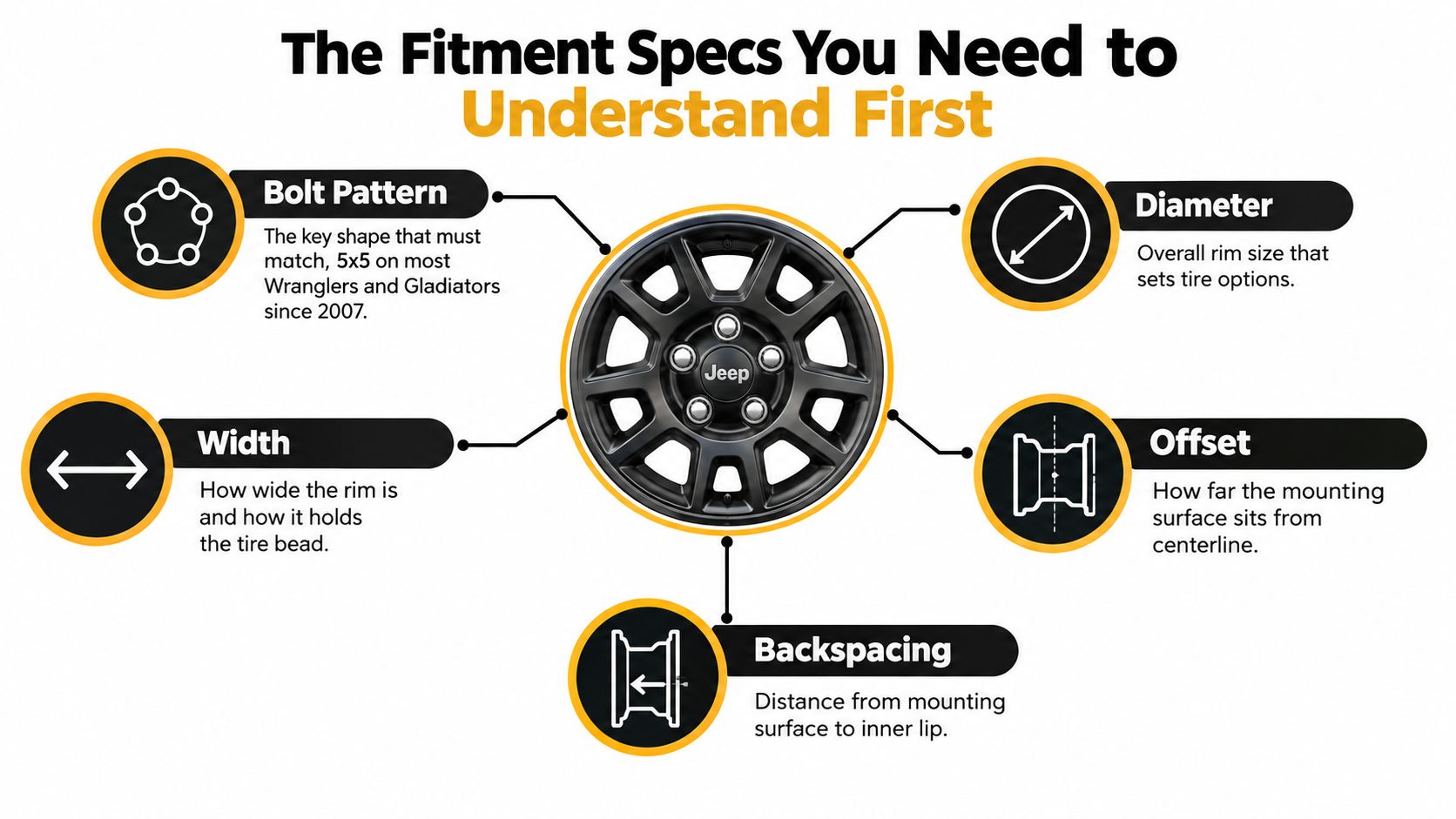
Here's a visual explanation of how these measurements interact in a Jeep wheel setup:
Stock vs Aftermarket Dimensions on Popular Jeeps
Factory dimensions give you a reference point, not a universal aftermarket recipe. Stock wheels usually keep the tire close to the body and suspension because they are matched to the original tire size and steering range. Add a larger tire, lift, or different wheel width, and the clearance equation changes.
On JK platforms, factory offset is about +44 mm. Many aftermarket wheels move into the -12 mm to +12 mm range. A frequently used combination is a 17x9 wheel with 4.5 inches of backspacing, equal to about -12 mm offset, for tire sizes up to 35 inches. That position can increase inner clearance, but the specific Jeep still requires a physical inspection before purchase.
| Model | Bolt Pattern | Stock Size | Stock Backspacing | Common Aftermarket Target | Typical Lift |
|---|---|---|---|---|---|
| Wrangler JK | 5x127 mm | 17x7.5 | Around 6.5 inches | 17x9 with 4.5 inches | Mild lift with clearance check |
| Wrangler JL | 5x127 mm | 17x7.5 or 18x7.5 | Roughly 6.25 inches | 17x9 with reduced backspacing | Mild lift with tire-specific check |
| Gladiator JT | 5x127 mm | Verify by trim and package | Verify before purchase | 17-inch aftermarket wheel with appropriate load rating | Lift and payload dependent |
| Grand Cherokee WK2 | 5x127 mm | Verify by trim and brake package | Verify before purchase | Model-specific wheel with brake clearance confirmed | Suspension and brake dependent |
Wrangler differences matter
The JK and JL share the modern Wrangler bolt pattern, yet their wheel and tire combinations are not automatically interchangeable. Control arms, tire width, steering stops, fender liners, and brake components can change the result. A backspacing measurement that clears one build may contact another.
Confirm the exact year, trim, suspension parts, tire dimensions, and intended steering travel before ordering. Test-fitment remains more reliable than a catalog listing alone.
Gladiator requires a higher level of caution
The Gladiator uses the same 5×127 mm bolt pattern as modern Wranglers, but its weight and payload make wheel load rating especially important. Matching the lug pattern does not confirm that the wheel suits a truck carrying recovery gear, camping equipment, or towing-related loads. Check the wheel rating against the vehicle and the load it will carry.
Grand Cherokee needs its own verification
The Grand Cherokee's shared pattern with modern Wrangler applications does not eliminate differences in caliper shape, hub interface, suspension layout, and trim-specific equipment. Treat a WK2 recommendation as a starting point. Before paying, verify the actual brake and hub dimensions, then confirm that the tire clears the suspension and body through the full steering range.
Sizing Up Diameter, Width, and Tire Compatibility
Diameter, width, and tire size need to be selected as one package. Choosing a rim for its appearance, then forcing the tire and suspension to accommodate it, can reduce sidewall, create rubbing, and move the Jeep away from its intended use.
A 17-inch wheel leaves more tire sidewall than an 18- or 20-inch wheel when the overall tire diameter remains similar. That sidewall cushions impacts and flexes over uneven ground. Larger diameters usually require lower-profile tires. They can sharpen the Jeep's stance, but leave less rubber protecting the rim from rocks and trail impacts.
A 35-inch build in practical terms
A 35-inch tire on a 17x9 wheel is a common mild-lift combination. The width supports the tire bead without making the package unnecessarily broad. Many JK builds use a 4.5-inch backspacing target to move the assembly outward for inner suspension clearance while keeping road behavior more manageable than an extremely aggressive stance.
Treat that target as a starting point, not a guarantee. Check the tire against the fender liner at full steering lock. Compress the suspension if possible, then inspect the upper control arm, sway-bar area, steering knuckle, and brake caliper. A parked Jeep can appear clear while the axle moves or the steering reaches its limit.
| Wheel Diameter | Wheel Width | Typical Tire Size | Best Use Case |
|---|---|---|---|
| 16 inches | Moderate width | Tire manufacturer's approved fitment range | More sidewall and traditional Jeep builds |
| 17 inches | 7.5 to 9 inches | Common choice for larger all-terrain or mud-terrain tires | Mixed street and trail use |
| 18 inches | Moderate to wide | Lower-profile tire builds | Street-focused style with selected trail use |
| 20 inches | Wide aftermarket fitment | Lower-profile tire builds | Appearance-led road builds |
Brake clearance can override the size plan
High-performance applications, including a Wrangler Rubicon 392 or Grand Cherokee SRT, may have calipers that need more inner-barrel clearance than a standard wheel listing indicates. Diameter alone does not confirm fitment. Spoke shape, barrel design, mounting-pad thickness, and offset all affect clearance around the brake package.
Before paying, request the manufacturer's brake-clearance information and compare it with the exact trim. Confirm the wheel's diameter, width, offset, and backspacing against the tire dimensions. If the data is unavailable, a test fit or professional measurement is safer than relying on a shared bolt pattern.
Matching Rims to How You Actually Use Your Jeep
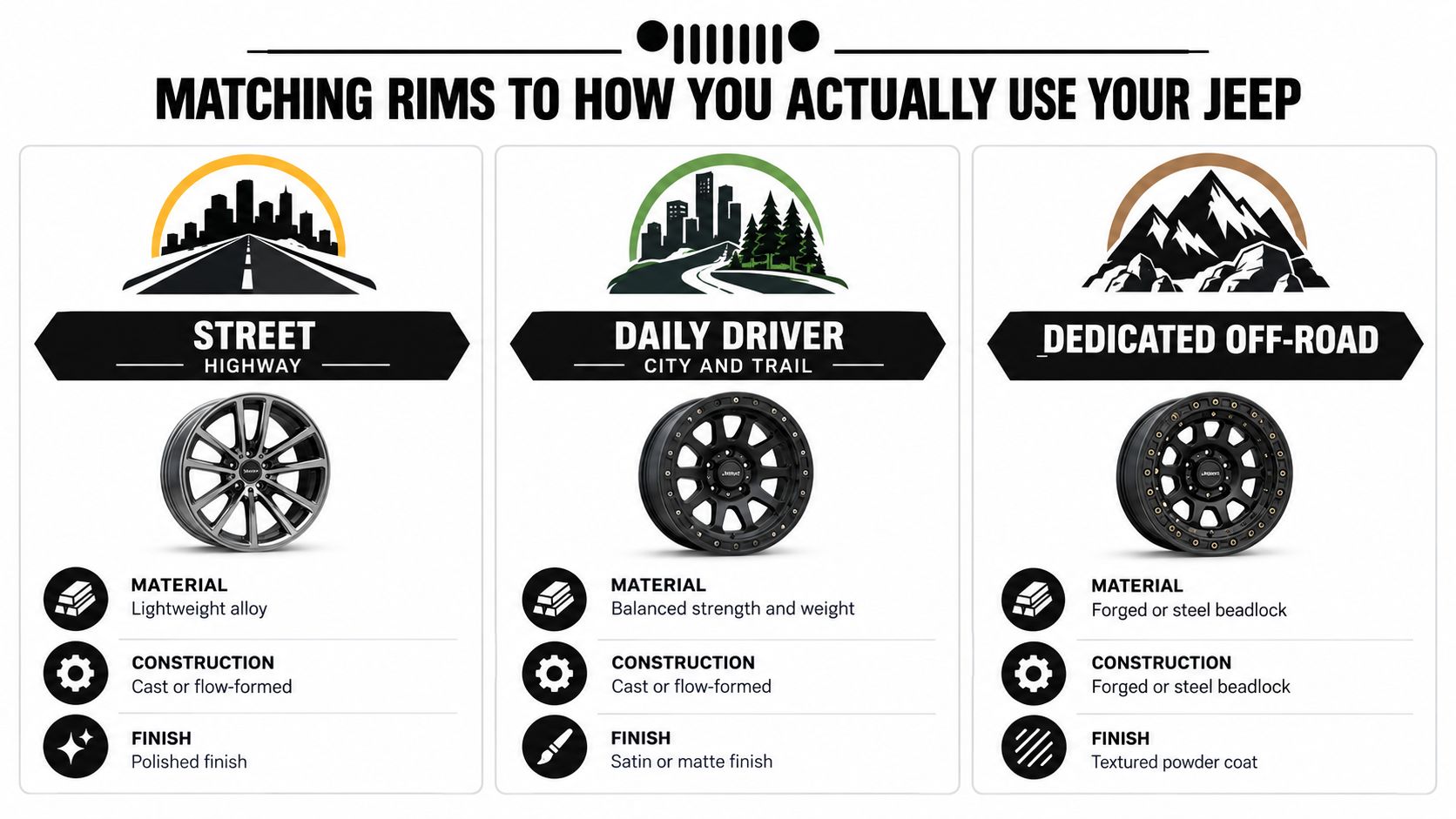
The best Jeep aftermarket rims depend on where the Jeep spends its time. A daily driver that sees pavement and occasional gravel needs a different balance than a dedicated crawler that regularly reduces tire pressure and accepts finish damage as part of the hobby.
Street and daily-driver choices
For mostly paved use, a cast-aluminum wheel can provide a practical balance of appearance, weight, and cost. A lighter alloy design can improve suspension response compared with a heavier construction, but the buyer still needs to verify the manufacturer's load rating and the wheel's compatibility with the tire.
Flow-formed construction sits between conventional cast and forged approaches in the way many buyers evaluate strength, weight, and price. Forged wheels can offer a high-strength construction path, but the extra expense only makes sense when the build and use justify it. A wheel's manufacturing label doesn't replace checking its actual rating and application data.
Finish and construction trade-offs
Painted and clear-coated surfaces can show chips and trail rash quickly. Matte, satin, and textured powder-coated finishes tend to disguise dirt and minor scuffs better, while chrome creates a bright, reflective appearance that suits a street-oriented build but demands more attention when damaged.
The 16" American Racing VN615 Torq Thrust II Chrome Custom Wheels are listed in 16x7 and 16x8 sizes, with fitment varying by vehicle, and include 5x127 mm among the listed bolt patterns. The product snapshot also lists chrome finish, several offset options, and lugs and locks sold separately. Those details make verification essential before treating the wheel as a Jeep match.
Dedicated trail use
Beadlock wheels make sense when the driver's routine includes serious technical terrain and low tire pressures. The mechanical ring holds the tire bead against the wheel, but the setup adds weight, requires careful fastener maintenance, and can be more difficult to balance for normal road use.
For a Jeep that commutes during the week and sees trails on weekends, a conventional 17-inch alloy or steel wheel is often the more sensible compromise. The dedicated off-road option works when its benefits solve a real problem. Otherwise, the owner is paying in weight, noise, maintenance, and road manners for capability they may rarely use.
Safety, Load Ratings, and Certification You Should Not Skip
A rim that bolts on isn't automatically roadworthy. Buyers often focus on pattern, finish, and spoke design, then overlook the stamp or specification that tells them whether the wheel can carry the Jeep's actual loads.
Wheel load rating should be compared with the vehicle's axle requirements, with sensible margin for passengers, cargo, impact loads, and modifications. This matters even more on a Gladiator or a heavily equipped Wrangler, where larger tires, recovery gear, camping equipment, and sustained rough-road use can increase the demands placed on the wheel.
Structural first: Fitment answers whether the wheel can mount and clear. Load rating and testing help answer whether it's an appropriate structural component for the way you drive.
What testing information tells you
U.S. federal law doesn't mandate a single performance test for aftermarket wheels. SAE J2530 testing is voluntary but widely used, and reputable industry guidance recommends checking load ratings against axle loads with margin, as explained in Performance Plus Tire's wheel-safety guidance.
That distinction matters. A DOT marking or other legal marking may identify a compliance-related feature, but it doesn't by itself tell you everything about the wheel's design, testing history, or suitability for a particular loaded build. Ask the seller or manufacturer for clear documentation rather than relying on a marketplace description.
Inspect the product information
Before ordering, look for:
- A published load rating: Confirm the rating applies to the exact wheel size, offset, and finish you're buying.
- Test information: Ask whether the wheel was evaluated under SAE J2530 or another identified standard.
- Manufacturer identity: Avoid listings that provide no traceable brand, model, casting information, or technical support.
- Accurate dimensions: Confirm bolt pattern, hub bore, offset, backspacing, and brake-clearance details.
- Hardware requirements: Check whether the wheel needs a specific lug seat, shank style, or separate locking hardware.
A low-priced rim may fit cosmetically while offering poor support or unclear structural documentation. That's a bad trade for a Jeep used off-road, loaded for travel, or driven at highway speed with large tires. Choose the finish and spoke pattern after the wheel passes the safety screen.
Installation, Lift Considerations, and Buying With Audio Jam
A successful wheel upgrade ends at the installation bay, not the checkout page. Before mounting anything, verify the lug-seat design, the thread engagement, the hub interface, and the clearance around the brake and suspension components.
Start with the vehicle's exact model, year, trim, tire size, lift details, and any control-arm or brake changes. Confirm whether the wheel is hub-centric or needs hub-centric rings. Check the lug nuts supplied for the wheel, because a factory lug may not seat correctly in an aftermarket wheel even when the threads match.
A practical pre-install checklist
- Confirm the dimensions. Match the bolt pattern, hub bore, diameter, width, offset, backspacing, and load rating to the specific Jeep.
- Test the wheel. Check inner barrel clearance around the caliper and inspect the upper control arm, tie rod, sway-bar area, and steering knuckle.
- Check the tire position. Turn from lock to lock and inspect the fender liner, flare, pinch seam, and suspension clearance.
- Use the correct hardware. Verify lug-seat shape and thread engagement before applying torque.
- Torque in sequence. Follow the Jeep and wheel manufacturer's specification rather than guessing. The correct value depends on the model and hardware.
- Balance the assembly. A heavier off-road tire and wheel may benefit from road-force balancing when a conventional balance doesn't eliminate vibration.
- Recheck after driving. Inspect lug torque, clearance marks, and tire wear after the initial drive and after the first trail outing.
A lift changes more than ride height. It affects control-arm angles, axle position, brake-line routing, and the amount of tire movement available during compression and articulation. A 2-inch lift may support a 17x9 wheel with 4.5 inches of backspacing on many Wrangler builds, but the tire, wheel offset, steering stops, fender configuration, and suspension parts still decide whether the combination works. More lift doesn't automatically eliminate rubbing, and trimming or geometry correction may be necessary on a more aggressive build.
Audio Jam Inc can help buyers verify fitment against a specific vehicle, source wheels and tires as a package, and arrange professional mounting and balancing. The company's Delaware-based operation also handles Jeep and truck upgrades such as lift kits, wheels and tires, winches, lighting, and related installation work. That kind of package review is useful when the goal is a finished, road-ready setup rather than a box of parts that still needs troubleshooting.
If you're planning a Jeep wheel upgrade, visit Audio Jam Inc with your Jeep's year, trim, tire size, lift details, and intended use ready for review. The team can help verify the fitment, source a compatible wheel and tire package, and handle mounting, balancing, and installation checks before you put the Jeep back on the road.