

8 Inch Speakers

“Bigger is better” is the most expensive shortcut in car audio. An 8 inch speaker can deliver strong midbass and useful output, but the number on the box tells you only the approximate cone diameter, not whether the driver will fit your door, work with your amplifier, or produce the bass you want. A smaller speaker that's sealed correctly and coupled to the vehicle properly can sound cleaner and more authoritative than a larger universal model installed badly.
That distinction matters in doors, Jeep soundbars, truck panels, marine enclosures, and shallow modern vehicles. Before buying, treat the project as an engineering job. Confirm the geometry, electrical load, acoustic alignment, and intended role of the driver. An 8-inch midbass speaker and an 8-inch subwoofer may share a nominal size, but they aren't interchangeable parts.
Table of Contents
- Why 8-Inch Speakers Are Not Always the Upgrade You Think
- Measuring for Fitment Before You Buy
- Understanding Power, Impedance, and Sensitivity
- Enclosure Choices and Acoustic Trade-offs
- Marine and Rugged Applications
- Installation Tips and When to Call Audio Jam
Why 8-Inch Speakers Are Not Always the Upgrade You Think
An 8-inch driver has a nominal diameter of approximately 200 to 203 millimeters, placing it between compact 6.5-inch designs and larger 10- or 12-inch woofers. That makes the format useful, but it doesn't make every 8-inch model superior. Performance depends on the enclosure, cone material, voice coil, suspension, crossover, and application. BC Speakers' 8-inch low-frequency driver specifications show how much a purpose-built professional driver can vary from an ordinary factory replacement.
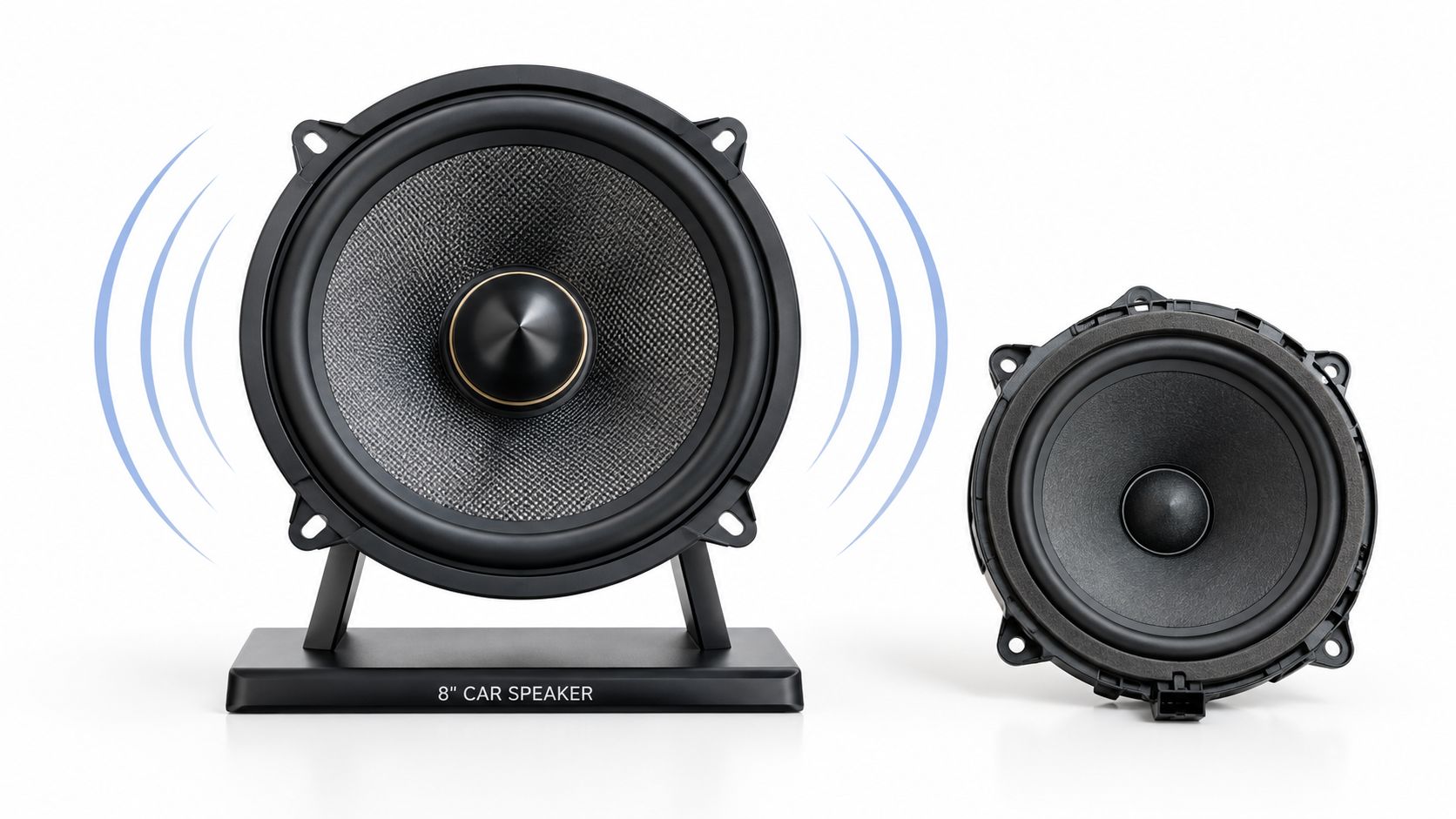
A door isn't automatically a proper speaker enclosure. It has openings, flexible trim, wiring routes, water paths, and moving glass. If the front and rear radiation from the cone mix through those gaps, bass cancels instead of building. A large driver mounted to a flimsy adapter can also vibrate the panel, leak air, and lose the acoustic coupling that gives midbass its impact.
Practical rule: A well-sealed smaller speaker beats a larger driver that leaks, flexes, or interferes with the window.
The historical record reinforces the point. The Acoustic Research AR-8B, introduced in 1968, used an 8-inch woofer with a 1-inch soft-dome tweeter in a sealed two-way cabinet. Its approximately 2,500 Hz crossover separated bass and lower midrange from high frequencies, while the relatively compact cabinet showed that system design mattered as much as woofer diameter. The AR-8B reference also describes a separate 1973 Coral Flat-8, an 8-inch double-cone full-range driver. Those are different solutions built around the same nominal size.
For a vehicle, the correct question isn't “How large a speaker can I fit?” Ask whether you need midbass punch, broad-range output, or genuine sub-bass. A larger universal driver may require cutting plastic or metal, compromise door sealing, or approach the window track. A vehicle-specific 8-inch replacement, or even a smaller component that mounts rigidly and seals well, can produce the more satisfying result.
Measuring for Fitment Before You Buy
Measure the vehicle, not the product label. “8 inch” describes the approximate driver class, while the basket, frame, mounting flange, terminal location, and magnet structure determine whether installation is possible. A speaker can match the factory cone diameter and still fail because the cutout is shaped differently or the motor extends into the glass path.
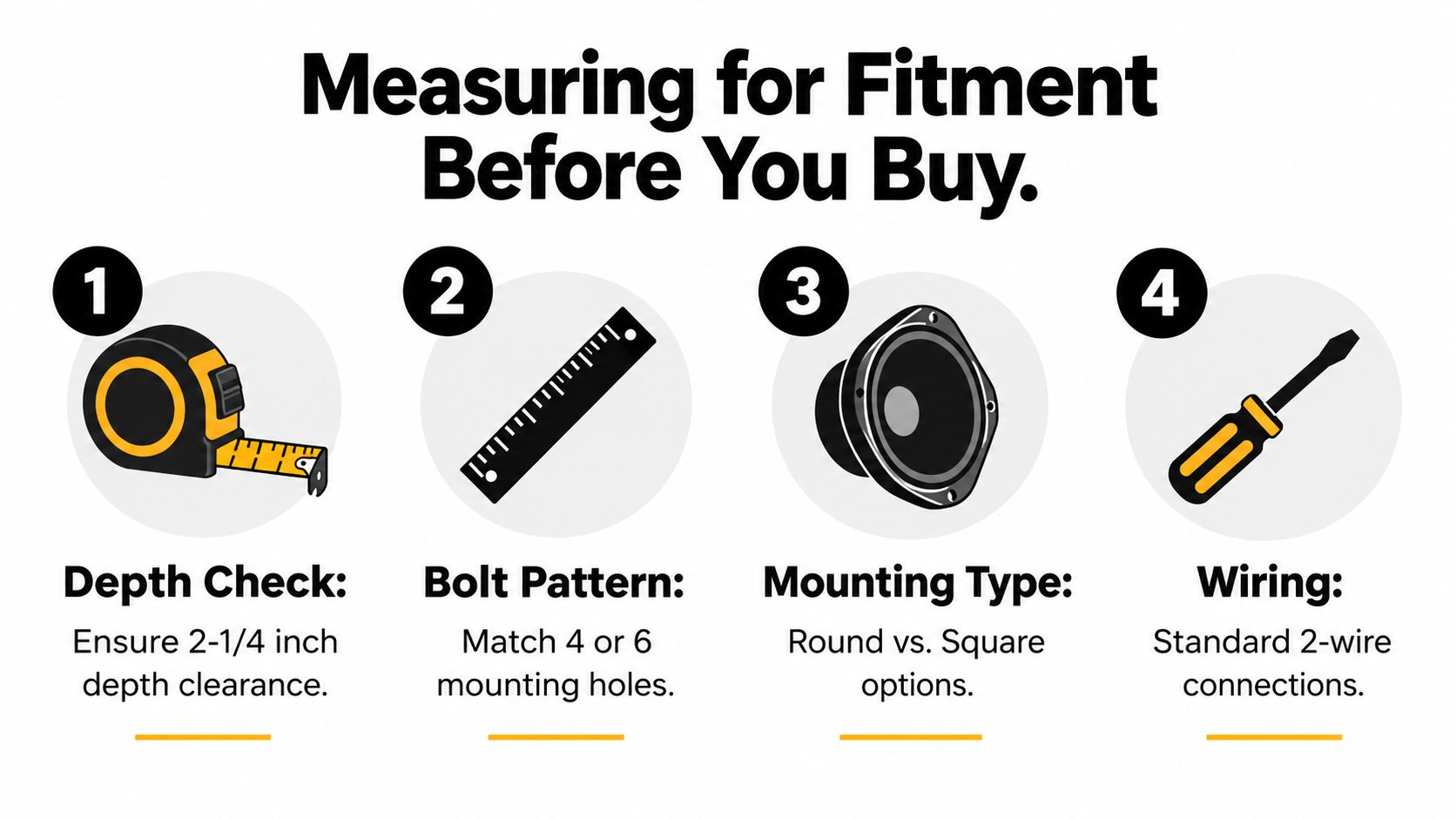
Four checks prevent most installation mistakes
- Record the opening. Remove the grille or factory speaker and measure the cutout at its narrowest points. Note whether the opening is round, oval, square, or an irregular OEM shape. Measure the outer mounting surface too, because a flange can collide with trim even when the cone clears the opening.
- Measure mounting depth. Hold a straightedge across the mounting surface and measure to the nearest obstruction. Check the magnet, basket, terminals, and any protective cover, not just the published depth. Window glass often travels behind the speaker, so move it through its full range with the panel removed and the vehicle power isolated as appropriate.
- Map the mounting pattern. Count the factory fasteners and mark their positions. A round aftermarket basket may need an adapter ring, and the ring must leave enough material around the holes to stay rigid. Don't drill into structural bracing or create a path for water into the cabin.
- Check the front clearance. Refit the grille or hold it in place while checking cone travel, surround clearance, and trim pressure. A grille touching the surround can create distortion, while a protruding frame can prevent the panel from seating.
Create a worksheet for each location. Include cutout shape, mounting depth, hole pattern, grille clearance, window travel, connector type, polarity, and impedance. The often-repeated claim that every 8-inch speaker needs the same cavity is precisely what causes trouble. Fitment guidance for 8-inch car speakers emphasizes checking cavity dimensions, depth, grilles, and amplifier compatibility rather than trusting diameter alone.
Measure twice before cutting once. If the installation requires metal removal, custom spacers, or changes to door sealing, stop treating it as a simple replacement.
Use cardboard or thin scrap material to make a temporary template. Test the template against the opening, window path, grille, and adapter location before ordering the driver. That inexpensive step exposes interference that a catalog fitment chart may miss.
Understanding Power, Impedance, and Sensitivity
Start with impedance, usually shown in ohms. Every factory radio and amplifier is designed for a particular electrical load. A lower-impedance speaker can demand more current, so the label on a replacement driver is not permission to wire it into any system. Check the amplifier's supported load before replacing one speaker, several speakers, or combining drivers.
Many professional 8-inch drivers use an 8-ohm nominal impedance, while vehicle-specific models may use a different load. An unsuitable match can reduce output, trigger protection, generate excess heat, or damage the amplifier. Follow the equipment documentation instead of assuming that any replacement is electrically safe.
Sensitivity can matter more than wattage
Sensitivity describes the acoustic output a driver produces from a defined input. Manufacturers commonly state it at 1 watt and 1 meter, or using an equivalent 2.83-volt test condition. With an 8-ohm speaker, 2.83 volts corresponds to approximately 1 watt, but the relationship changes as impedance changes. Biamp's Desono EX-S8 data sheet shows why the complete specification matters more than one headline figure.
A driver rated at 97 dB sensitivity will produce substantially more output from the same amplifier power than one rated at 88 dB, all else equal. A 3 dB sensitivity advantage requires roughly half the amplifier power to reach the same sound-pressure level. Conversely, doubling amplifier power produces only about a 3 dB increase under ideal conditions. High sensitivity therefore helps when a factory amplifier has limited headroom.
Power handling answers a different question. One 8-inch low-frequency driver is specified at 400 watts continuous, while another is rated at 700 watts continuous, with both listed at 97 dB sensitivity in a manufacturer's specification. This comparison separates thermal capacity from efficiency. Neither wattage nor sensitivity, by itself, predicts sound quality.
| Specification | What it tells you | What it doesn't tell you |
|---|---|---|
| Impedance | The electrical load presented to the amplifier | Whether the speaker will physically fit |
| Sensitivity | How efficiently input power becomes acoustic output | How deep the bass will extend |
| Continuous power handling | The thermal power the driver is designed to tolerate | How much clean power your factory system supplies |
| Frequency range | The intended operating bandwidth | Whether the vehicle installation will reproduce it accurately |
Choose the complete combination: impedance, sensitivity, continuous power handling, frequency target, and installation depth. A high-wattage driver will not automatically play louder on a low-power factory system. The amplifier still controls how much power reaches the voice coil, while the enclosure and vehicle installation determine how effectively that output becomes useful bass.
Enclosure Choices and Acoustic Trade-offs
The enclosure is part of the speaker. In a vehicle door, the driver often operates in an infinite-baffle-style arrangement, where the front and rear of the cone are separated by the door structure rather than a small dedicated box. That arrangement can work well, but only when the adapter, inner door skin, vapor barrier, and outer seal keep the two acoustic sides from mixing.
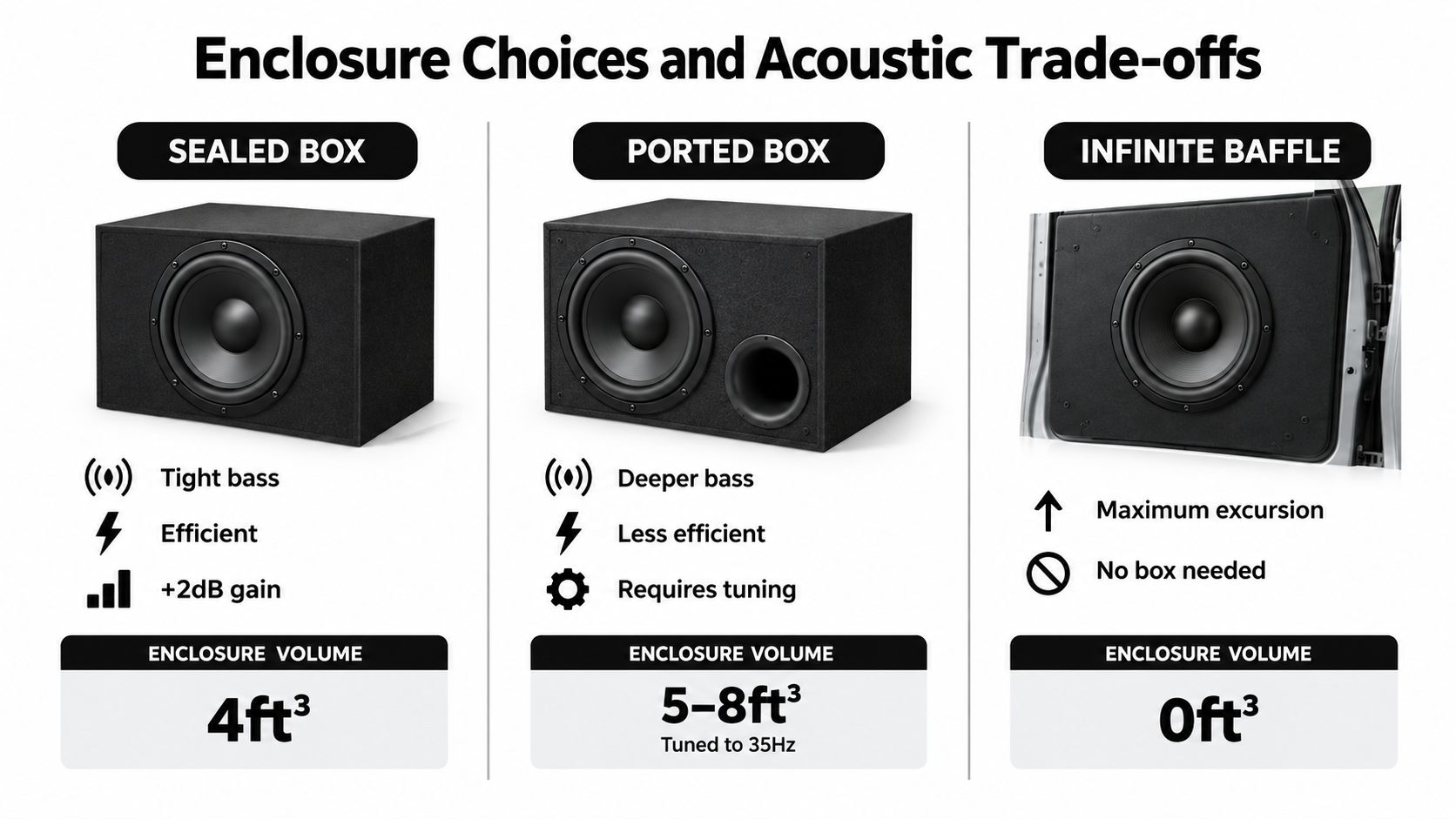
Sealed, vented, and door-mounted designs
A sealed enclosure gives the driver a controlled air spring. It generally produces predictable, tight bass, but the box must have the volume the driver was designed for. A vented enclosure can extend bass output around its tuning frequency, yet the port dimensions, box volume, and tuning must match the driver. A random prefabricated box is rarely a reliable shortcut.
The driver's Thiele-Small parameters provide the selection data. The important values include free-air resonance, (F_s), equivalent compliance volume, (V_{as}), total Q, (Q_{ts}), effective cone area, (S_d), and linear excursion, (X_{max}). Cone displacement is approximated by (V_d = S_d × X_{max}), so two drivers with the same frame diameter can produce very different low-frequency output. The Thiele-Small parameter reference explains why enclosure alignment must follow the driver rather than the other way around.
A commonly used starting point associates (Q_{ts} ≤ 0.4) with vented alignments and (Q_{ts}) around 0.4 to 0.7 with sealed designs. Those values aren't a substitute for modeling the specific driver, but they show why a box selected only by diameter can produce weak, boomy, or uncontrolled bass.
Midbass is not sub-bass
An 8-inch door driver is normally chosen for midbass impact, vocal warmth, and strong transition into a subwoofer. An 8-inch subwoofer is designed for deeper bass in a purpose-built enclosure, with different suspension, excursion, power, and crossover requirements. Mounting a subwoofer in a leaky door doesn't turn the door into a subwoofer enclosure.
The useful division is simple:
- Door-mounted 8-inch midbass: Punchy kick drums, bass guitar definition, and higher output in the upper bass region.
- Sealed or vented 8-inch subwoofer: Deeper low-frequency reproduction when the enclosure and amplifier are designed together.
- Full-range or coaxial 8-inch driver: Broader bandwidth when space or component count matters, with compromises compared with a dedicated two-way system.
A speaker can be excellent in one role and disappointing in another. Set the crossover around the vehicle, driver, and subwoofer integration, then protect the door driver with a suitable high-pass filter so it isn't forced to reproduce frequencies it can't handle cleanly.
Marine and Rugged Applications
A boat, UTV, motorcycle, or open truck environment exposes a speaker to conditions a sealed passenger cabin may avoid. Moisture, salt, ultraviolet light, vibration, and temperature changes attack cones, surrounds, terminals, fasteners, and adhesives. A standard car speaker may play well initially and then deteriorate when its materials and enclosure weren't designed for repeated exposure.
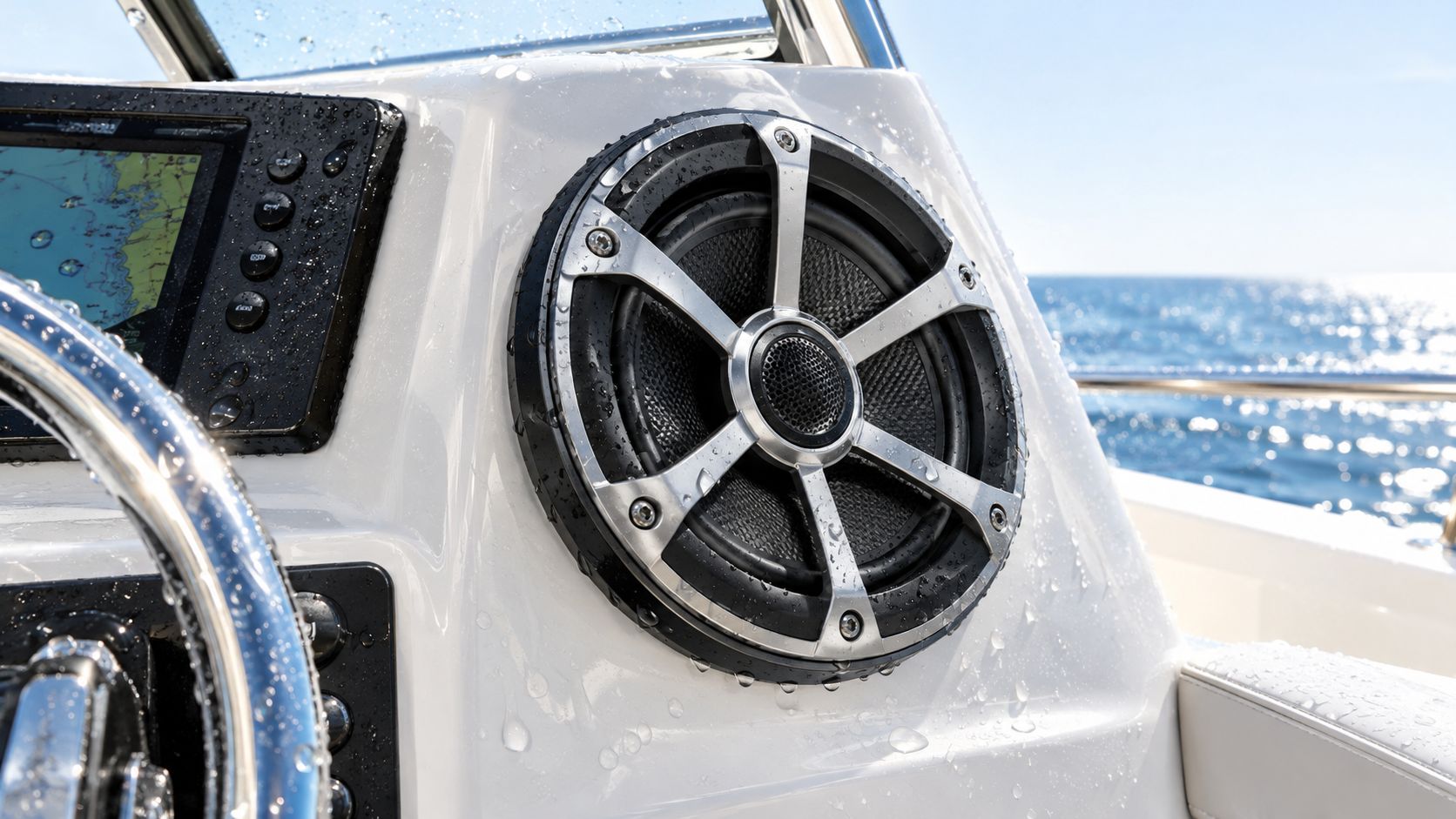
Select the whole installation, not just the cone
Marine-grade 8-inch speakers typically use weather-resistant materials and construction, but the exact protection level still varies by model. Look for a cone and surround suited to moisture and ultraviolet exposure, corrosion-resistant hardware, protected terminals, and a sealed or guarded motor structure. The grille must also tolerate the environment, especially when mounted where spray or washdown can reach it directly.
Mounting matters just as much as the product rating. Seal the cutout against the panel, use appropriate gasket material, provide a drip path where needed, and route wiring so water can't run along the cable into the connector. Stainless hardware helps, but it won't rescue a poorly sealed mounting surface or an amplifier installed where it collects water.
The product category also changes the acoustic plan. A tower speaker projects sound across an open area, a cockpit coaxial speaker serves nearby listeners, and a marine subwoofer needs an enclosure or a carefully engineered infinite-baffle installation. Do not use a tower-style driver where broad close-range coverage is the primary requirement.
Watch the installation context before choosing a wiring method or amplifier location.
For harsh applications, match the speaker's impedance to the amplifier and protect every connection from corrosion. Use marine-rated cable and connectors where exposure warrants them, keep amplifier ventilation clear, and avoid routing power and signal wiring where vibration can abrade insulation. On an open vehicle, physical protection and strain relief are part of audio quality because intermittent connections create noise, dropouts, and faults.
A rugged 8-inch speaker can be the right choice for a boat or off-road platform, but “marine” doesn't mean installation-free. The panel, wiring, amplifier, fuse protection, and mounting hardware all need to survive the same environment.
Installation Tips and When to Call Audio Jam
A straightforward replacement starts with documentation. Save the factory screw locations, photograph the connector and polarity, and test the new speaker at low volume before reinstalling the trim. If the vehicle uses a factory amplifier, active equalization, or a proprietary connector, identify that system before selecting the replacement.
A clean installation sequence
- Disconnect safely. Follow the vehicle's service procedure before removing panels or unplugging components. Protect trim with proper removal tools rather than forcing clips with a screwdriver.
- Build a rigid adapter. Use an appropriate mounting ring or vehicle-specific bracket. The adapter must support the basket without flexing and must preserve the seal around the speaker.
- Match polarity. Keep positive and negative connections consistent. Reversed polarity can make two speakers work against each other, reducing bass and weakening the center image.
- Protect the door. Restore vapor barriers, seals, and drainage paths. Add controlled damping where it solves panel resonance, but don't block water exits or interfere with window mechanisms.
- Set the crossover. A high-pass filter limits damaging low-frequency excursion in door-mounted drivers. A subwoofer needs its own low-pass integration, and both filters should be tuned by listening and measurement rather than by copying a generic setting.
- Test before closing up. Check every window position, lock, handle, grille, and trim panel. Listen for rattles at moderate output, then confirm that the amplifier stays stable with the final impedance load.
DIY makes sense when the replacement is direct-fit, the wiring is conventional, and no structural modification is required. Stop and get help when the job involves cutting metal, fabricating a deep adapter, relocating a window path, integrating a Jeep soundbar, building a marine enclosure, or tuning factory DSP. Those jobs can affect safety, water management, trim fit, and the life of the equipment.
Audio Jam Inc offers vehicle audio parts and installation, including speakers, amplifiers, subwoofers, custom enclosures, marine audio, and integration work for cars, trucks, Jeeps, and other rugged platforms. For a measured fitment plan and a properly sealed 8-inch speaker installation, visit Audio Jam Inc to shop products or arrange service in Delaware.