

2 Way Speakers vs 4 Way Speakers: Which Fits Your Car

Buying the speaker with more drivers is popular advice, but it's a poor shortcut. A crowded speaker basket won't fix a weak amplifier, a badly aimed tweeter, or a door installation that leaks air around the woofer.
The useful question in 2 way speakers vs 4 way speakers isn't which label sounds more advanced. It's which design your car can accommodate, power cleanly, and blend into a convincing stereo image.
Table of Contents
- 2-Way and 4-Way Speakers at a Glance
- How Crossovers Shape What You Hear
- Dispersion and Stereo Imaging by Layout
- Distortion and Specs That Predict Real Sound
- Fit Checks Before Buying Either Design
- What Each Design Costs to Get Right
- Choose the Right Design for Your Car and Goal
2-Way and 4-Way Speakers at a Glance
A 2-way speaker splits the signal between a woofer and a tweeter at one principal crossover point. A 4-way speaker divides it into four principal bands across three crossover transitions, although the actual driver assignments deserve a closer look before you buy.
2-way vs 4-way speakers compared on the criteria that matter in a car
| Criterion | 2-way speaker | 4-way speaker |
|---|---|---|
| Frequency bands | Woofer for bass and midrange, tweeter for treble | Commonly sub-bass or woofer, midbass, midrange, and tweeter |
| Crossover points | One principal transition | Three principal transitions |
| Typical car layout | Coaxial in the factory door or a component pair | Coaxial 4-way or component system with a separate midrange |
| Integration effort | Usually lower for a factory-location replacement | Higher for a fully adjustable component installation; passive coaxials can remain straightforward |
| Main strength | Fewer crossover regions to blend | Narrower operating bands can reduce individual driver demands |
| Main risk | The woofer handles a broad range through the midrange | More amplitude, phase, and directivity relationships to manage |
This table is a map of trade-offs, not a ranking. A well-matched component pair can deliver better results than a more elaborate speaker installed where its drivers can't work effectively.
Coaxial and Component Describe Placement
A coaxial speaker places its high-frequency driver over the woofer on a shared axis. It's a convenient format for replacing a factory door speaker without finding another mounting location.
A component set separates the woofer and tweeter. The woofer usually occupies the door, while the tweeter can use a suitable dash, sail-panel, or pillar location.
Multiway coaxials add smaller drivers to the same assembly. Component systems distribute those jobs among separate mounting positions, potentially including a dedicated midrange.
Buying rule: Check the driver assignments and crossover documentation, not just the number printed on the grille.
Don't assume a marketed 4-way coaxial includes a genuine sub-bass section. Likewise, don't assume a passive coaxial needs a separate amplifier channel for every visible driver.
For a daily driver, prioritize fit, sensitivity, and compatibility with the existing signal. For a custom system, prioritize adjustable crossovers, usable mounting positions, and access to each band for tuning. Those are different projects, even when both boxes carry the same way-count label.
How Crossovers Shape What You Hear
A crossover routes different frequency ranges to the drivers suited to reproduce them. In a passive speaker, electrical components filter the amplifier's output; in an active system, processing separates the signal before dedicated amplification.
Consider a recording containing bass guitar and a singer's consonants. The woofer handles the lower musical content, while the tweeter reproduces the upper detail. Neither driver stops abruptly at the handoff, so their overlapping output must combine correctly.
A coaxial assembly makes that division compact.
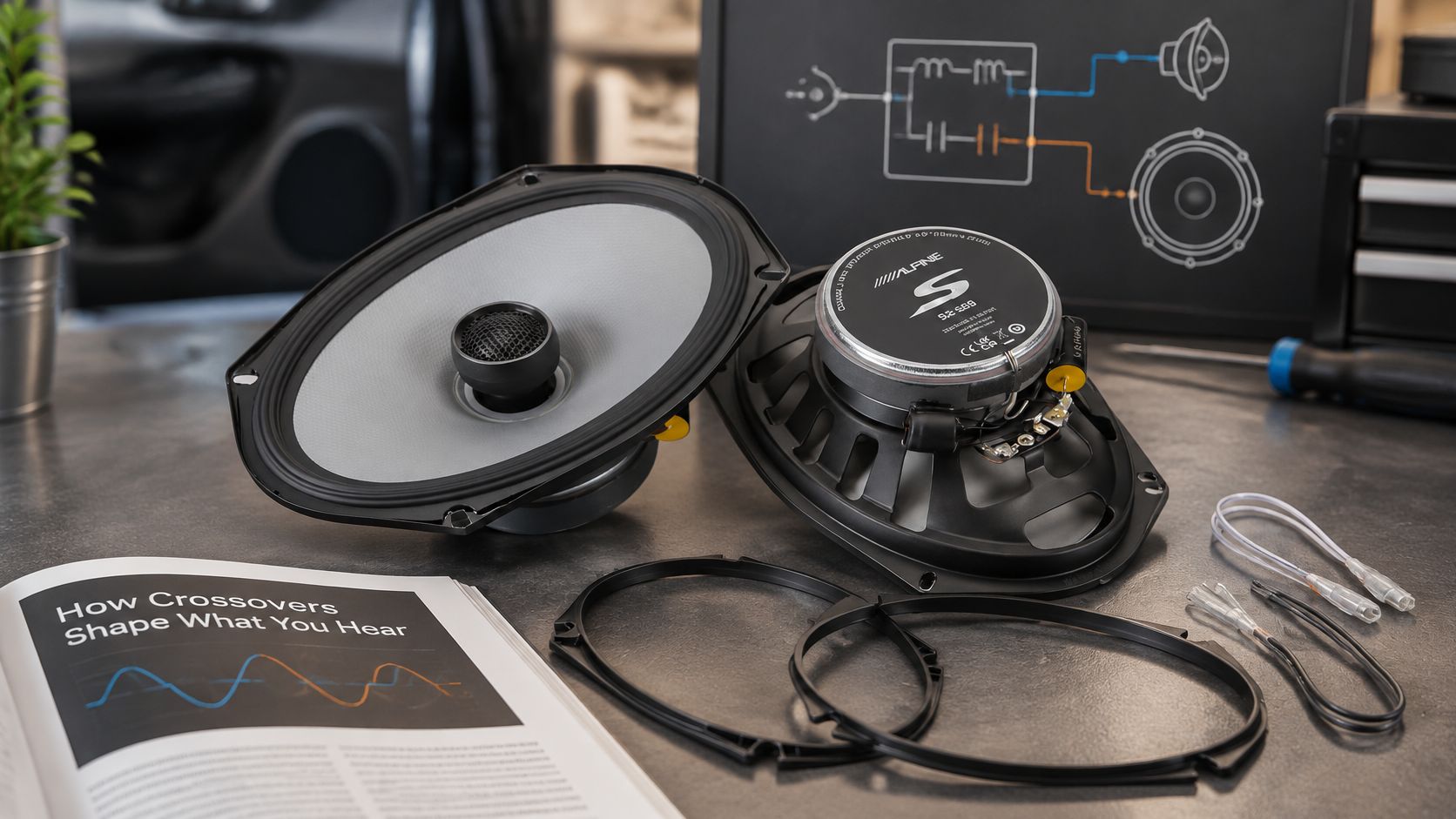
Frequency Bands Aren't a Physical Driver Count
Two-way means principal frequency bands, not necessarily physical drive units, and commercial examples were already established in the 1930s, as documented in Wikipedia's loudspeaker history. Multiple woofers can reproduce the same band without changing the basic architecture.
The simpler design asks its woofer to do a demanding job. It must reproduce bass movement while preserving much of the vocal range, so cone behavior, door mounting, and the upper crossover limit all affect clarity.
A more segmented system can relieve a midrange driver of deep-bass excursion. That doesn't mean every driver moves less air under every condition. It means the designer can allocate demanding frequencies to more suitable drivers.
The benefit disappears if adjacent bands don't sum properly. A poorly chosen handoff can make part of a voice sound recessed, forward, or disconnected from the rest.
Tune the Acoustic Result
The setting displayed on a processor isn't the complete acoustic response. Driver roll-off, mounting angle, polarity, and the cabin all influence what reaches your ears.
- Start with protection: Use the speaker manufacturer's recommended operating limits before experimenting.
- Measure the handoff: Check individual bands and their combined response with a measurement microphone and a real-time analyzer.
- Change one control: Adjust frequency, slope, level, or delay separately so you know what caused the difference.
Our guide to car audio crossover settings explains how to approach those adjustments without treating a preset as a finished tune.
Finish with a familiar vocal recording at normal listening volume. The singer should remain in a stable position as the melody rises and falls. If the image spreads across the cabin or changes height with pitch, investigate the crossover blend and placement before buying additional drivers.
Dispersion and Stereo Imaging by Layout
Dispersion describes how sound spreads away from a driver. For a given radiating surface, output generally becomes more directional as frequency rises, making listening angle important inside a car.
The driver's seat isn't centered between the speakers. Glass, trim, and unequal distances complicate the direct sound, so a speaker that measures well straight ahead may sound different from your seat.
The layout below illustrates why aiming and driver relationships matter.
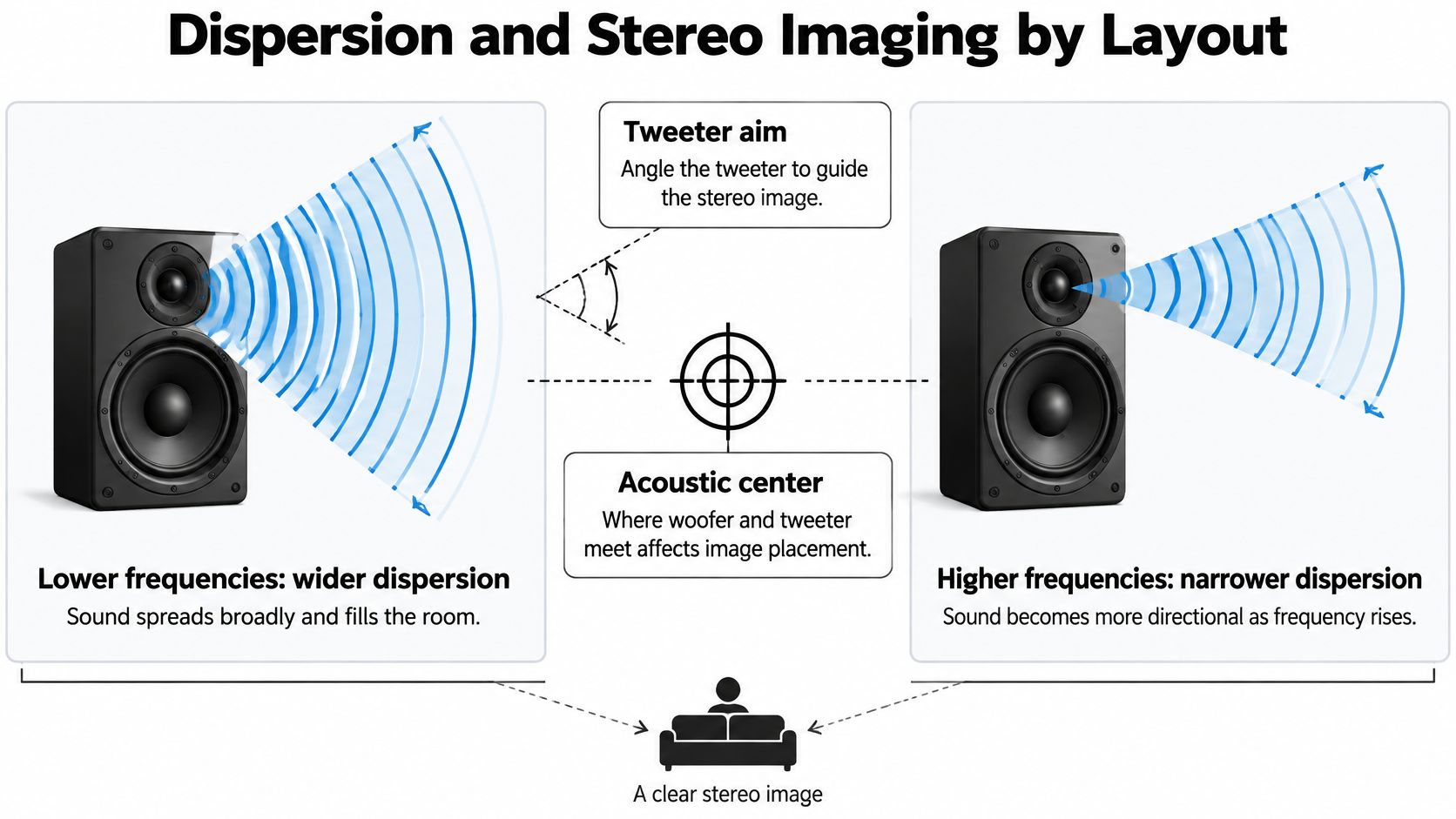
What Each Layout Gets Right and Wrong
Independent loudspeaker directivity research published by Springer explains why multiway radiation patterns require deliberate optimization and how coaxial alignment can help maintain consistent behavior. Sharing an axis is useful, but it doesn't guarantee identical acoustic centers or perfect integration.
- Door-mounted 2-way coaxial: The assembly stays together in the factory opening, but the tweeter may fire across your legs rather than toward your ears. Its likely weakness is off-axis treble combined with reflections from nearby surfaces.
- 2-way component set: A dash or pillar tweeter can raise the apparent stage when its location complements the door woofer. Its failure point is excessive separation or unsuitable aim that makes the tweeter sound detached.
- 4-way coaxial: The additional drivers remain clustered in the door, preserving installation convenience. Their differing acoustic centers and radiation patterns can still create uneven blending at the listening position.
- 4-way component system: Separate mounting and DSP provide control over arrival time and level. A midrange arriving out of time can blur vocal placement even when each driver sounds clear alone.
Aim Before Making Permanent Mounts
Temporarily secure component tweeters with removable mounting material and compare suitable positions. Keep them clear of airbags, visibility requirements, and moving trim.
Don't automatically point both tweeters directly at your head. Compare direct aim with cross-cabin aim using the same recording and level, then verify the response from the intended listening position.
This video provides another reference while considering speaker arrangements.
A convincing stage needs stable placement, not just apparent width. A well-integrated component pair can produce centered vocals and clearly located instruments; an unaligned multiway system can sound broad but vague.
A narrow stage isn't automatically desirable, either. Listen for instruments occupying distinct positions across the dashboard without pulling attention toward an individual tweeter.
Distortion and Specs That Predict Real Sound
More drivers can still mean more audible distortion if the system is badly matched or poorly integrated. Intermodulation distortion, or IMD, occurs when simultaneous signals interact and produce unwanted sum-and-difference components that weren't in the recording.
In one standardized automotive test, overall average IMD was approximately 2% across six microphones, with increased low-frequency distortion and another rise around 1.5 kHz, likely near a crossover; separate measurements in the same Listen automotive measurement paper identified substantial distortion bands around 20–80 Hz, 150–700 Hz, and 2–7 kHz, despite multiple drivers and electrical crossovers.
Those results describe tested systems, not every speaker in either category. They demonstrate why the presence of crossovers alone isn't proof of clean playback.
Read the Specifications Together
Specifications that predict how a speaker sounds in a car
| Specification | What it tells you | What to check |
|---|---|---|
| Sensitivity | Output for a stated input under stated test conditions | Favor suitable sensitivity for low-power radios; compare equivalent measurement methods |
| Power handling, RMS | Continuous power capability under the manufacturer's test conditions | Match amplifier output and gain structure to the speaker's requirements |
| Frequency response | The range and balance of reproduced sound | Look for a response curve and tolerance, not just endpoints |
| Impedance | The electrical load presented to the amplifier | Confirm the amplifier supports the speaker's nominal load and impedance behavior |
| Crossover frequency and slope | Where filtering occurs and how rapidly output falls | Request settings for every band transition |
| Measured IMD | Unwanted interaction products at a specified playback level | Ask for curves at the intended listening level |
A high power-handling rating doesn't tell you how loud a speaker will play from the factory radio. A sensitive, well-matched speaker may provide more usable output than a less sensitive alternative with a larger advertised wattage.
Sensitivity comparisons also need care. Measurements taken with different input references aren't automatically interchangeable, especially when speaker impedances differ.
Check What Happens at Your Listening Level
Use our explanation of what frequency response means to distinguish usable coverage from balanced reproduction. A broad printed range doesn't reveal a sharp peak in the vocal band or a cancellation caused by installation.
A clean demonstration at quiet volume doesn't establish how a speaker behaves when you turn it up.
Ask for measured distortion curves where available, or prioritize reviews that publish them with test conditions. IMD rarely appears on ordinary retail specification sheets.
During an audition, compare candidates at matched perceived loudness. Listen for vocals becoming rough during bass-heavy passages, cymbals turning splashy, or the tonal balance changing as volume rises. Those symptoms deserve investigation before you blame or credit driver count.
Fit Checks Before Buying Either Design
Measure the door before choosing the speaker. Buying by configuration first can leave you with an assembly that clears the opening but strikes the window mechanism or presses against the grille.
The Business Research Company's automotive speaker market overview provides category context, but a market label doesn't establish compatibility with your vehicle. Fit requires checking the actual opening, electrical system, and acoustic installation.
A Practical Pre-Purchase Routine
- Measure rear and front clearance. Remove the factory speaker and use a depth gauge or ruler from the mounting plane to nearby obstructions, then check through the window's travel. Also measure the space between the mounting face and door grille, because a projecting tweeter can interfere even when the magnet clears.
- Identify the signal source. Find out whether the speakers connect to the radio or a separate factory amplifier, and whether that output is full-range or already filtered. A replacement woofer won't restore treble that the factory system never sends to that location.
- Match sensitivity, load, and usable power. Compare the proposed speaker's requirements with the amplifier's documented continuous output at the appropriate load. Don't treat a speaker's RMS rating as power it must receive constantly, and don't use peak ratings to set gains.
- Choose the mounting format. Use coaxials when preserving a suitable factory opening is the priority; consider components when safe dash or pillar locations offer useful staging options. Check factory tweeter wiring before leaving it connected alongside a new coaxial.
- Confirm control over an active system. Before buying separate multiway components, map amplifier channels, processor outputs, crossover controls, and access to each driver. A passive 4-way coaxial doesn't automatically require external DSP, but a custom active installation needs a workable tuning plan.
- Prepare the door properly. Use a rigid, moisture-resistant mounting adapter and a suitable gasket to seal the speaker to it. Apply damping where panels resonate, secure wiring, and preserve drainage holes and the door's moisture protection.
Use this clearance checklist while the trim is removed.
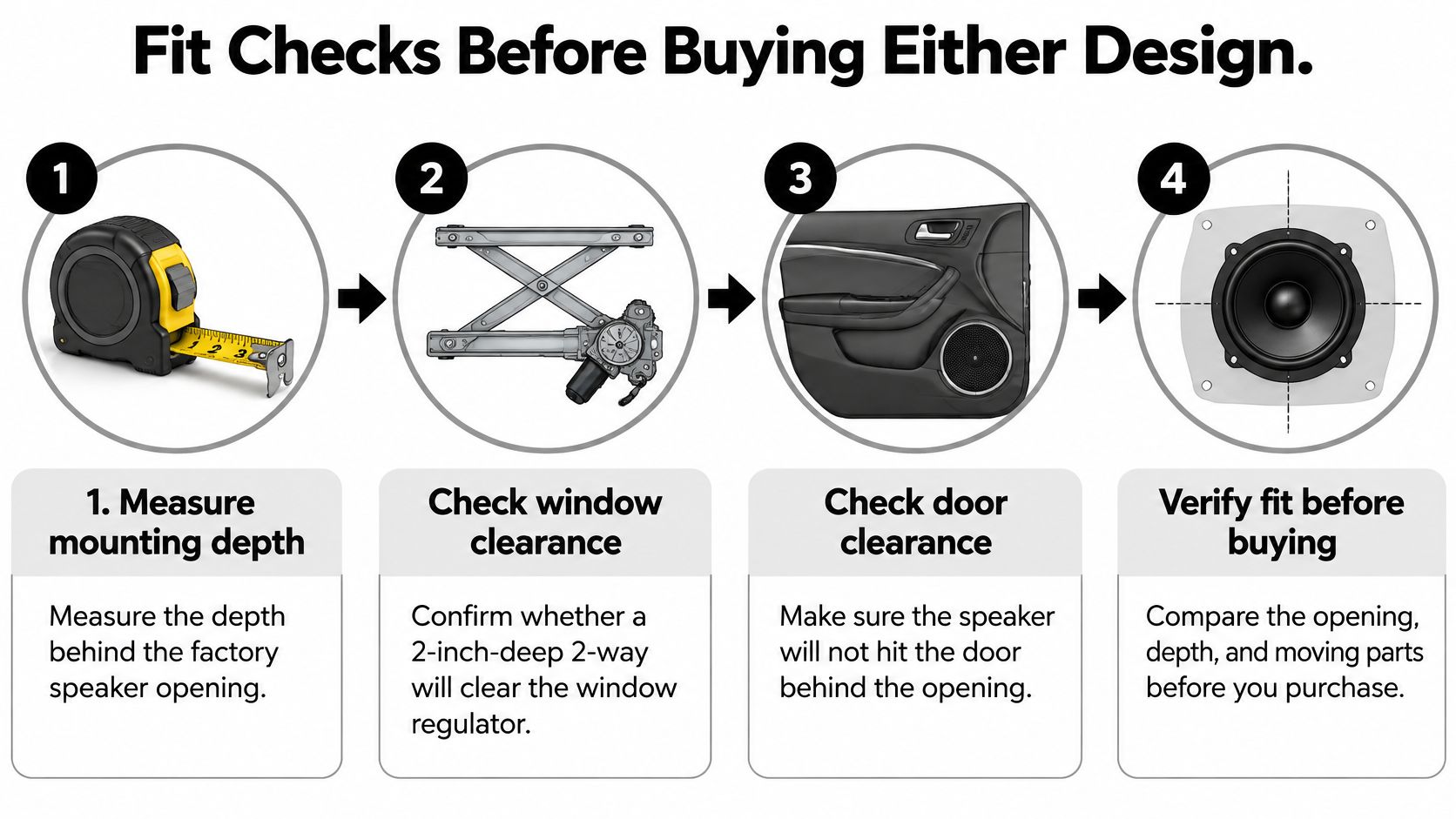
Verify the Individual Speaker
Start with our speaker size by vehicle guide, then compare the candidate's mounting drawing with your measurements. Nominal speaker size doesn't describe basket shape, terminal position, or tweeter protrusion.
For example, the Alpine S2-S69 6x9 Car Speakers | High Power & Clean Sound is a two-way coaxial option. Its format alone doesn't establish whether it clears your vehicle's moving parts or works with its factory amplification.
Avoid using a spacer as an automatic cure for insufficient depth. Moving the basket outward can create a new interference problem at the door panel, so test the complete assembly before fastening the trim.
What Each Design Costs to Get Right
Two-way car speakers were listed at approximately $40–$80 per pair in 2024 in the AliExpress speaker buying guide. That figure is an entry-price reference rather than an installed quote or a benchmark for premium component systems.
A basic coaxial replacement can keep the project simple when the existing signal and power are suitable. Adapters, wiring interfaces, door treatment, and installation remain separate considerations.
Separate Passive Replacement From Active System Cost
Passive replacement and custom active installation carry very different costs, and the gap has little to do with whether the speaker has two drivers or four.
A passive multiway coaxial uses its onboard filtering and runs on the channels already in the car. A fully active component build has a different shopping list:
- Processing: Enough outputs and adjustment range for the intended bands.
- Amplification: Suitable channels, clean output, and compatible loads.
- Mounting: Secure midrange and tweeter locations, potentially requiring fabricated parts.
- Integration: Access to a usable signal without losing necessary factory functions.
- Tuning labor: Measurements, gain adjustment, crossover work, and listening verification.
That last line is where budgets slip. Reserve a share of the total comparable to the speaker purchase itself for measurement and tuning labor, because that work is what turns a box of parts into a working system. A properly powered component pair in prepared doors is a more predictable purchase than additional drivers squeezed into compromised locations.
Compare Equal Project Scopes
We offer brands including Alpine, JL Audio, MB Quart, Focal, Memphis Audio, and Hifonics. Compare products within a matching price tier and installation format instead of assuming every model from a brand serves the same purpose.
Ask for an itemized system proposal that separates equipment, integration parts, installation, and tuning. That makes it easier to decide whether a processor solves a real limitation or adds equipment you aren't ready to use.
The sensible spending order depends on what is already working in the car. An adequate amplifier stays in place, a clipped output or an unsecured door panel gets corrected first, and processing or extra drivers earn their place once you can name the specific problem they will solve.
Choose the Right Design for Your Car and Goal
Which speaker design fits each situation
| Situation | Better fit | Why |
|---|---|---|
| Factory door replacement with limited mounting depth | A verified shallow-fit 2-way coaxial | Keeps the installation compact, provided clearance and factory filtering are compatible |
| Dash or pillar stage with an amplifier and processor | A carefully planned 4-way component system | Allows dedicated midrange placement and controlled arrival times when mounting space supports it |
| Daily commuter with a factory head unit | High-sensitivity 2-way | Makes sensible use of limited clean power |
| Truck or Jeep that needs more bass | 2-way plus subwoofer | Assigns deep-bass work to a suitable dedicated driver |
| Marine or UTV exposed to weather | Weather-rated 2-way | Prioritizes environmental suitability and straightforward installation |
| Budget build without a processor | 2-way | Keeps integration and adjustment manageable |
For most drivers replacing factory speakers, a well-matched, high-sensitivity 2-way is the safer starting point. Add amplification when the existing source can't supply the clean output you need.
A separate multiway component system earns its complexity when you have useful mounting positions, sufficient amplification, and time for measured adjustment. A processor belongs in that project when it solves a problem you can name, since the unit alone changes nothing about placement or tuning discipline.
Match the Recommendation to the Complaint
Be precise about what you want to change. Weak bass, harsh vocals, a low soundstage, and insufficient volume are different problems with different fixes.
If bass is the complaint, evaluate a subwoofer rather than expecting small extra drivers above a door woofer to solve it. If vocals seem to come from your ankles, investigate component placement instead of choosing a more crowded coaxial assembly.
For marine and UTV use, weather resistance and secure mounting come before configuration. Driver count says nothing about corrosion protection, so confirm the product carries a rating for that environment before comparing formats.
- Keep what works: Retain compatible equipment that already meets the goal.
- Specify the improvement: Ask for cleaner output, better staging, or deeper bass rather than more drivers.
- Approve the whole installation: Include wiring, mounting, signal integration, and tuning in the decision.
Bring Useful Information to the Installer
The fit checks covered earlier already list the measurements to collect: mounting clearance, head-unit or factory-amplifier output, and the aftermarket amplifier's RMS rating if fitted. Add the vehicle's trim and factory audio package, since those can change the wiring and available signal.
If output figures aren't documented, bring the equipment model details rather than guessing. A fit decision based on assumed power or an incomplete opening measurement can send the entire project in the wrong direction.
Customers can visit one of Audio Jam Inc's two store locations or call to speak with an expert about fit and amplifier matching. Bring familiar tracks that expose the problem you want fixed, then compare at realistic volume.
A complete brief reads like a build sheet: truck model and trim, confirmed shallow door openings, factory head unit retained, one aftermarket amplifier with its RMS rating on paper, a defined goal such as deeper bass or cleaner vocals at highway volume, and a budget that reserves room for mounting and tuning labor. Hand that to an installer and the 2-way versus 4-way question mostly answers itself, because the mounting space, signal path, and amplifier have already narrowed the choice.
Audio Jam Inc offers speakers, amplifiers, subwoofers, and professional installation for vehicle-specific audio upgrades. Visit Audio Jam Inc with your vehicle details and equipment information so we can help you compare speaker formats, check fit, and plan suitable amplification.