

12 Inch Subwoofer Box: Sealed, Ported, or Fit

A 12-inch subwoofer doesn't automatically need a big ported box, and a box advertised as fitting "any 12" isn't a safe bet. Your sub may already be sitting in the trunk, yet if the enclosure's airspace, shape, or placement suits neither the driver nor the vehicle, the bass can sound uneven, the box can eat more cargo room than expected, or the sub may fail to fit at all.
Measure the finished box at the trunk opening, then listen from the driver's seat. Those two checks can overturn a specification that looks correct on paper. The same enclosure changes character once it sits against a seat, faces the hatch, or plays inside a closed trunk. Before you order a prefab or commission a custom build, work out what your sub needs, how much airspace the box holds, and where the finished enclosure will live.
The car is part of the speaker.
Carry a short list of fit and tone requirements to your box supplier or installer: the right enclosure type, net airspace, construction, placement, and mounting clearances. That list beats any generic cubic-foot chart.
Table of Contents
- Why a 12 Inch Subwoofer Box Is Not One Size
- What a 12-Inch Driver Really Needs
- Sealed Ported and Bandpass Boxes Compared
- How Internal Volume Shapes the Bass
- Materials Bracing and a Box That Stays Quiet
- Matching the Box to Your Vehicle
- Wiring Mounting and Your Next Step
Why a 12 Inch Subwoofer Box Is Not One Size
You've chosen the sub, opened the trunk, and decided there's room for a box. An online listing says its enclosure fits any 12-inch woofer, so you're tempted to order it and call the install done.
That claim leaves out the main question: does the box suit your particular driver and your vehicle? Two subwoofers with the same nominal size can call for different enclosure volumes. One may be suited to a compact sealed chamber, while another may be designed for a larger vented enclosure. A box that works well for one isn't automatically right for the other.
The cabin changes the decision, too. The trunk or cab can reinforce some bass frequencies, while the enclosure's position and orientation affect what you hear from the driver's seat. A box that looks like a good match on a product page might make too little room for the driver, block a port, or take up cargo space you meant to keep.
Start with the complete installation
A useful fit check considers more than the box's outside dimensions. You need to account for the driver's mounting requirements, the internal airspace it calls for, and enough room around the enclosure for it to work in its installed position.
Then consider what you want the bass to do. Do you want a controlled sound for varied music, or are you willing to trade cargo room and some flexibility for more output around a particular range? Your answer helps narrow the enclosure choices, but it doesn't replace the manufacturer's specification for the sub.
A good plan also includes how the box will be built, where it can sit, and how it'll be secured and wired. Those details matter whether you buy a prefab or have an enclosure made for your vehicle.
The goal is a specific fit-and-sound checklist, not a universal 12-inch box measurement. Start with the physical driver, then choose an enclosure and location that work together. The popular sealed-versus-ported choice is only one part of that decision.
What a 12-Inch Driver Really Needs
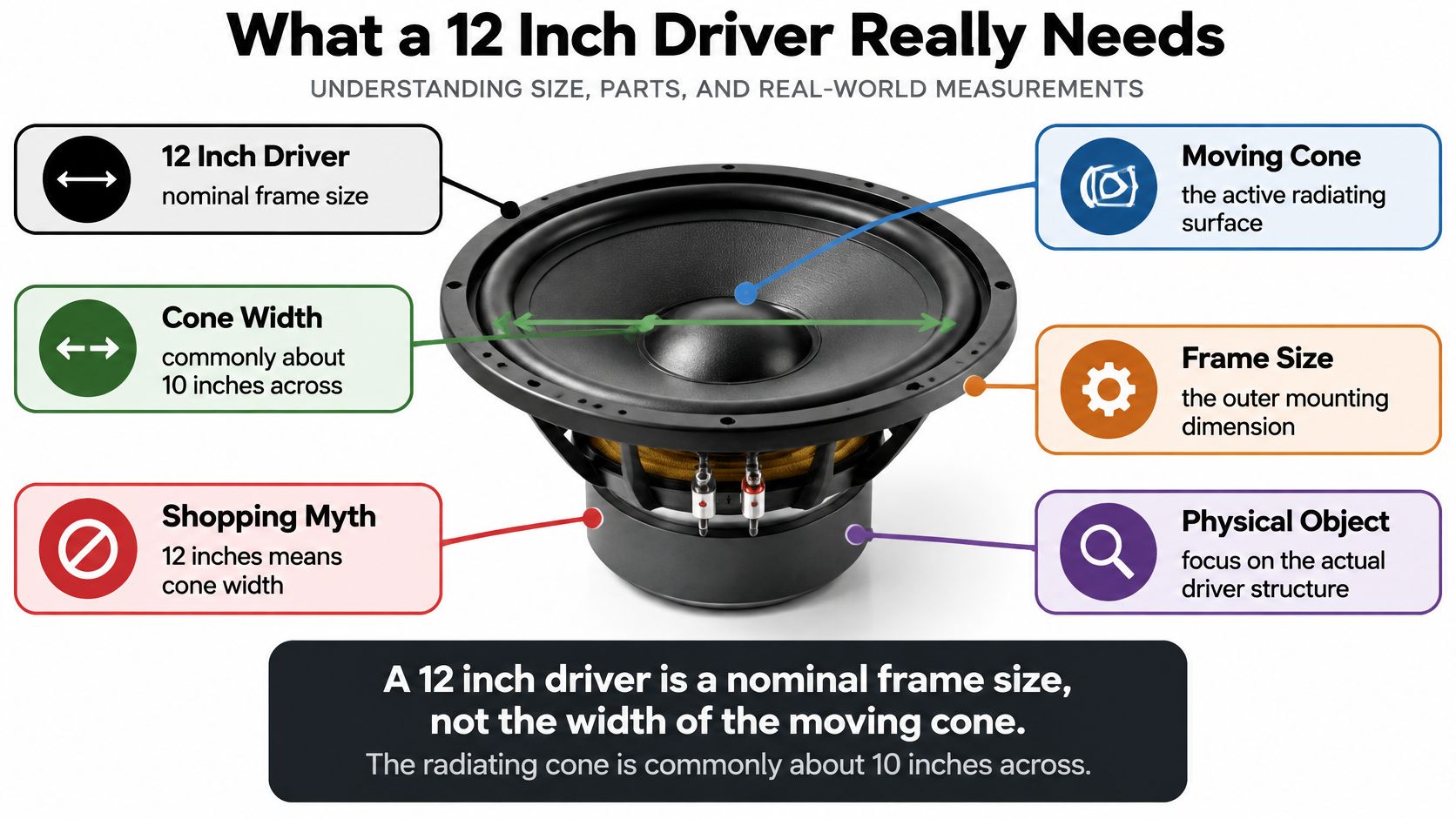
A "12-inch driver" does not have a moving cone that measures 12 inches across. The label refers to the nominal frame size, the outside class the basket belongs to. The part that pushes air, the radiating cone, is commonly about 10 inches across once you subtract the surround and mounting edge.
Do the arithmetic yourself with the standard circle-area formula (pi times radius squared). A 10-inch diameter works out to about 78.5 square inches, and a 12-inch diameter to about 113.1 square inches, so the frame figure overstates the working cone by roughly 44%. These numbers expose the naming problem. They say nothing about loudness. Cone area is one ingredient in output, while excursion, excursion velocity, cone breakup, enclosure loading, and amplifier headroom decide how much clean bass reaches your seat. A discussion of early loudspeaker design describes 12 inches as an "ideal compromise" chosen by Avery Fisher and Henry Kloss, a frame size, not a performance rating.
Measure the driver, not just the frame
The frame-size label helps you shop within a general class of subwoofer, but it tells you nothing about fit. Pull these figures from the manufacturer's specifications instead:
- Cutout diameter: the opening the enclosure's front panel needs for the driver.
- Mounting depth: how far the driver extends behind that panel.
- Driver displacement: the air volume the speaker itself takes up inside the box.
- Recommended net airspace: the usable internal volume specified for that exact model.
That last number deserves a closer look. Net airspace is what remains after the driver, the port, and any bracing displace air, so two boxes with identical outside dimensions can offer very different working volumes. Your vehicle cabin behaves like a second chamber on top of that: trunk shape and seat position reinforce some frequencies and swallow others, which is why a generic cubic-foot chart can steer you toward a box that measures correctly on paper and sounds wrong in the car.
In car audio, the 12-inch format stays practical because it moves more air than smaller drivers without demanding the very large enclosures that bigger woofers call for. Match the cutout, depth, displacement, and recommended net airspace to the specific sub you own, then let the cabin decide whether that volume still makes sense where the box will physically sit.
Sealed Ported and Bandpass Boxes Compared
Every enclosure type answers the same question differently: what should happen to the air your subwoofer pushes against? A sealed box traps that air in a closed chamber. A ported box adds a vent that reinforces output near its tuning frequency. A bandpass design hides the driver between chambers and lets only the port speak.
Audioholics' technical comparison of sealed and ported enclosures describes the low-frequency behavior behind the numbers in this table: sealed systems typically roll off at about 12 dB per octave, while ported systems fall at about 24 dB per octave once you drop below their tuning frequency.
| Enclosure | Low-frequency behavior | What you gain | What to watch |
|---|---|---|---|
| Sealed | Typically rolls off at about 12 dB per octave at low frequencies | A closed chamber and no port tuning to manage | The driver still needs the right chamber for its response |
| Ported | Rolls off at about 24 dB per octave below its tuning frequency | Greater extension and output near the tuning frequency | Below tuning, acoustic loading on the cone drops; how much excursion rises then depends on the driver, the amp, and the airspace |
| Bandpass | Uses chambers and ports to shape output through a narrower range | Strong output potential in a limited band | Volume, port design, and sealing need careful matching |
A sealed box works like a spring: the trapped air pushes back on the cone and helps control it. The design stays simple in principle, but the sound still depends on matching the chamber to the driver.
A ported box uses its vent as a resonant helper. Near tuning, it adds output and relieves some of the cone's workload. Below tuning, the port stops helping and the enclosure's acoustic loading on the cone falls away. Excursion at that point depends on the driver's suspension, your amplifier settings, and the airspace the box provides. It can rise, but the increase is not universal across every woofer.
Bandpass is the fussiest of the three. Its hidden driver and chamber arrangement can deliver strong output over a narrower range, yet it forgives less: wrong volumes, port dimensions, or small leaks show up fast. If you want even bass across many kinds of music, don't pick bandpass because the layout looks clever.
Bigger changes more than loudness
Published sealed-enclosure examples show the same driver's system Q falling as the chamber grows, sliding from a livelier, peak-prone response in a modest box toward a heavily damped one in a much larger enclosure. The lesson: changing volume reshapes the system's damping and response along with its loudness.
Thiele and Small's early-1970s loudspeaker modeling formalized how driver characteristics such as resonance, compliance, and damping help predict closed- and vented-box behavior. That work is why a generic 12-inch cubic-foot chart can't replace the parameters for your specific woofer or the net volume its manufacturer recommends.
The chart fails for another reason, too. Your cabin behaves like part of the enclosure: seat position, trunk shape, and where the box fires all change what reaches your ears. A larger ported box is not automatically the better one. In a tight trunk, an oversized ported enclosure may never play into its strengths, and two vehicles can make the same box sound different.
No enclosure type wins in every car. Pick the trade-offs that suit your listening and cargo space, then confirm the specific driver can work in the box you're considering.
How Internal Volume Shapes the Bass
A bigger box is not a bass upgrade by itself. Once the enclosure goes behind a seat or into a trunk, the cabin becomes part of the system: the same 12 inch sub can sound tight in one car and boomy in another because seat position, trunk shape, and open versus closed cargo space change how pressure builds around the cone.
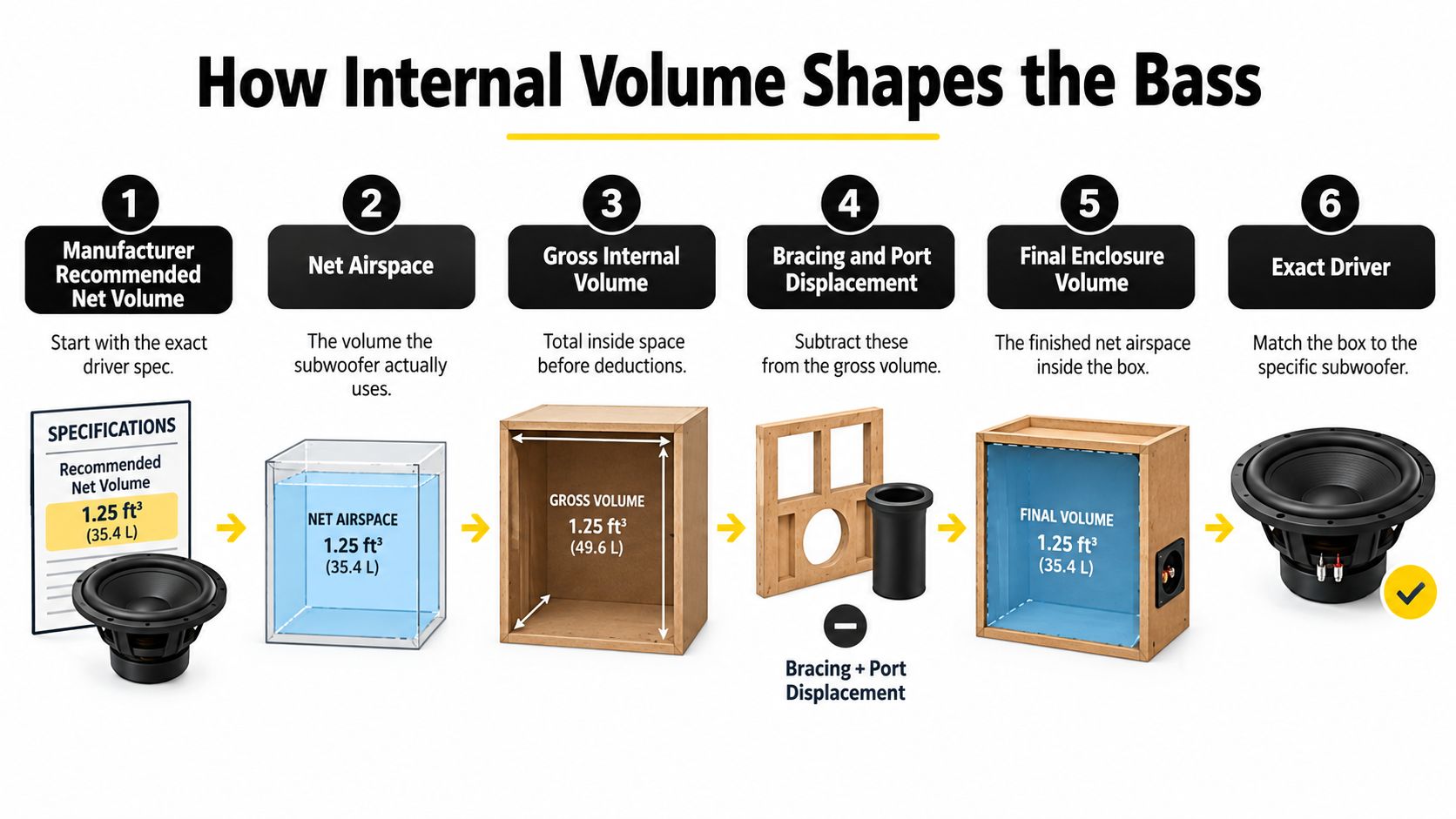
Start with the air the driver can actually use: net airspace. Gross internal volume is the empty cavity before parts are counted. Net volume is what remains after the driver, port, bracing, and other displaced air are removed. For a rectangular enclosure, multiply internal length by internal width by internal height, then subtract driver, port, brace, and other displacement to obtain usable net airspace.
Match the number to the car and the driver
Use the manufacturer's recommended net volume for your exact subwoofer and chosen enclosure type. Generic cubic-foot charts are a starting guess at best; they fail when the trunk narrows near the hinges, the seat sits close to the box, or the driver's specification calls for a different chamber than the prefab provides.
A practical check goes like this:
- Find the required net volume. Match it to the exact driver and enclosure type.
- Measure the cavity. Work from inside dimensions, then subtract what occupies space.
- Give each measurement one job. Use external dimensions for the trunk-opening check, and use net volume for the driver-match check.
- Account for cabin loading. A larger ported box that looks right on paper can crowd a trunk, sit too far from the cabin opening, or lose the easy low-end control you expected.
If the specification uses a different volume unit from the box listing, convert carefully before comparing. Don't guess based on a product photo: the apparent shape won't tell you the chamber's net airspace.
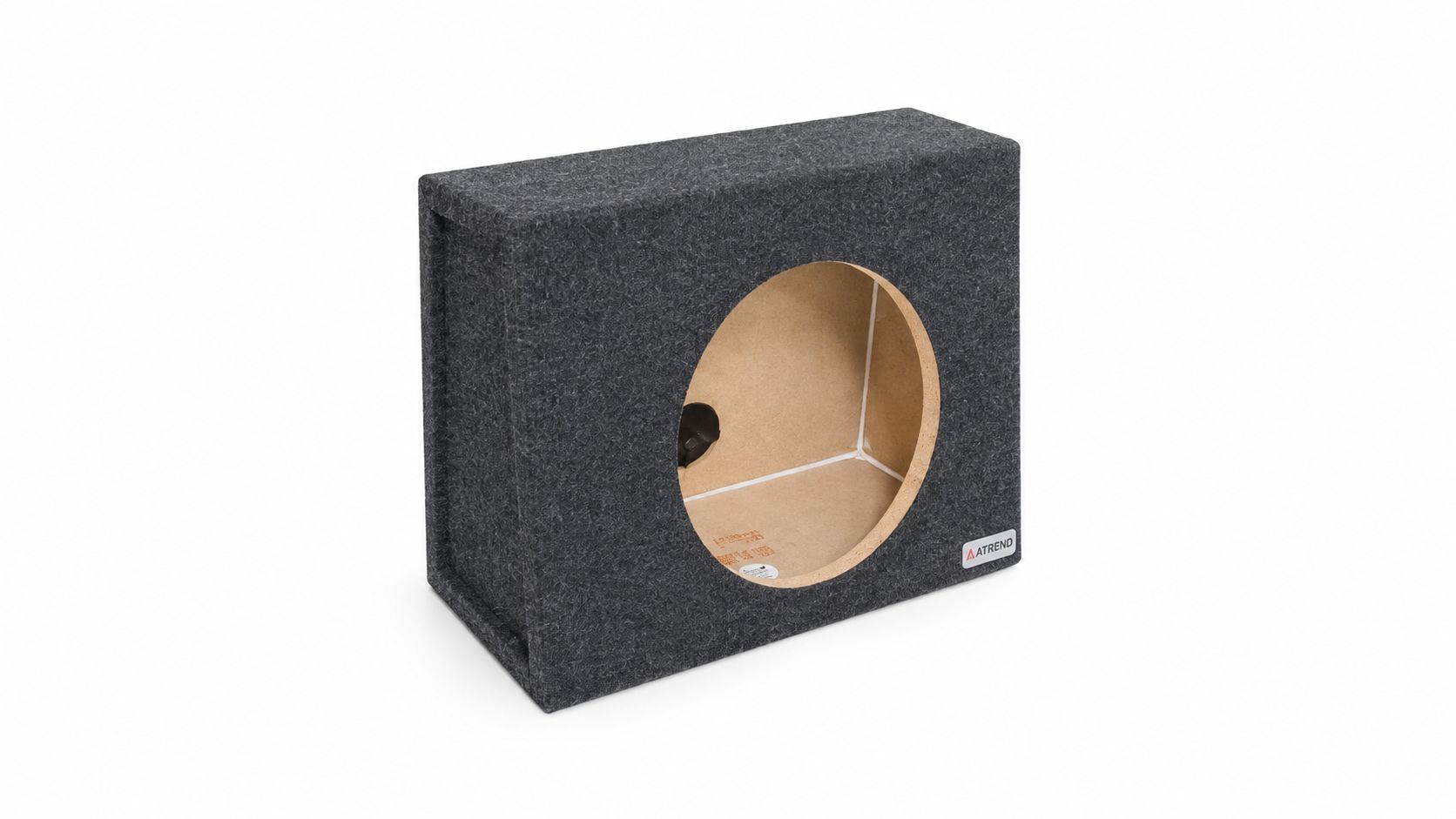
A sealed empty enclosure such as the Atrend E12ST 12" Single Bass Box Sealed Empty Truck Enclosure is a candidate only when the seller or manufacturer confirms the usable net airspace. If that figure is missing, or it lands far from your driver's recommendation, choose a different prefab or plan the box around the sub instead of around the photo.
Materials Bracing and a Box That Stays Quiet
Correct airspace won't save a box that flexes, leaks, or rattles. The panels and joints need to stay firm when the sub moves air. Properly glued, dense sheet material such as MDF is a common choice for car-audio enclosures, while thinner hobby plywood may need more bracing to keep its panels from flexing.
Remember that the outside dimensions include the box walls. To estimate internal size from an outside measurement, account for the thickness of the walls on both sides of that dimension. If you skip that step, your estimate of the cavity will be wrong, and that can affect both fit and net airspace.
Keep the panels from becoming part of the sound
Bracing ties opposing walls together so they're less likely to move with the bass. A flimsy panel can act like an unwanted second speaker, adding noise instead of letting the sub do its job. A plain, well-braced enclosure can be quieter than a polished-looking one with a broad panel that bows in and out.
Sealing matters just as much. In a sealed box, the seams, terminal cup, and wire openings should be airtight. In a ported box, the port is the intentional opening; unwanted gaps elsewhere can interfere with the enclosure's behavior. A carpet or bedliner finish protects the surface and changes its appearance, but it doesn't replace stiff panels, strong joints, or a sound brace plan.
A practical build should have well-aligned joints, glue, and mechanical fasteners. Predrill screw lines to help avoid splitting material. Let the adhesive cure before the first loud test, and make sure a port mouth isn't pressed against a trunk wall or seatback.
Listen for the panel: If a box chirps on kick drums, check for a loose seam or a panel that's flexing before blaming the sub.
When you're evaluating a prefab or custom build, ask for the net volume, wall thickness, brace plan, sealed seams, and terminal arrangement. The terminal should suit the woofer leads, and the finished box should stay quiet under normal use. A good-looking carpeted enclosure is no substitute for a construction check.
Matching the Box to Your Vehicle
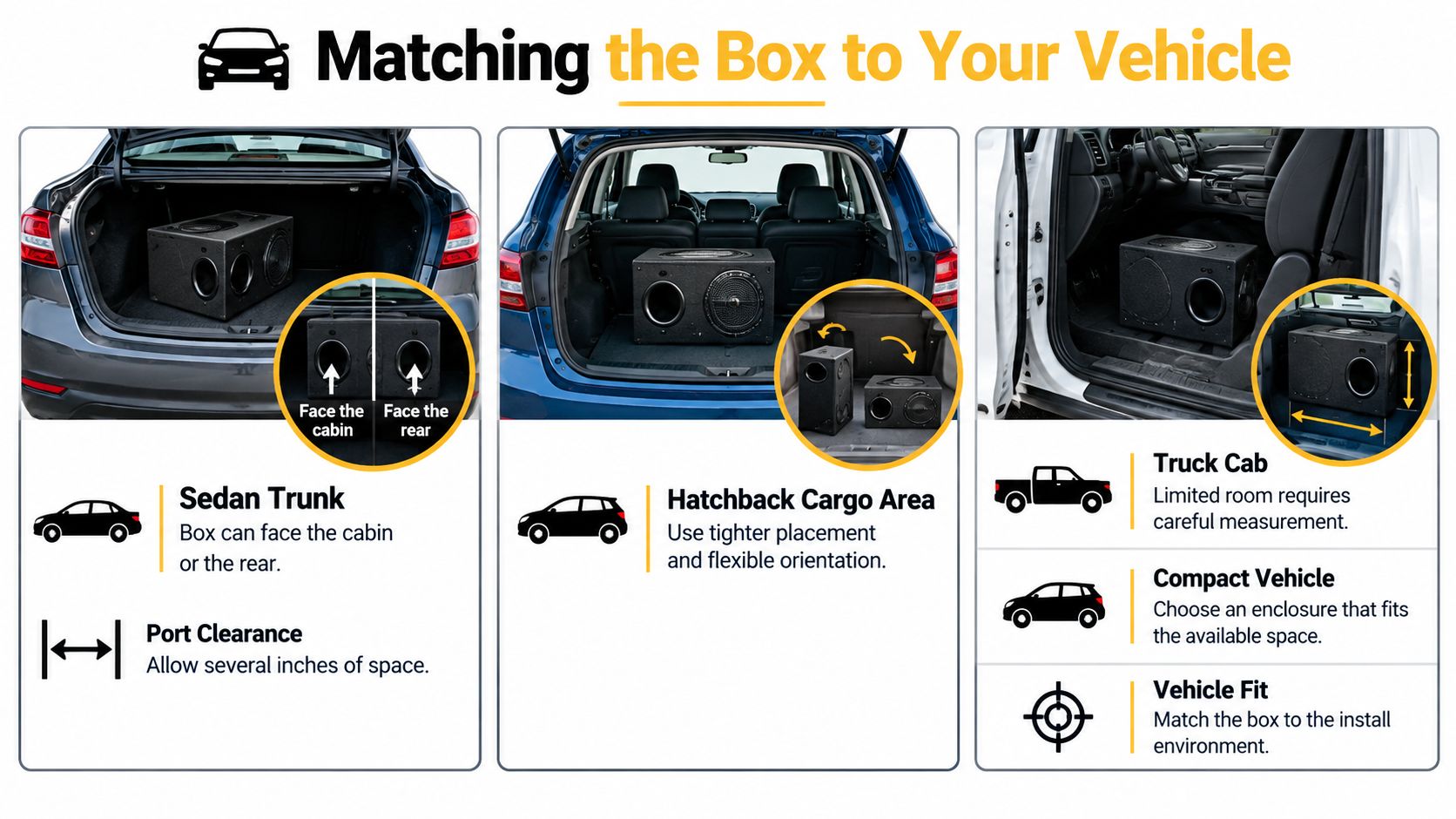
A box that works on paper can still be the wrong choice for your car. Your cabin acts like a second chamber attached to the enclosure, and trunk shape, seat position, and which way the driver faces all change how bass reaches your ears. Measure the actual mounting spot and the open space around the box before you buy.
In a sedan, you may be able to aim the enclosure toward the rear of the trunk or toward the cabin. Either orientation can work, but the results differ, so listen from the driver's seat both ways.
In an SUV or hatchback, the cargo area connects more openly with the cabin. That changes how bass reaches the front seats, and it makes orientation worth testing. A larger ported box also eats into cargo space, so weigh the sound you want against the room you are willing to give up.
A pickup presents a different challenge. Behind-the-seat and under-seat spaces can be too tight for a conventional 12-inch enclosure, even when the driver itself looks small enough to fit. If the cone or port would be blocked, a shallow driver in a compact enclosure is a more practical choice than forcing a 12 into the space.
Let the cabin inform the choice
The vehicle interior reinforces low frequencies, a behavior called cabin gain. Vehicle-cabin measurements can show stronger in-car low-frequency response relative to an anechoic measurement of the same enclosure. That difference is a property of the cabin and the measurement location, so compare the response at your listening position rather than inferring box performance from how a living-room playback sounds.
For some 12-inch drivers, published enclosure guidance lists roughly 0.8 to 1.25 cubic feet sealed and 1.5 to 2.5 cubic feet ported. Treat those figures as a starting point only. The manufacturer's recommended net volume still decides, and the car's shape and the box's position change what you hear in practice.
Before buying, measure the port area, rear-vent clearance, and seatback clearance in the installed position. Then play the same familiar track from the driver's seat with the enclosure facing forward and again facing toward the cabin. A phone microphone gives a rough check, but your ears on a track you know well tell you more.
A larger ported box isn't automatically the upgrade. In a small cabin, a properly modeled sealed enclosure can deliver smoother usable bass while taking less cargo room and avoiding port-placement problems.
Wiring Mounting and Your Next Step
Once the enclosure type and net volume are settled, check how the sub connects to the amplifier and how the box will stay in place. Wiring isn't just about getting sound: the woofer's voice-coil arrangement must create a load the amplifier can handle. If you're unsure, check the amplifier and subwoofer manuals or have an installer verify the wiring before powering the system.
Keep the power and signal wires apart where practical, and put a fuse on the power wire near the battery. Use a terminal cup so the wiring can connect cleanly without getting pinched between the woofer and mounting panel.
Secure the box and test it carefully
The driver should mount to a reinforced baffle, with enough room behind it for the magnet and any rear vent. Make sure the port opening also has space around it. Secure the enclosure so it can't slide forward during a sudden stop. A heavy box that isn't fastened down can become a safety hazard.
Before playing music, check polarity and make sure the gasket seals against the baffle. Listen at a moderate level for air leaks or rattles, then raise the amplifier gain only until the sub reaches clean output. If you hear mechanical noise, don't try to hide it by turning the music up.
For a local install, write down your vehicle's year, make, model, and cab style, along with where the box needs to fit, the amplifier you're using, and whether your goal is clean daily bass or maximum output. Take that note to the Bear showroom or use it while browsing, rather than guessing at a universal box online.
Bring your vehicle details and listening goal to Audio Jam Inc's Bear showroom for help with enclosure fit, custom subwoofer boxes, and car-audio installation. Visit Audio Jam Inc to shop or arrange a local appointment.