

How Much Does It Cost to Install Car Audio in 2026

A basic professional head-unit install typically runs $125 to $220 in labor, while a full custom system can reach $1,500 to $4,000 or more once equipment is included. The actual answer depends on whether you're replacing one component or integrating an entire sound system into a modern vehicle.
You're probably asking because the factory stereo has started cutting out, the speakers sound thin, or you want Apple CarPlay without turning the dashboard into a science project. One shop may quote a few hundred dollars, while another mentions amplifiers, interfaces, fabrication, and tuning that push the estimate well past $1,000.
Both quotes may be reasonable. The difference is usually not the installer trying to inflate the bill. It's the difference between a straightforward receiver replacement and a vehicle-integrated system that requires more parts, more disassembly, and more testing. A fair comparison separates labor, equipment, integration modules, fabrication, and tuning instead of hiding everything under one installation charge.
Table of Contents
- What Drivers Actually Pay to Install Car Audio
- How Install Quotes Are Built Behind the Counter
- Sample Package Price Ranges From Simple to Custom
- What Quietly Drives the Total Higher
- Why the Cheapest Quote Is Not Always the Cheapest Job
- DIY Versus Professional Work and Where Each Path Wins
- Questions to Ask Your Shop and Smart Ways to Save
What Drivers Actually Pay to Install Car Audio
A driver with an older vehicle and a standard dash may need little more than a receiver, a wiring harness, and a dash kit. A driver with a factory amplifier, backup camera, steering-wheel controls, and an integrated touchscreen is buying a different service, even if both jobs are described as “installing a car stereo.”
For a basic head-unit replacement, the professional labor portion generally falls between $125 and $220, based on approximately 1.25 to 2.25 labor hours at a median professional rate of $98 per hour. The same survey found billed rates ranging from $78 to $142 per hour among ASE-certified auto-electric specialists across multiple states. The survey-based car-audio installation cost breakdown explains why labor varies with vehicle access, integration, and equipment complexity.
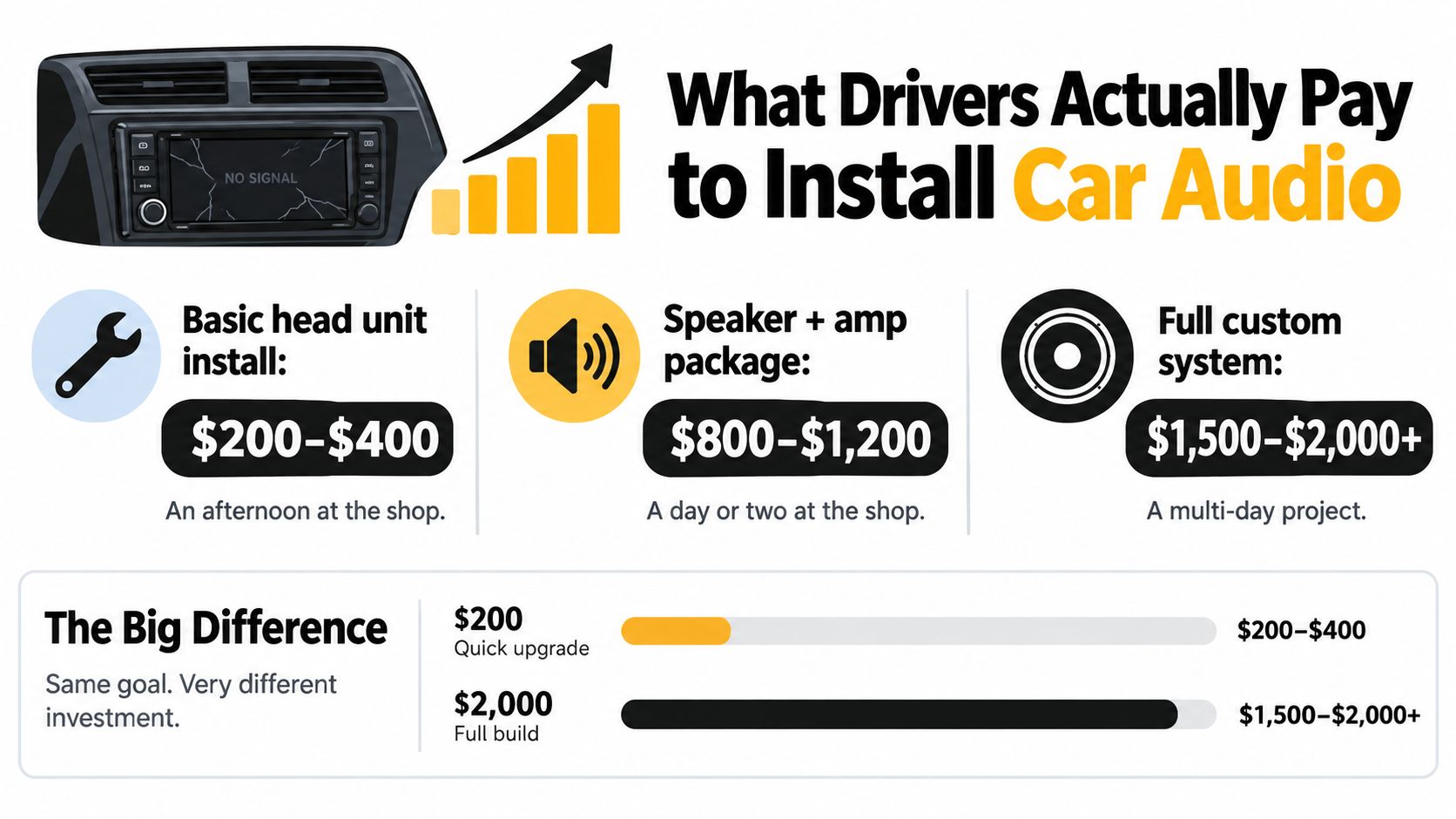
A receiver upgrade may stay near the lower end when the vehicle uses ordinary wiring and a conventional dash opening. It moves higher when the installer must retain the backup camera, steering-wheel controls, factory alerts, or CAN-bus communication. Those functions don't disappear just because the original radio comes out.
The practical price tiers
A complete system with speakers, amplification, a subwoofer, signal processing, power wiring, and acoustic treatment typically requires 6 to 16 labor hours. At the professional rates cited above, that represents approximately $590 to $2,270 in labor before equipment, enclosure materials, and vehicle-specific interfaces, according to this complete car-audio installation cost reference.
Consumer pricing shows the same sharp separation between a small upgrade and a full build. A typical professionally installed head-unit upgrade can total about $500 to $550, while complete systems can exceed $2,500. A subwoofer installation alone averages about $1,000 when equipment and labor are combined, while a simple DIY speaker swap can cost roughly $36 if the owner already has the tools, as outlined in this consumer car-stereo installation cost guide.
Shop-floor rule: Never approve a quote that says only “stereo installation.” Ask what portion covers labor, what portion covers equipment, and which vehicle-specific parts are included.
The rest of the estimate becomes easier to judge once those categories are separated. A receiver, a speaker upgrade, and a custom subwoofer enclosure aren't three versions of the same job. They carry different risks, different preparation, and different testing requirements.
How Install Quotes Are Built Behind the Counter
A good installer doesn't start by guessing a round number. The quote begins with the vehicle, the equipment list, and the functions the owner expects to keep. From there, the shop builds four separate cost buckets.
Labor comes first
Labor covers removing panels, disconnecting the factory equipment, routing wire, securing components, making electrical connections, configuring interfaces, testing every function, and correcting problems before delivery. The shop may quote a fixed job price rather than an open-ended hourly bill because the technician already knows the expected procedure and assumes responsibility for completing the work properly.
The verified labor reference supports a professional range of $78 to $142 per hour, with a median near $98 per hour. A basic receiver typically needs 1.25 to 2.25 hours, while a complete system commonly needs 6 to 16 hours. Those figures reflect the difference between accessing one dash opening and building a system that needs power distribution, signal routing, amplification, subwoofer integration, and tuning.
Integration modules are not optional decoration
Modern vehicles often need a harness or interface to preserve functions that were built into the factory radio. Depending on the vehicle, that can include steering-wheel controls, backup-camera retention, factory amplifier communication, CAN-bus data, chimes, and advanced driver-assistance warnings.
A quote that omits those modules may look cheaper because the shop has priced only the visible hardware. The customer then discovers that the camera doesn't display, the steering-wheel buttons stop responding, or the replacement receiver doesn't wake and shut down correctly with the vehicle.
Fabrication and equipment finish the estimate
Fabrication includes brackets, dash modifications, speaker rings, enclosure construction, amp mounting, wire management, and sound-deadening work. Equipment includes the receiver, speakers, amplifier, digital signal processor, subwoofer, enclosure, wiring kit, and accessories.
| Job Type | Typical Labor Hours | Hourly Rate | Notes |
|---|---|---|---|
| Basic head-unit replacement | 1.25 to 2.25 | $78 to $142 | Labor estimate before optional vehicle-specific parts |
| Factory-integrated upgrade | 3 to 6.5 | $78 to $142 | May include camera, steering-wheel, CAN-bus, and safety-feature integration |
| Complete component system | 6 to 16 | $78 to $142 | Includes the type of work associated with amplification, subwoofer integration, DSP, and acoustic treatment |
The figures in this table come from the professional installation labor reference cited earlier. Read the quote line by line. Two shops may charge similar totals but offer very different equipment, warranty coverage, wiring practices, and retained factory functions.
Sample Package Price Ranges From Simple to Custom
Package pricing works best when it describes the scope of the job rather than promising a particular sound quality. A basic receiver replacement is limited by the dash opening and the vehicle wiring. A full system adds power distribution, signal control, acoustic decisions, mounting, and final calibration.
The lowest-cost path is a personal speaker replacement. Consumer pricing data places a simple DIY speaker swap at roughly $36 when the owner already has the tools and performs the work. That price doesn't include paid labor, troubleshooting, or the cost of correcting a damaged panel or incorrect connection.
A professionally installed receiver upgrade sits in the middle. A typical receiver and related parts cost about $400, with installation labor of approximately $100 to $150, producing a common total near $500 to $550. The final bill can rise when the vehicle needs a camera-retention interface, steering-wheel-control module, factory-amplifier interface, or additional programming.
Compare scope before comparing totals
| Tier | Scope | Installed Price Range | What's Included |
|---|---|---|---|
| Basic DIY replacement | Simple speaker swap | About $36 when the owner supplies tools and labor | Speaker replacement, basic personal labor |
| Professional receiver upgrade | Receiver and related parts | About $500 to $550 commonly | Receiver, ordinary installation labor, related parts |
| Integrated factory upgrade | Receiver with vehicle-function retention | Higher than a basic receiver upgrade | Interface hardware may support cameras, steering-wheel controls, factory amplification, or CAN-bus communication |
| Subwoofer installation | Subwoofer system with equipment and labor | About $1,000 on average | Subwoofer equipment, installation, wiring, and integration |
| Complete custom system | Receiver, speakers, amplifier, subwoofer, and related work | More than $2,500, with full installations commonly reaching $1,500 to $4,000 or more | Components, power wiring, signal processing, integration, enclosure or acoustic work, and tuning |
The consumer figures in this table come from this car-stereo installation price comparison, while the complete-system range is supported by the professional full-system installation reference.
Don't treat the tiers as mandatory steps. Many owners get the best result by improving the weakest part first. If the factory speakers are the problem, replace them before buying a large amplifier. If the factory receiver lacks the features you use every day, solve that problem first, then decide whether the existing speakers deserve more power.
A package should make the system easier to install and support. It shouldn't force you to buy equipment you don't need.
What Quietly Drives the Total Higher
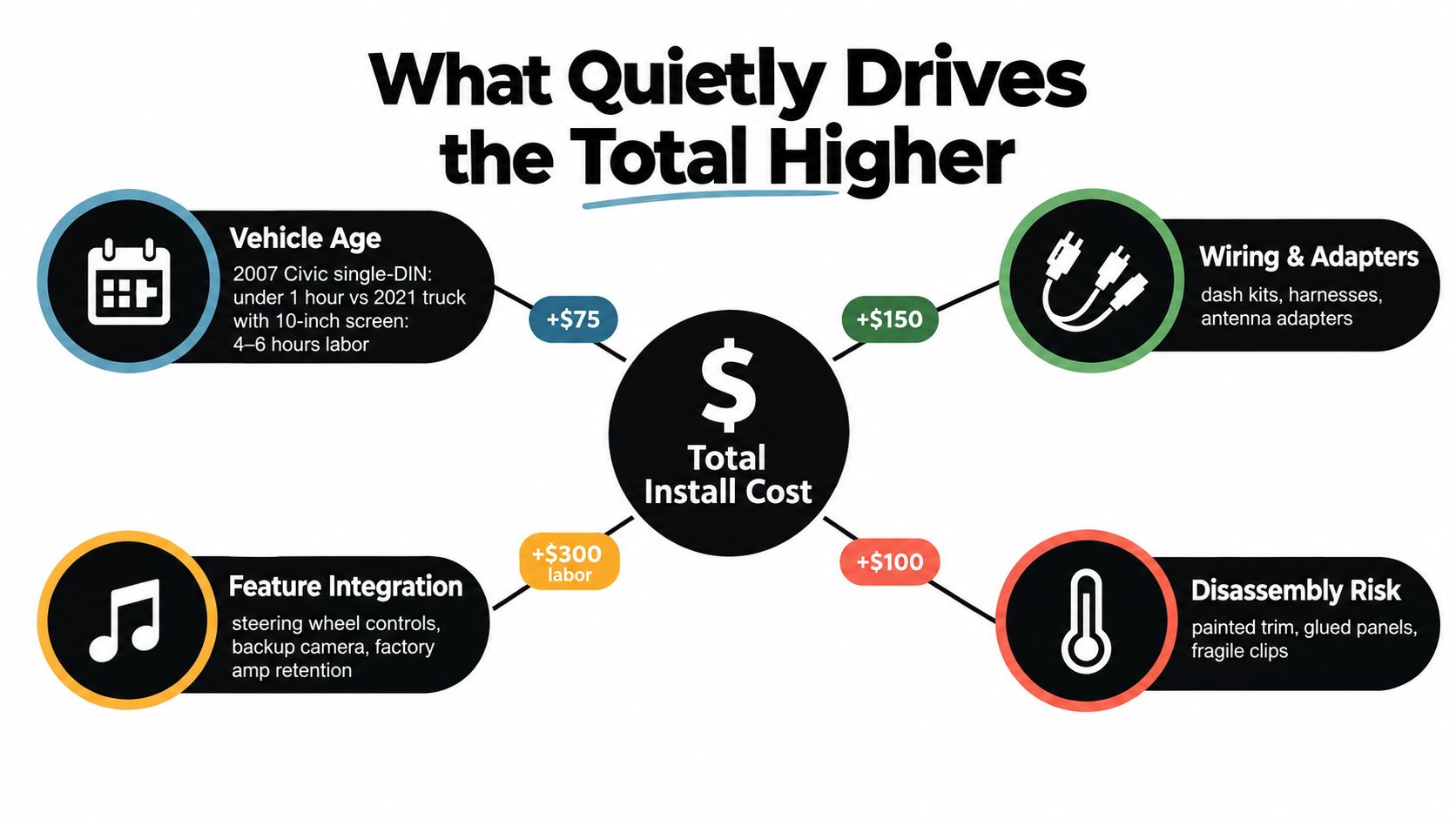
The vehicle itself often decides the labor bill before the installer touches the equipment. A conventional dash opening gives the technician direct access to the receiver and speaker wiring. An integrated dashboard may require careful panel removal, multiple interfaces, programming, and a complete test of factory features after reassembly.
Factory integration is the biggest hidden cost in many late-model vehicles. The replacement receiver may need to communicate with the vehicle through steering-wheel-control interfaces, backup-camera retention, CAN-bus communication, factory-amplifier interfaces, and safety-related warning systems. The verified installation data specifically identifies these requirements as reasons an integrated upgrade costs more than a basic receiver replacement.
The four cost drivers I look for
- Vehicle electronics: A factory amplifier can change how the new receiver sends signal. A direct speaker connection that works in an older car may be the wrong approach in a vehicle with amplified or digitally managed audio.
- Dash and trim access: Fragile clips, painted trim, glued panels, and tightly integrated screens add care and time. The technician has to protect the interior as well as install the equipment.
- Power and signal routing: Amplifiers need safe high-current power from the battery, proper firewall protection, grounding, fuse placement, and clean signal-level adaptation. A neat installation is more than hiding a cable under carpet.
- Subwoofer and DSP work: A subwoofer may need enclosure construction and tuning. A digital signal processor requires crossover setup, equalization, phase alignment, and time alignment so the system sounds balanced from the driver's seat.
A quote should also identify whether sound deadening, enclosure work, amp-rack construction, or electrical upgrades are included. Those services can be valuable, but they shouldn't appear as unexplained additions after the vehicle is already disassembled.
The right question isn't “Why is this install expensive?” Ask, “Which task, part, or retained function accounts for this line?” A shop that can answer clearly is giving you a usable estimate. A shop that gives only one total is making it difficult to compare workmanship and scope.
Why the Cheapest Quote Is Not Always the Cheapest Job
A low quote usually wins by removing something from the scope. Sometimes that means the shop uses fewer integration parts. Sometimes it means the customer supplies the equipment. Sometimes it means the installer has priced the labor for a basic connection while ignoring the factory features the owner expects to retain.
That shortcut becomes expensive when the vehicle loses its backup camera, steering-wheel controls, factory chimes, or proper amplifier output. It can also create battery-drain, error-code, noise, or warranty problems that weren't visible when the vehicle first left the bay.
The market context matters. OEM systems represented 68.32% of car-audio market share in 2025, while aftermarket growth was reportedly supported partly by DIY buyers purchasing plug-and-play kits online, according to the car-audio market data reference. That means many owners are working with factory systems that weren't designed to accept a universal replacement without additional planning.
Compare ownership cost, not just the first invoice
A professional integrated upgrade may cost more at the beginning because it includes the hardware and labor needed to preserve factory functions. The cheaper alternative may leave the owner responsible for troubleshooting, returning incompatible parts, finding a second installer, or living with features that no longer work.
DIY has a legitimate place. Plug-and-play equipment can be sensible for a simple vehicle with standard wiring and no factory amplifier. It becomes a weaker financial decision when the job involves complex infotainment, safety-related interfaces, or a custom multi-component system.
A written warranty also changes the value of a quote. Ask whether the shop stands behind only its labor or also helps diagnose problems involving the supplied components and integration modules. The lowest price is useful only when both bids cover the same result.
DIY Versus Professional Work and Where Each Path Wins
DIY installation makes sense when the job is simple, accessible, and reversible. A speaker swap in a straightforward vehicle can be a good weekend project for someone comfortable removing door panels, identifying polarity, using adapter harnesses, and testing before reassembly.
The risk rises when the vehicle's radio controls more than audio. Factory amplifiers, CAN-bus communication, active noise cancellation, backup cameras, premium sound packages, and integrated displays require more than basic wire matching. Firmware updates, vehicle-specific interfaces, diagnostic tools, and correct signal adaptation can matter as much as the speaker brand.
Choose your path by the vehicle, not your confidence
| Situation | Better choice | Reason |
|---|---|---|
| Simple speaker replacement with ordinary wiring | DIY can work | The job has a limited scope and fewer integration points |
| Factory amplifier or premium audio package | Professional installation | Signal adaptation and amplifier communication need proper diagnosis |
| Integrated touchscreen or safety-related interface | Professional installation | Incorrect connections can disable factory functions |
| Amplifier, subwoofer, DSP, and custom enclosure | Professional installation | Power routing, fabrication, and tuning require specialized procedures |
| You already own compatible equipment | Either, depending on vehicle | A shop may install customer-supplied equipment while charging labor separately |
A staged upgrade is often the smartest budget move. Start with the receiver or front speakers, confirm that the vehicle's factory functions remain intact, and add amplification or a subwoofer later. This approach lets you fund the system in separate decisions instead of buying every component before you know what the first upgrade changed.
Don't buy equipment before confirming compatibility. A receiver that looks perfect online may require additional interfaces, a different dash kit, or a solution for the factory amplifier. A short conversation with an installer before purchasing can prevent an expensive return and a second round of labor.
Questions to Ask Your Shop and Smart Ways to Save
A professional quote should make the work understandable before the technician removes a panel. Ask these questions directly and write down the answers.
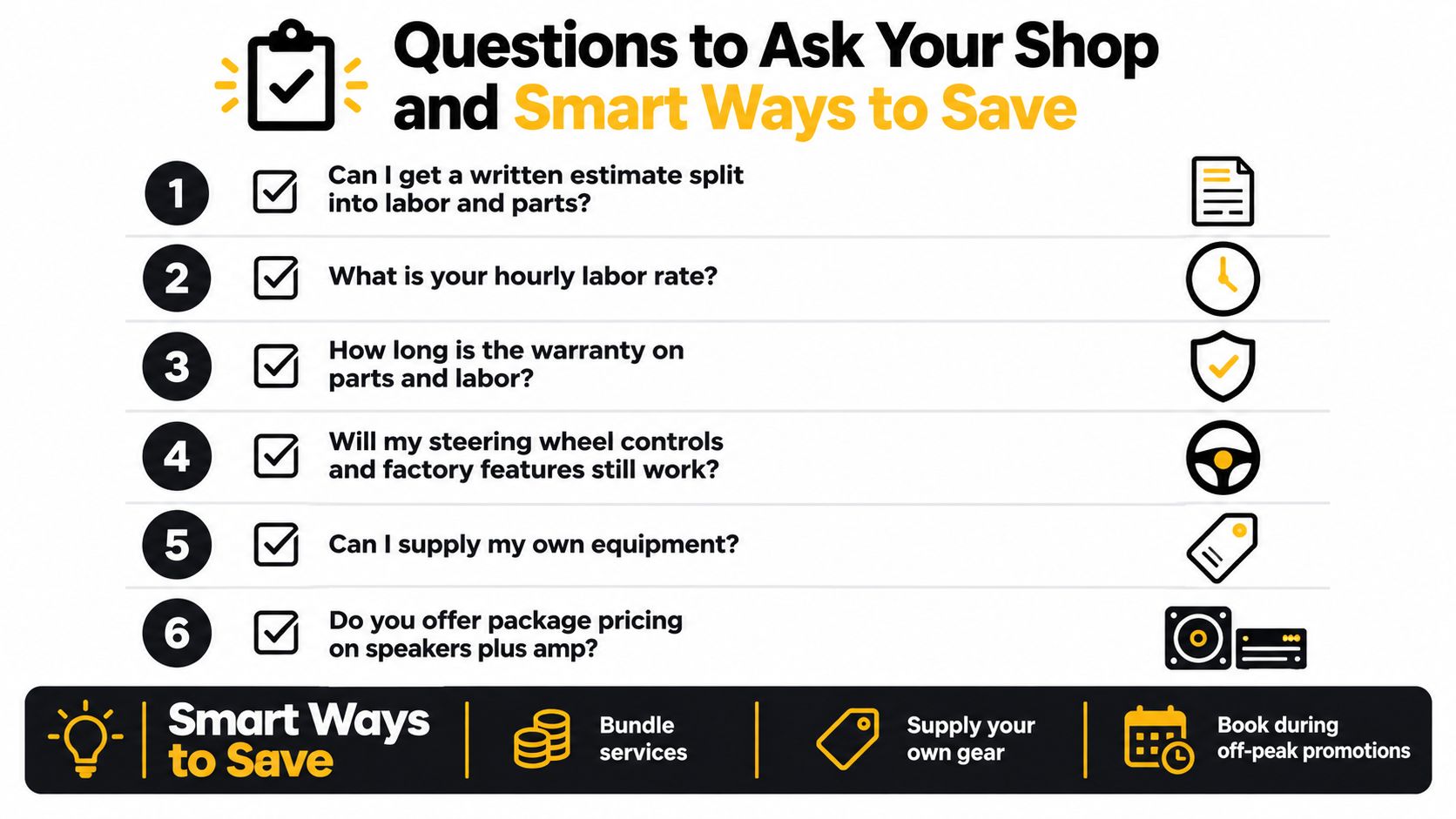
- Can I get a written estimate split between labor and parts? You need to know whether the headline price includes equipment, wiring, installation, programming, and testing.
- What hourly labor rate or fixed labor charge applies? A fixed quote is fine, but the shop should still explain how it calculated the work.
- What warranty covers labor and supplied equipment? Ask what happens if a connection fails, an interface stops communicating, or a supplied component proves defective.
- Which brand and model is included for every component and adapter? “Four-channel amplifier” isn't enough information to compare two estimates.
- Does the quote include the required vehicle-specific integration modules? Confirm coverage for the factory amplifier, steering-wheel controls, backup camera, chimes, and CAN-bus functions when applicable.
- How will retained accessory power be handled? The new system should turn on and shut down correctly with the vehicle rather than creating a battery-drain concern.
- What happens if the installer finds a hidden wiring or trim issue? Agree on how additional work will be approved before the bill changes.
- How long will the vehicle remain in the shop? A basic job and a custom build shouldn't be treated as the same appointment.
Save money without cutting the wrong corner
- Bundle related work: Installing speakers, an amplifier, and a receiver during one visit can avoid repeating trim removal and system testing.
- Supply compatible equipment: If you already own a head unit or speakers, ask whether the shop accepts customer-supplied equipment and what labor warranty applies.
- Reuse factory mounting locations: A standard speaker adapter or existing mounting position costs less than unnecessary custom fabrication.
- Skip nonessential acoustic treatment: Sound deadening has a purpose, but not every panel needs treatment for the system to improve.
- Schedule around the shop's workload: Ask whether slower weeks or package promotions offer a better labor arrangement.
- Consider approved pre-owned or B-stock equipment: Savings make sense only when the component has a clear return policy and compatibility is confirmed.
- Choose a compact enclosure when space matters: A small enclosure such as the Aquatic AV BR-B65A can provide a practical route for a compact subwoofer installation without committing to a large custom box.
Audio Jam Inc in Bear, Delaware, provides itemized quotes for receivers, speakers, amplifiers, subwoofers, vehicle-specific adapters, and related installation work. Visit Audio Jam Inc to request a free estimate, confirm compatibility for your vehicle, and compare a staged upgrade with a complete system before approving the work.