

Vehicle Window Tinting: The Complete 2026 Guide

Most drivers still choose window tint by shade. They ask for the darkest film available, assuming a blacked-out cabin must be a cooler cabin. That advice is wrong. Visible darkness and heat rejection are separate performance measures, and a lighter ceramic film can keep a vehicle cooler than a much darker dyed film because infrared control comes from film chemistry and particle structure, not appearance alone. ClearPro's explanation of infrared rejection and vehicle tint makes that distinction clear.
The same mistake causes legal trouble. A film's label doesn't tell you how the finished window will measure after it's installed over factory glass. For a Delaware driver, the right question isn't “What percentage is this film?” It's “What does the complete glass-and-film combination transmit, and is that combination legal on this specific window?”
Table of Contents
- Rethinking What Makes a Great Window Tint
- Comparing the Five Main Types of Tint Film
- Measuring the Actual Benefits of UV and Heat Rejection
- Navigating Delaware Window Tint Laws and Compliance
- Evaluating DIY Kits Versus Professional Installation
- Maintaining Your Tint for Maximum Longevity
- Trusting Audio Jam for Your Delaware Tinting Needs
Rethinking What Makes a Great Window Tint
VLT, or visible light transmission, measures how much visible light passes through the glass. Lower VLT looks darker, while higher VLT looks lighter. Neither figure shows how effectively a film rejects infrared heat.
A light ceramic film can provide strong heat control without making the cabin look heavily tinted. ClearPro's vehicle tint guidance explains why film chemistry matters more than visual darkness. Ceramic particles target infrared energy, while a dyed film can mainly reduce visible light. The result is a technical mismatch: the darker film may look more effective on the lot, yet the lighter ceramic film can perform better against solar heat.
A dark dyed film can still reduce glare and improve privacy, but its appearance does not guarantee a cooler interior. Seats, the dashboard, steering wheel, and occupants may continue absorbing substantial heat through the glass. Darkness changes the visual experience. Infrared rejection changes the thermal experience.
Practical rule: Set the performance target first. Choose a shade that also fits visibility, privacy, and legal requirements.
Factory glass makes the legal question more specific. The film's printed VLT is not the finished window's VLT, because the film is installed over glass that already filters some light. In Delaware, compliance depends on the complete glass-and-film combination, measured on the actual window. Ask the installer to test that combination before accepting a darker shade.
Front side windows and windshields deserve extra caution. Drivers need clear views of mirrors, pedestrians, intersections, and road hazards, particularly at night or in rain. Adding dark film to solve a heat problem can reduce usable visibility without delivering the cooling result you wanted.
Ceramic film uses nonmetallic ceramic or nano-ceramic particles to manage infrared energy without depending on a dark appearance. A lighter ceramic option can improve cabin comfort, reduce glare, and protect the interior while keeping the glass close to its factory look.
Choose the film for its IR rejection, UV protection, clarity, glare control, durability, and measured legal compliance, not its shade alone. Ask for performance data and a VLT measurement, not only a sample card.
Comparing the Five Main Types of Tint Film
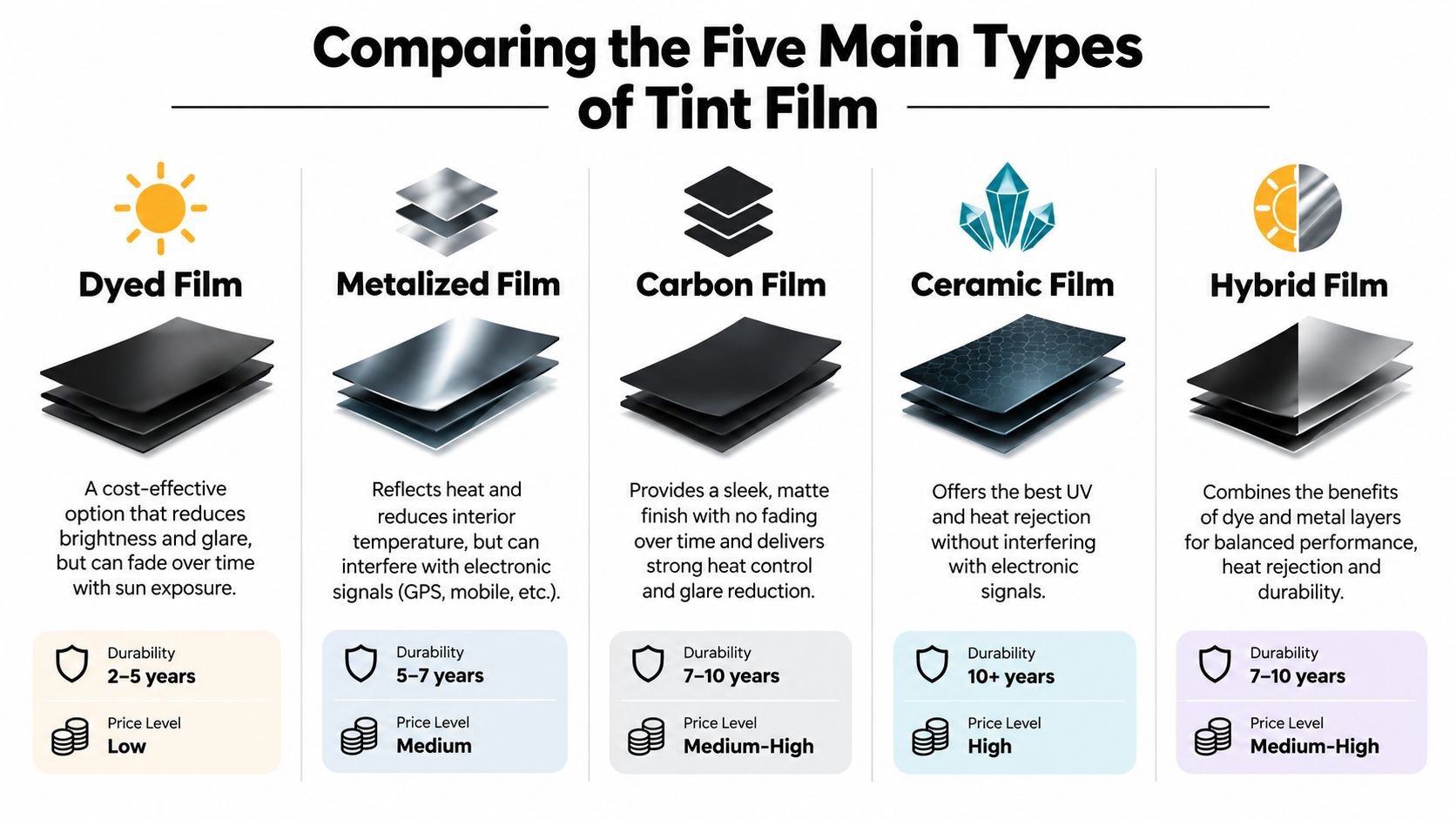
The film category matters more than the color sample on the shop wall. Two films can look similar from outside and perform very differently in heat management, signal compatibility, color stability, and long-term appearance.
Dyed film
Dyed film uses a colorant within the film structure to create its appearance. It's usually the simplest and most budget-conscious option, and it can provide privacy and a noticeable change in appearance without the reflective look associated with some metalized products.
Its weakness is long-term stability. Lower-grade dyed film may lose its original color, develop a purplish cast, or show uneven fading as it ages. It also isn't my first choice for a vehicle that sits outside regularly or for an owner who prioritizes cabin heat control.
Metalized film
Metalized film incorporates fine metallic particles that reflect solar energy. That construction can provide stronger heat management than basic dyed film and may add a distinctive reflective appearance.
The tradeoff is signal compatibility. Metallic content can interfere with GPS, mobile connectivity, radio reception, or toll-transponder performance in some vehicles. That risk matters more in modern cars packed with wireless systems. Ask the installer whether the specific film has been tested for compatibility with your vehicle's electronics before approving the work.
Hybrid film
Hybrid film combines dyed and metalized layers. It aims to balance the subdued appearance of dyed film with some of the reflective and heat-control characteristics of metallic construction.
This middle-ground approach can make sense for an older vehicle or a driver who wants more performance than basic dyed film without moving to ceramic pricing. Still, the exact result depends heavily on the product line. “Hybrid” describes a construction approach, not a guarantee of superior heat rejection.
Carbon film
Carbon film uses carbon-based particles to create a matte appearance and improve resistance to color change. It generally offers stronger heat control than basic dyed film without the obvious metallic shimmer of some metalized products.
Carbon is a sensible choice for drivers who want a clean, nonreflective look and solid everyday performance. It often sits between conventional dyed products and premium ceramic film in both features and price. It can be a good value when maximum infrared rejection isn't the main priority.
Ceramic film
Ceramic film uses nonmetallic particles engineered to reject infrared radiation while preserving clarity and avoiding the signal issues associated with metallic construction. It's the category I recommend when the owner cares about cabin comfort, interior preservation, and long-term performance.
Ceramic doesn't make a dark film safe to see through at night. A dark ceramic film is still dark. Its advantage is that it can provide meaningful heat and UV performance at a lighter VLT, which gives the driver more flexibility.
| Film type | Main strength | Main limitation |
|---|---|---|
| Dyed | Affordable appearance and privacy | Greater risk of fading and weaker heat performance |
| Metalized | Reflective heat management | May affect wireless and radio signals |
| Hybrid | Compromise between dyed and metalized construction | Performance varies by product |
| Carbon | Matte appearance and stable color | Usually below ceramic for premium IR control |
| Ceramic | Strong heat rejection without metallic signal interference | Higher-quality construction requires a larger investment |
Don't buy from a shop that treats all film as interchangeable. Ask what the film is made of, how it handles infrared radiation, whether it can affect signals, and what warranty covers bubbling, peeling, discoloration, and adhesive failure.
Measuring the Actual Benefits of UV and Heat Rejection
A darker window is not automatically a cooler or safer window. Tint delivers value through solar comfort, UV management, glare reduction, and protection for the cabin and occupants, but those results depend on the film's construction, the glass position, and the complete installed assembly. Visual darkness measures appearance. It does not measure infrared rejection or UV control.
The Cancer Council Australia's tinted-window resources report that clear or tinted films on side and rear windows can reduce UV transmission through tempered glass by over 99%. The same guidance references outdoor UV of 3.92 mW/cm² and 0.32 mW/cm² inside front windows with quality tint, a reduction of more than 90%. The practical point is straightforward: a film can provide strong UV protection without looking dark.
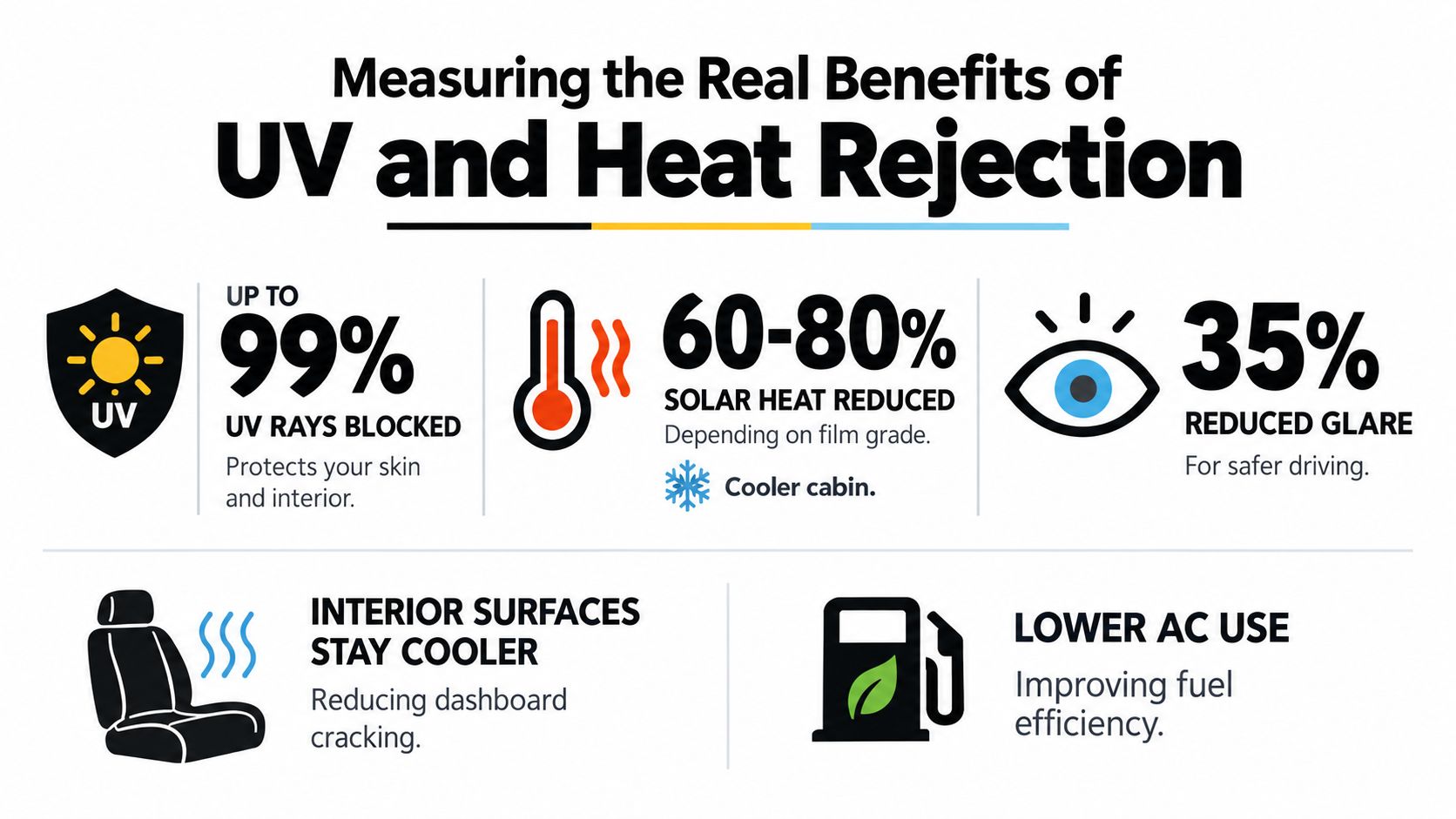
Heat rejection involves a different part of the solar spectrum. Infrared performance matters, but it is not the only factor. The film's visible-light transmission, total solar-energy rejection, glass location, and installation quality all affect cabin comfort. ClearPro's technical overview explains why a high-performing film can reduce heat while preserving more visible light than a darker, lower-performing product.
Factory glass changes both the measured result and the compliance calculation. Privacy glass already contains color or light reduction, so adding film produces a darker final VLT than the film label alone suggests. A light-looking film can therefore measure below the legal limit once installed, while a clear film may still provide UV control and heat performance.
Choose the film by the problem you need to solve:
- For skin protection: Require documented UV performance. Darkness is not the deciding factor.
- For cabin heat: Prioritize infrared rejection and total solar-energy performance, especially for the windshield and front side glass.
- For privacy: Choose the final shade carefully, because darker glass can reduce nighttime visibility.
- For interior preservation: UV control helps protect dashboards, seats, trim, and other surfaces. It does not replace shade, sensible parking, or interior care.
Ask for measured UV, infrared, and total solar-energy specifications. Then have the installer test the finished glass, including the factory glass beneath the film.
Navigating Delaware Window Tint Laws and Compliance
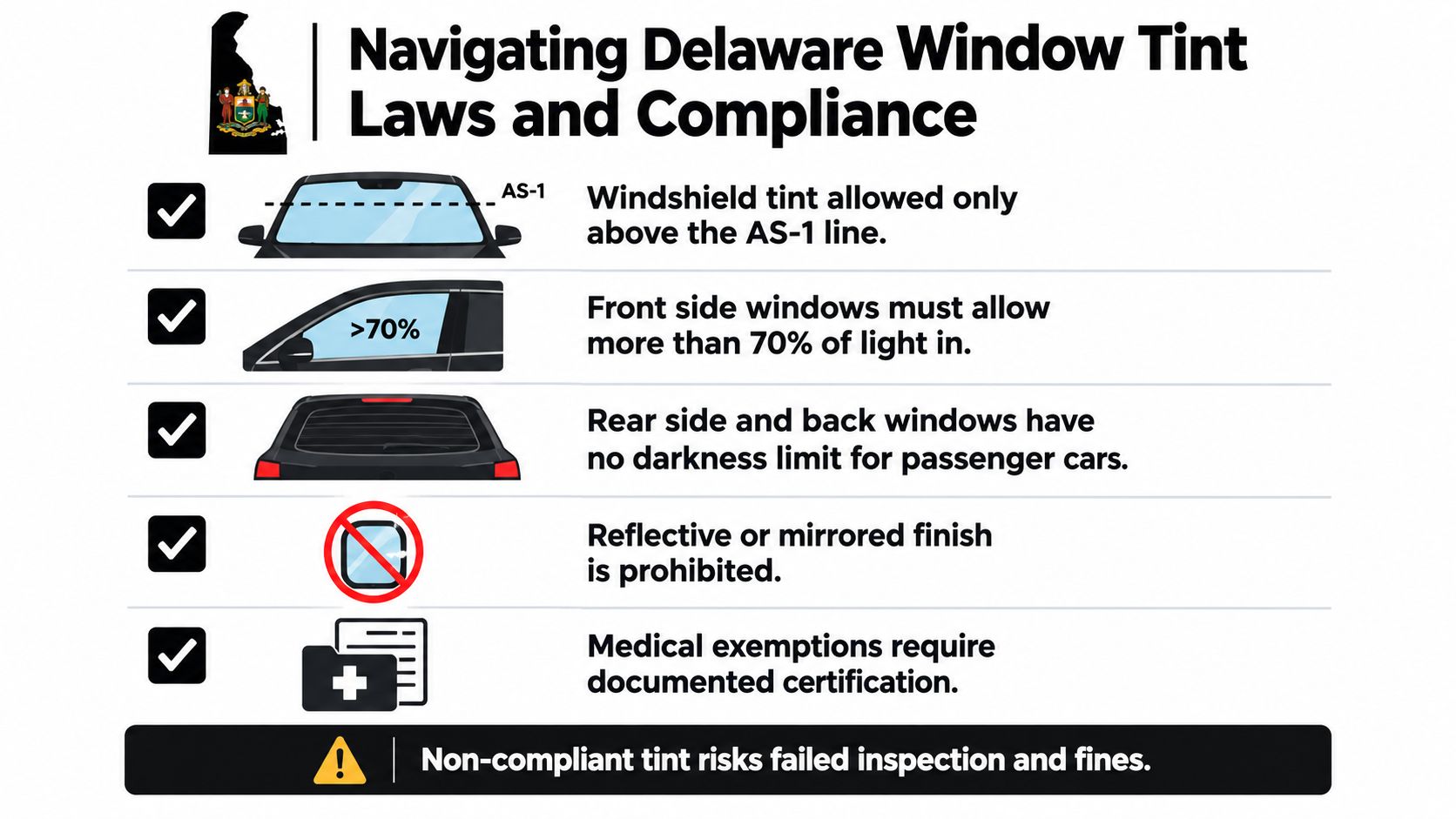
A tint can perform well and still be illegal. Regulations generally focus on visible light transmission, not on how much infrared heat the film rejects. Texas Department of Public Safety window-tint standards illustrates the broader regulatory principle: federal glazing guidance for windows needed for driving visibility specifies at least 70% light transmittance for passenger-car windows, while state rules can establish different limits for particular windows.
Delaware drivers should confirm the current rule for each glass position before installation. Don't rely on a film box, an internet shade chart, or the appearance of another vehicle. Delaware compliance can depend on the window location, vehicle classification, factory glass, aftermarket film, and any applicable exemption.
Why factory glass changes the result
Many vehicles already have privacy glass or slightly tinted OEM glazing. When an installer applies film over that glass, the final VLT becomes the result of both layers. A film advertised at a particular VLT may therefore measure darker once installed.
That's why professional measurement focuses on the combined glazing stack. The installer should measure the untreated glass, identify the proposed film, and test the finished assembly where legal compliance matters most.
Ask for a meter reading on the completed window, not a promise based on the film label.
A light ceramic film can be the smarter choice for front glass because it may improve heat and UV performance without pushing the combined VLT below the applicable requirement. On rear glass, the correct choice still depends on the vehicle and current Delaware rules.
A practical compliance process
- Identify each window position. Windshield, front side, rear side, and back glass may not share the same requirements.
- Measure the factory glass. Existing tint changes the starting point.
- Review the film specification. Confirm VLT and performance data for the exact product.
- Test the finished installation. Use a calibrated tint meter on the combined glass and film.
- Document exemptions. Medical exemptions, where available, require the correct certification and paperwork.
- Check current Delaware guidance. Rules can change, and out-of-state advice may not apply.
Travel creates another problem. A tint that passes in one jurisdiction may not satisfy another jurisdiction's rules, and moving a vehicle across state lines can expose the owner to different enforcement standards. Treat legal compliance as a location-specific requirement, not a permanent property of the film.
Evaluating DIY Kits Versus Professional Installation
DIY tint looks inexpensive until the first piece goes wrong. The film must be cut accurately, the glass must be surgically clean, the adhesive must be handled without contamination, and the edges must finish without lifting. A small piece of dust can create a visible defect that remains trapped under the film.
The rear windshield is especially unforgiving. Its curve, defroster lines, tight interior access, and large surface area make shrinking and positioning difficult for an inexperienced installer. Side windows look simpler, but the lower edge and door panel leave little room for mistakes.
Where DIY installation usually fails
A home installation can work for someone with the right workspace, tools, patience, and experience. Most owners, however, underestimate the preparation.
- Dust contamination: Tiny particles create permanent bumps beneath the film.
- Poor shrinking: Incomplete heat-shrinking leaves fingers, creases, and trapped air.
- Uneven cutting: A rough edge can peel when the window moves.
- Excess moisture: Slip solution can reach door electronics, switches, speakers, or trim.
- Weak surface preparation: Dirt and residue prevent the adhesive from bonding evenly.
- No meaningful remedy: If the film bubbles, peels, or discolors, the owner usually has to buy material and start again.
The hidden cost isn't just wasted film. It's time, frustration, possible trim damage, and the cost of removing a failed installation before a professional can begin.
What a professional installer adds
A reputable shop inspects the glass, checks existing film, cleans the work area, and uses patterns or cutting methods suited to the vehicle. Computer-cut patterns can reduce the risk of scoring the glass or damaging seals, while experienced hands still matter for edge finishing, shrinking, and contamination control.
Professional work also creates accountability. Ask what the warranty covers, how the shop handles existing tint, whether the vehicle will be measured for legal compliance, and what curing instructions you'll receive. A written warranty is more useful when it identifies the film, workmanship, and conditions for coverage.
| Decision factor | DIY kit | Professional installation |
|---|---|---|
| Initial expense | Lower upfront commitment | Higher service cost |
| Fit | Depends on cutting and shaping skill | Vehicle-specific precision is available |
| Work environment | Often exposed to dust and interruptions | Controlled preparation is more likely |
| Legal confidence | Owner must arrange measurement | Shop may test the finished glazing |
| Warranty | Often limited or absent | Film and workmanship coverage may be available |
| Rework | Owner absorbs failed attempts | Installer handles corrections under the service terms |
My recommendation is simple. Use DIY only if you already understand film installation and accept the possibility of rework. For a daily driver, a professional installation usually delivers better long-term value because the finish, fit, legal measurement, and warranty are handled together.
Maintaining Your Tint for Maximum Longevity
New film needs time to bond and dry. Follow the installer's curing instructions, and don't roll down the windows during the specified curing period. Moving the glass too soon can disturb the lower edge, create a gap, or pull the film away from the seal.
Wait until the installer says cleaning is appropriate. Small hazy areas or moisture pockets can appear during curing, but you shouldn't press, scratch, or lift the film to correct them yourself.
Use safe cleaning methods
- Choose an ammonia-free cleaner. Ammonia can attack the film and adhesive over time.
- Use a clean microfiber towel. Grit trapped in a rough cloth can scratch the surface.
- Wash the inside gently. Spray the cleaner onto the towel rather than flooding the door panel.
- Avoid abrasive tools. Scouring pads, blades, and harsh paper products can mark the film.
- Wipe the edges carefully. Repeated aggressive rubbing can weaken an exposed edge.
- Report lifting early. Peeling is easier to address before contamination spreads beneath the film.
Clean the glass when it's cool and out of direct sun. Don't use a hard squeegee or force moisture toward switches, speakers, or electronic controls. If bubbles, discoloration, or edge failure appear after curing, return to the installer instead of attempting a patch.
Good maintenance won't repair poor film or a contaminated installation. It will, however, protect a properly installed film from avoidable scratching, adhesive stress, and chemical damage.
Trusting Audio Jam for Your Delaware Tinting Needs
The installer matters as much as the film. A premium ceramic product installed over dirty glass, cut inaccurately, or applied without checking the factory tint can still produce a disappointing result. Look for a shop that discusses your driving conditions, desired privacy, nighttime visibility, vehicle glass, and Delaware compliance before recommending a shade.
Audio Jam Inc serves Delaware drivers from its Bear location with professional window tinting alongside car audio, remote start, security, dash cam, blind spot detection, and related vehicle accessories. That broader installation experience is useful when tint work must coexist with door speakers, trim panels, cameras, wiring, or other equipment.
A sensible consultation should cover four points:
- Your goal: Heat control, UV protection, privacy, glare reduction, or a balanced combination.
- Your glass: Factory tint and existing film must be measured before the final shade is selected.
- Your film: Ask whether the product is dyed, metalized, hybrid, carbon, or ceramic.
- Your protection: Confirm curing instructions, cleaning requirements, warranty terms, and post-installation measurement.
Don't select a film because another vehicle looks dark at a parking lot. Select it because its construction solves your problem while preserving safe visibility and legal compliance. For most Delaware owners focused on comfort and protection, a quality ceramic film at a carefully measured VLT is the strongest all-around recommendation.
Audio Jam Inc offers professionally installed vehicle window tinting in Bear, Delaware, with film selection and final-glass measurement focused on heat control, UV protection, visibility, and compliance. Visit Audio Jam Inc to review installation options and book a consultation for your vehicle.