

Sub Box Enclosure Guide: Sealed vs Ported vs Bandpass

Most sub box advice starts with the wrong question. “Which box gets louder, sealed or ported?” sounds practical, but it ignores the driver, the vehicle cabin, the usable cargo space, and the way the system will be driven every day. A box that wins on paper can produce weak, boomy, or unreliable bass once it's installed in the wrong vehicle.
A sub box enclosure is an acoustic system, not an empty container. The enclosure controls how the driver moves, how efficiently the amplifier creates bass, and how the vehicle reinforces low frequencies. The right choice comes from matching those pieces, not automatically choosing the largest ported cabinet.
Table of Contents
- Why Bigger and Louder Is Not Always Better
- How Sealed, Ported, and Bandpass Enclosures Work
- Comparing Enclosure Types for Real-World Builds
- Matching Driver Parameters and Cabin Gain to Your Enclosure
- Sizing, Tuning, and DIY Build Considerations
- Vehicle-Specific Enclosure Strategies
- Your Enclosure Decision Checklist
Why Bigger and Louder Is Not Always Better
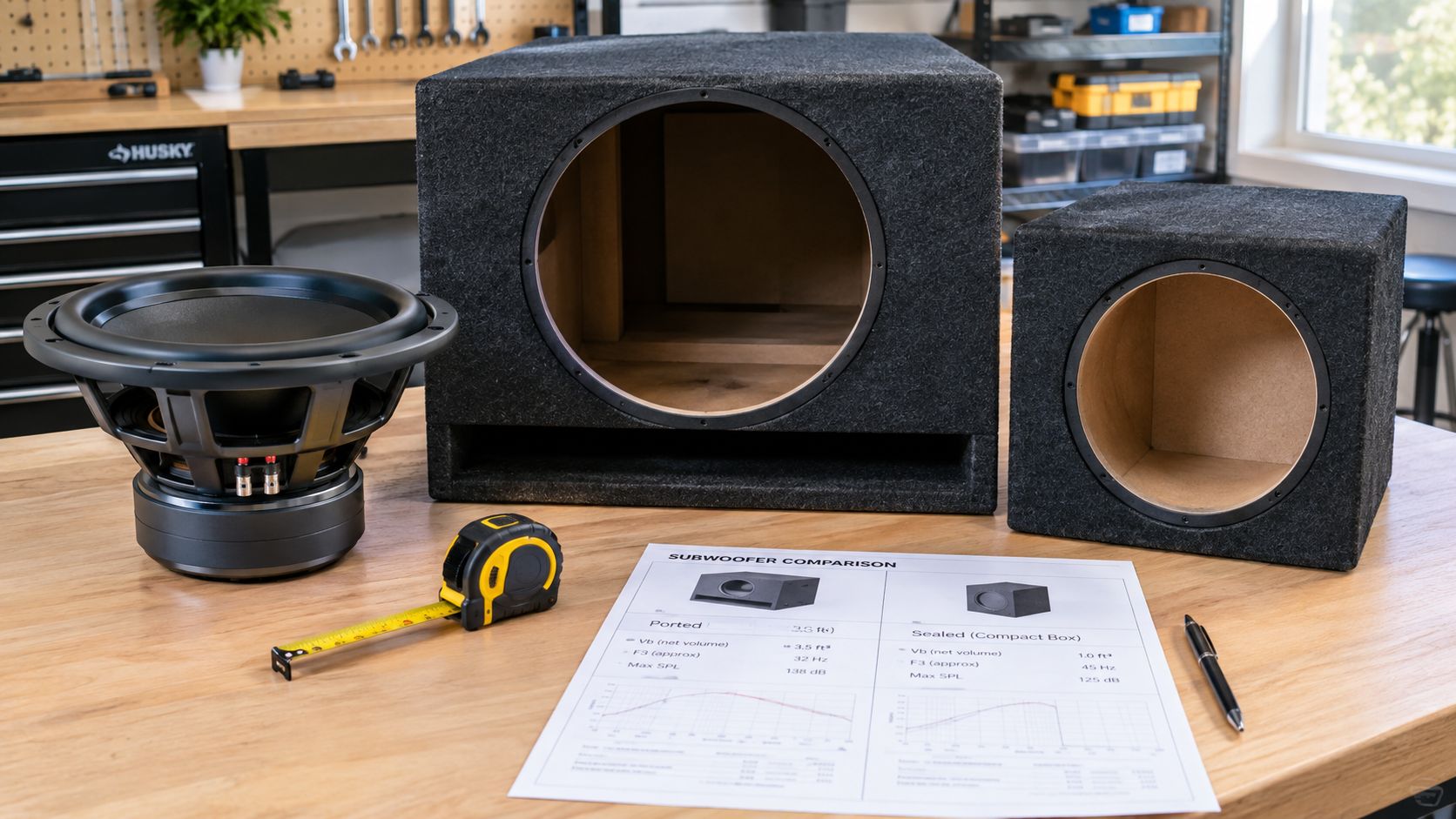
A larger enclosure can create more output in the right conditions, but more output isn't automatically better bass. Ported designs often trade additional cabinet volume for stronger output around their tuning region, while sealed designs usually occupy less space and deliver a more controlled response. That tradeoff matters in a daily driver where the box has to coexist with passengers, groceries, tools, or a folding rear seat.
The better question is simple: what enclosure can be built, tuned, and installed correctly in this vehicle with this driver? Driver parameters, net airspace, cabin gain, amplifier power, and mounting location all affect the result. A theoretically ideal ported design may be impossible under a truck seat or inside a compact hatchback, while a carefully matched sealed box can deliver cleaner and more predictable bass in the available space. Independent enclosure guidance also emphasizes that Qts, EBP, usable volume, and vehicle limitations matter more than a generic sealed-versus-ported preference.
Output has to fit the installation
A ported enclosure can be a strong choice when the vehicle has enough room for the cabinet, port, and required clearance. It makes less sense when the installer has to shrink the port, compromise the internal volume, or force the enclosure against a surface that blocks airflow. Those shortcuts change the design and can erase the benefit the customer expected.
Sealed boxes are often easier to package in compact cars, EVs, trucks, and stealth OEM+ installations. They don't need a port opening or a specific port path, and their response is generally more forgiving when the final volume differs slightly from the target. That doesn't make sealed automatically superior. It makes sealed a practical choice when predictability, compact packaging, and controlled response matter more than peak output.
Practical rule: Choose the enclosure that can be built to the driver's requirements and fitted without compromise. A smaller correct box will usually outperform a larger box that was squeezed into the vehicle incorrectly.
The vehicle itself also changes the decision. A cabin reinforces low frequencies, so a subwoofer that sounds restrained in open air may become powerful inside a car. That means the installer can often design for the cabin rather than chasing maximum output from the enclosure alone. For a customer who wants daily listening instead of competition-level peaks, a balanced system may be louder where it matters, easier to tune, and less intrusive.
How Sealed, Ported, and Bandpass Enclosures Work
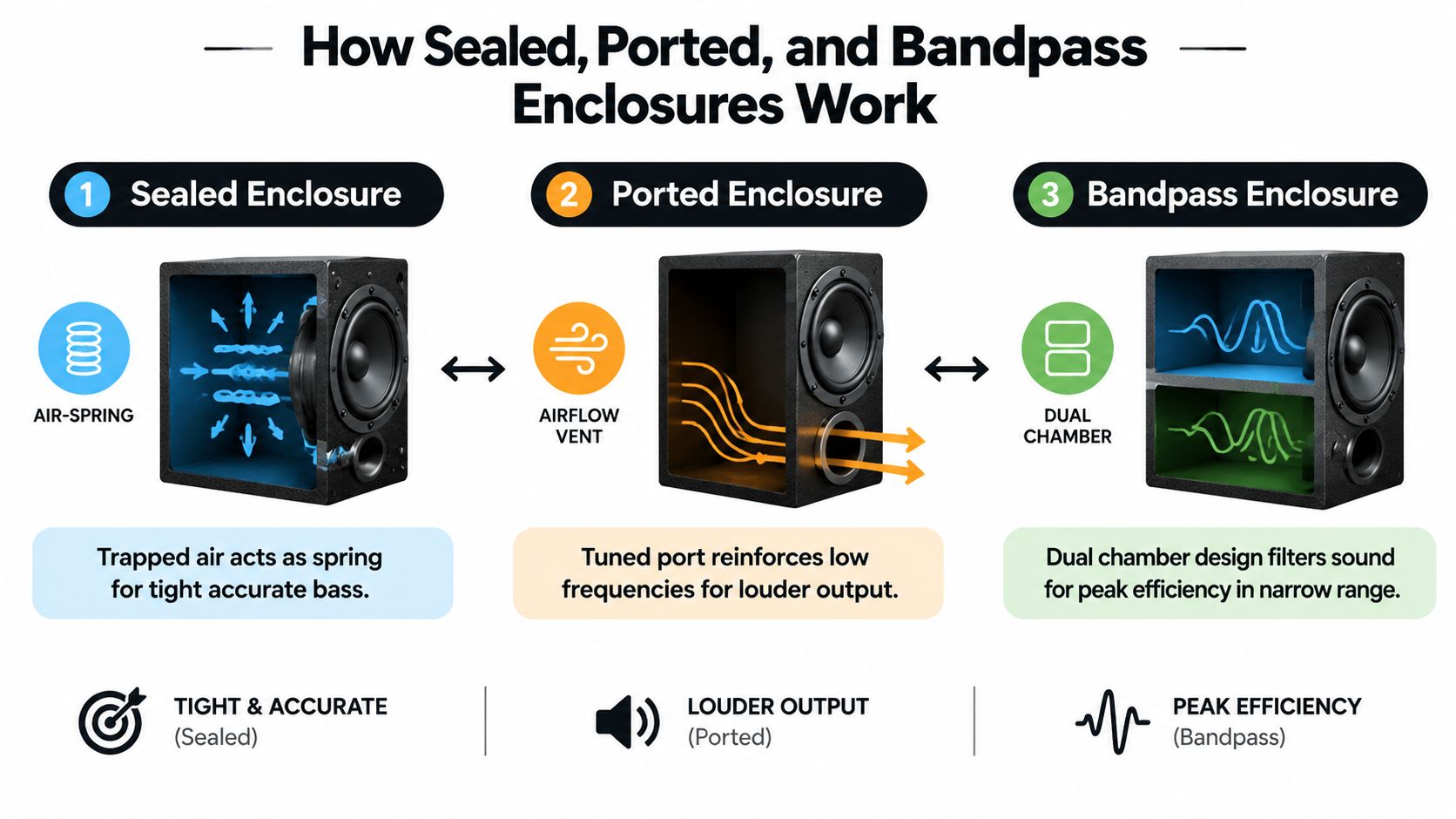
The three common enclosure families use the air around the subwoofer in different ways. Sealed and ported designs are the most common choices for everyday car audio, while bandpass boxes use a more specialized dual-chamber arrangement.
Sealed enclosures use air as a spring
A sealed box is fully closed. As the woofer cone moves, the trapped air compresses and expands behind it. That air acts like a spring, helping control cone movement and shaping the low-frequency response.
A sealed design typically rolls off at 12 dB per octave below resonance, as described in KICKER's enclosure theory reference. In practical terms, its output decreases progressively below the system's resonant region rather than dropping as sharply as a vented design below tuning. Sealed boxes are usually compact, mechanically controlled, and straightforward to integrate with an amplifier and vehicle cabin.
That controlled behavior is useful for daily systems. The box doesn't need a port to be calculated, protected, or positioned, and the driver remains coupled to the air spring even when the signal moves below the enclosure's main operating region. The tradeoff is that a sealed box may give up some efficiency and peak output compared with a properly designed ported enclosure.
Ported enclosures add a tuned air path
A ported box, also called a bass-reflex enclosure, has a vent or port that resonates with the air inside the cabinet. At the tuning frequency, the port contributes acoustic output and reduces some of the work the cone must do on its own. That can produce stronger output around the tuning region and make the system feel more forceful with the same driver and amplifier.
Below tuning, however, the ported system's output typically rolls off at 24 dB per octave, about twice as steep as the sealed alignment. The same KICKER engineering document identifies a theoretical efficiency advantage of about 2.9 dB for vented systems over closed-box systems. The advantage depends on correct driver matching, net volume, port dimensions, and tuning.
A ported box isn't a sealed box with a hole cut into it. Port area, port length, internal volume, wall clearance, and airflow all affect performance. If those details are wrong, the enclosure may sound boomy, produce port noise, or lose control below tuning.
Bandpass boxes filter the usable output
A bandpass enclosure places the subwoofer inside a sealed rear chamber and a ported front chamber. The listener hears the driver through the ported chamber, so the enclosure filters the output into a narrower operating range.
That design can create strong output in its intended band, but it demands careful calculation and installation planning. The driver is hidden inside the cabinet, troubleshooting is less convenient, and the response can become uneven if the chambers or port are poorly designed. Bandpass makes sense when a specific output range and installation layout justify the complexity. It usually isn't the first choice for a flexible daily system.
The video below provides another visual reference for enclosure behavior and construction concepts.
Comparing Enclosure Types for Real-World Builds
Specifications matter, but the enclosure has to survive the vehicle and the customer's habits. A box may sound excellent during a short demonstration and still be a poor daily choice if it occupies needed cargo space, requires delicate tuning, or leaves the driver exposed to excessive excursion below its operating range.
The following comparison keeps the focus on installation outcomes rather than marketing labels.
Sealed vs Ported vs Bandpass Enclosure Comparison
| Criteria | Sealed | Ported | Bandpass |
|---|---|---|---|
| Output character | Controlled and smooth | Strong around tuning | Concentrated in a narrower range |
| Space requirement | Usually smaller | Typically larger | Often bulky and complex |
| Construction difficulty | Straightforward | Requires accurate port design | Highest calculation and construction demands |
| Low-frequency behavior | 12 dB per octave roll-off below resonance, KICKER reference | 24 dB per octave roll-off below tuning, KICKER reference | Depends on both chambers and port |
| Same-driver output potential | Lower peak efficiency than vented | Can produce about 3 to 6 dB more SPL than sealed with the same driver and amplifier, Sparked Innovations guide | Can be very high within its passband |
| Volume tolerance | More forgiving | Less forgiving if net volume or tuning is wrong | Least forgiving |
| Best fit | Compact, stealth, daily systems | Output-focused systems with available space | Specialized builds with a defined target |
Ported boxes also need 30 to 60 percent more internal volume than sealed designs in the comparison provided by Amped Up Car Audio. That additional volume isn't just the airspace behind the driver. The builder must account for port displacement, driver displacement, bracing, and the outer dimensions needed to contain everything.
A sedan with a roomy trunk may accommodate a ported enclosure facing the cabin, especially when the owner values impact and doesn't need the full cargo area. A compact hatchback may benefit from a sealed enclosure that leaves usable floor space and avoids a port becoming blocked by luggage. A truck owner may have no realistic path to a properly sized ported box under the seat, making a compact sealed design or a vehicle-specific enclosure more sensible.
Bandpass can work when the design has a clear purpose, but it creates more opportunities for errors. It shouldn't be selected merely because it looks louder in a product photo. If the system needs broad musical response and easy service access, sealed or ported is usually easier to live with.
Matching Driver Parameters and Cabin Gain to Your Enclosure
The subwoofer's label doesn't tell the whole story. Two drivers with the same diameter can need very different enclosure alignments because their suspension, motor strength, and electrical characteristics differ.
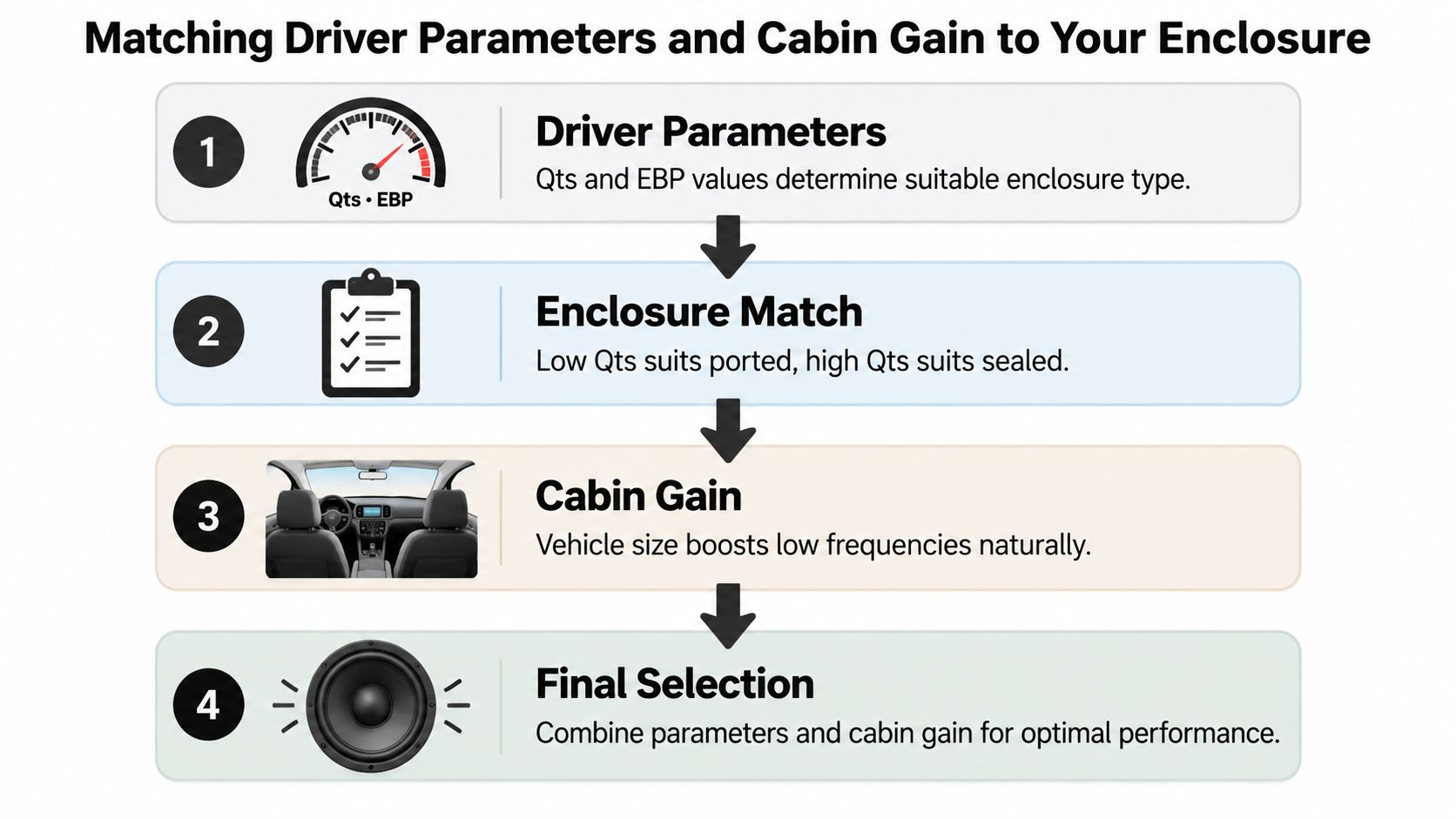
Qts is one of the key parameters used when evaluating enclosure compatibility. Practical guidance commonly places drivers with Qts below 0.4 in the ported-friendly category, while drivers with Qts around 0.4 to 0.7 are often better candidates for sealed alignments, according to Sparked Innovations' enclosure guide. EBP is another useful indicator, but it shouldn't replace the manufacturer's recommended enclosure range or a complete design calculation.
Start with the driver, not the empty space
The driver's specifications should determine the target volume and alignment. If a customer chooses a woofer first and then tries to force it into a pre-existing box, the system may miss the driver's intended performance even if the sub physically fits.
Before building, check:
- Qts and EBP: Use them as screening values for sealed or ported suitability.
- Recommended airspace: Treat the manufacturer's range as a design requirement, not a suggestion.
- Displacement: Subtract the driver, port, and bracing from the gross cabinet volume.
- Vehicle packaging: Confirm that the finished enclosure fits with the required orientation and service clearance.
Available space can overrule the theoretical preference. A ported alignment may suit the driver, but the vehicle may not provide enough depth for the enclosure and port. In that situation, forcing a smaller ported design usually creates a compromise that affects tuning and airflow. A properly sized sealed box may give the customer a more dependable result.
Account for the vehicle's cabin gain
A car cabin reinforces bass differently from open air. One cited car-audio reference describes a 110 cubic foot compartment gaining roughly 7 to 8 dB around 40 to 50 Hz and as much as 20 dB at 20 Hz, as outlined in Sparked Innovations' guide. Those figures show why the vehicle can dramatically change the apparent response.
A sedan, hatchback, truck, and SUV won't produce the same result from the same enclosure. Cabin size, openings between the trunk and passenger area, seat position, and the direction of the woofer all affect how the bass reaches the listening position. The installer should evaluate the enclosure and the cabin together instead of tuning solely from open-air expectations.
The best enclosure is the one whose response complements the vehicle, not the one with the most impressive specification sheet.
Sizing, Tuning, and DIY Build Considerations
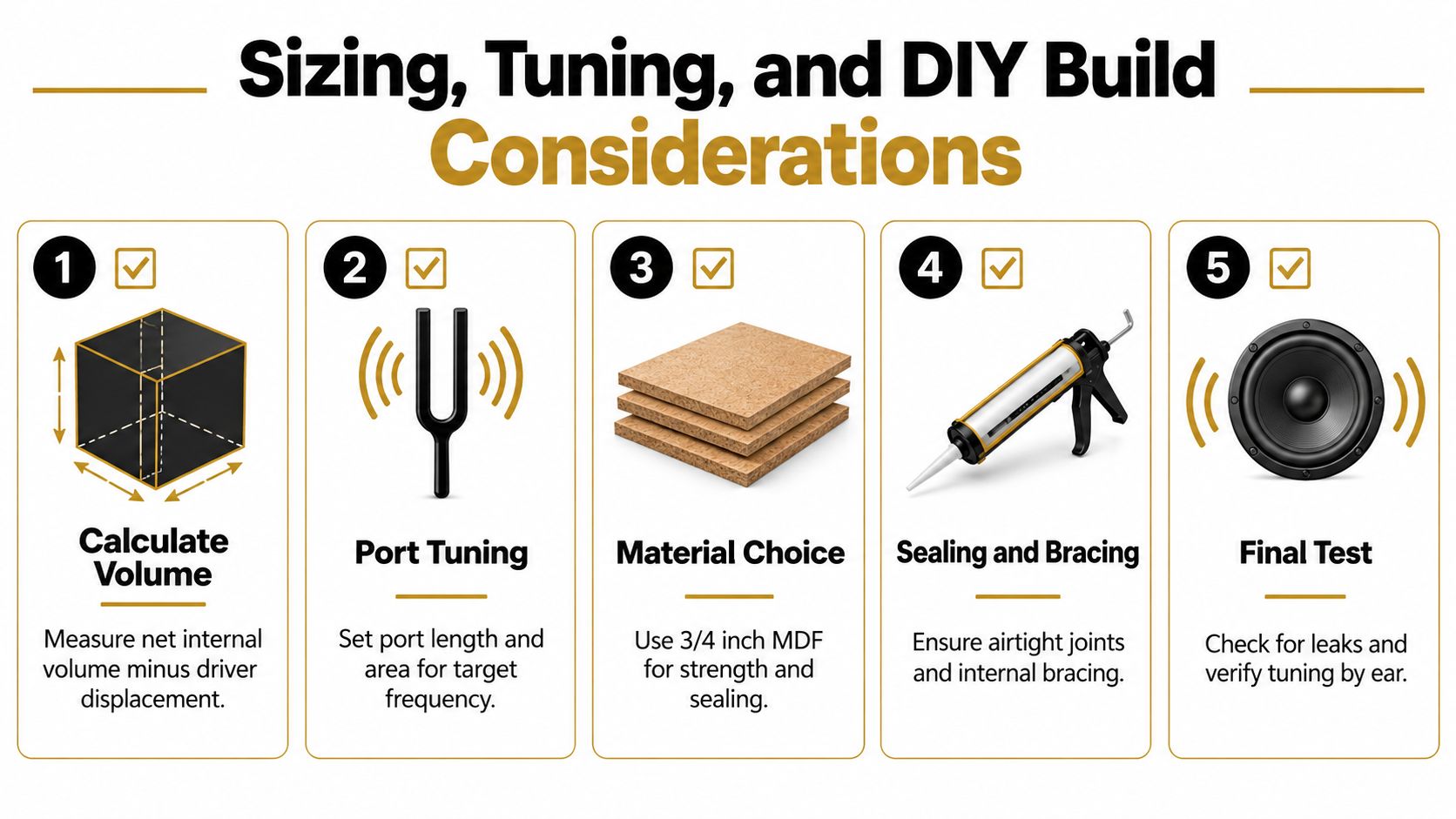
A good enclosure starts with net internal volume. Gross dimensions describe the space inside the assembled cabinet before subtracting anything. The driver, port, bracing, and other internal structures all occupy airspace, so the final usable volume must be calculated after those displacements are removed.
Measure the internal length, width, and height, then subtract the volume taken by the driver and construction elements. For a ported design, the port itself can occupy a substantial part of the cabinet, which is why copying the external dimensions of another box rarely produces the same tuning.
Port design needs room to work
Port tuning depends on port length, port area, and enclosure volume. A port that is too small can create audible turbulence, while a port that is too long may not fit inside the cabinet without bends or a larger enclosure. Keep the port opening clear of walls, carpeting, and cargo so air can move freely.
DIY builders should also avoid treating the box as a simple woodworking project. Panel joints need to be airtight, large panels may need internal bracing, and the finished enclosure must be rigid enough to avoid flexing. A vibrating panel wastes amplifier power and can add unwanted sound.
Construction choices affect reliability
Many installers use 3/4-inch MDF for conventional subwoofer cabinets because it offers a solid, workable panel structure. Seal every internal seam, brace broad panels, and test the enclosure for leaks before final installation. A ported enclosure deserves extra attention because air leaks can alter the intended acoustic behavior.
A pre-fabricated enclosure can make sense when its internal volume, driver opening, and terminal arrangement match the woofer. Vehicle-specific boxes are especially useful when the installation depends on under-seat contours, side panels, or a particular cargo-floor shape. A generic box is a poor choice if it forces the driver against a seat, blocks a port, or cannot be secured safely.
Finally, match the amplifier to the subwoofer's power and impedance requirements, then set gain conservatively. Confirm polarity, listen for distortion, and verify that the enclosure remains secure during normal driving. A box that sounds good but shifts under braking isn't a finished installation.
Vehicle-Specific Enclosure Strategies
Vehicle shape often determines the enclosure before sound preference enters the discussion. The same driver can require a different solution in a truck, sedan, Jeep, or stealth installation because available depth, cabin connection, and cargo priorities change from platform to platform.
Trucks and Jeeps
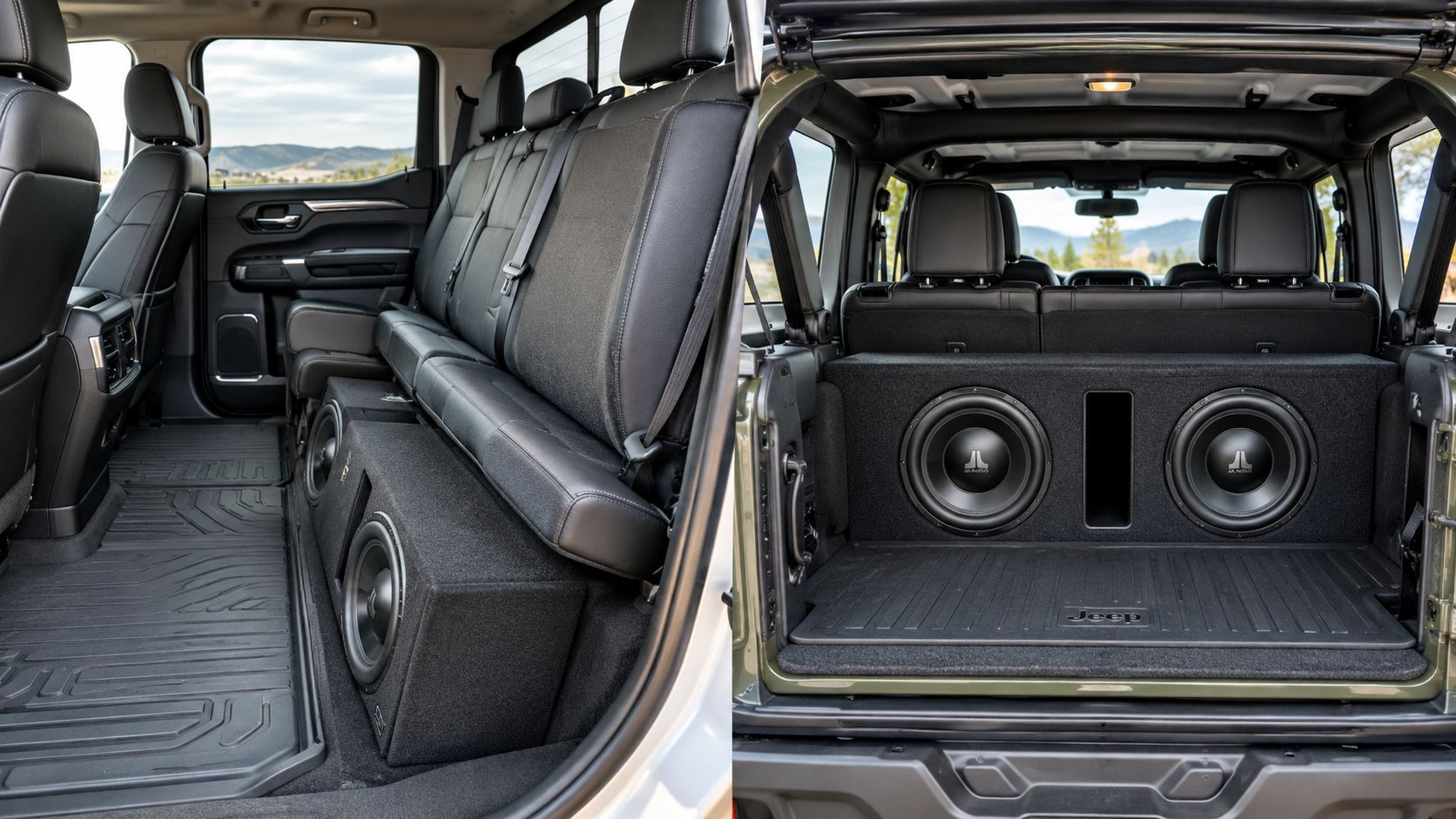
Under-seat and behind-seat installations place strict limits on enclosure height and depth. A shallow sealed enclosure often fits more predictably because it doesn't require a port path that may be blocked by the seat frame or carpet. The builder still has to protect the driver from contact with the seat and leave enough room for wiring and terminals.
Jeeps and other off-road vehicles add vibration, dust, water exposure, and cargo movement. The enclosure should be firmly mounted, seams should be sealed, and the installation should avoid obstructing removable tops, rear access, or recovery equipment. A rugged sealed design may be more practical than a larger ported cabinet that consumes the cargo area.
Sedans and coupes
Trunk installations need a deliberate path into the cabin. The enclosure can be aimed toward the rear, upward, or through a seat opening depending on the vehicle, but the trunk lid, rear deck, and seatback can all affect bass transfer. A ported design may work well when the trunk has enough room and the port can breathe, but a sealed box can simplify placement where the trunk is narrow or irregular.
Coupes often have less practical cargo depth and more limited access around the rear seats. Measure the trunk opening, not just the trunk floor. A cabinet that fits inside the compartment may not pass through the opening during installation.
SUVs and stealth OEM+ builds
SUV owners usually balance bass output against daily cargo use. A side-panel enclosure, false floor, or removable cargo-area box can preserve utility, but each approach requires accurate measurements and secure mounting. The enclosure shouldn't interfere with tie-down points, emergency equipment, or rear-seat movement.
Stealth builds hide the subwoofer behind factory panels or inside a spare-wheel area. These systems reward compact, predictable designs and careful attention to ventilation, rattles, and service access. Audio Jam Inc offers pre-designed enclosed subwoofers and vehicle-oriented installation options alongside custom subwoofer enclosure work, giving shoppers a choice between a ready-made solution and a measured build.
Marine and off-road installations need additional protection from moisture and impact. Use enclosure materials, terminals, fasteners, and finishing methods appropriate for the environment, and don't assume a standard trunk box will tolerate exposure outside the cabin.
Your Enclosure Decision Checklist
Before ordering wood or buying a pre-fabricated box, document the system requirements. A short checklist prevents the most expensive mistakes, especially when the enclosure has to fit a vehicle with limited space.
- Verify the driver parameters. Record Qts, EBP, recommended sealed or ported volume, displacement, impedance, and power requirements.
- Measure the vehicle opening and destination. Check the trunk opening, under-seat height, seat travel, cargo-floor shape, port clearance, and mounting points.
- Choose the alignment based on the complete system. Use sealed for compactness and controlled behavior when it suits the driver. Use ported when the driver, net volume, port design, and vehicle space all support it. Reserve bandpass for a clearly defined application.
- Calculate net volume. Subtract driver, port, and bracing displacement from the gross internal volume. Don't rely on external dimensions alone.
- Set the port design before cutting. Confirm port area, length, opening clearance, and target tuning. A port that doesn't fit shouldn't be reduced casually.
- Plan construction quality. Use rigid panels, airtight seams, internal bracing where needed, and a secure terminal connection.
- Match the amplifier and wiring. Confirm impedance compatibility, power needs, polarity, and safe gain settings.
- Decide between pre-fabricated and custom. Choose a pre-made enclosure when its specifications and dimensions match the driver and vehicle. Choose custom work when packaging, stealth, unusual airspace, or OEM integration controls the project.
- Test the finished installation. Listen for leaks, rattles, port noise, distortion, and movement before calling the system complete.
The right sub box enclosure should produce the bass you want without sacrificing the way you use the vehicle. Audio Jam Inc can measure the available space, match an enclosure to your subwoofer and cabin, and handle a clean installation for cars, trucks, Jeeps, and other vehicle platforms. Visit Audio Jam Inc to shop enclosure options or arrange a professional consultation for a custom system.