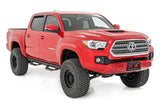


Remote Start Systems: What Every Driver Should Know

A lot of Delaware drivers start looking at remote start systems on the same kind of morning. The windshield is frosted over, the cabin feels like a refrigerator, and the car is sitting out in the driveway while you debate whether to go out early and let it run. If you commute from Bear, Newark, Middletown, or one of the suburban neighborhoods where the car sits outside overnight, remote start sounds simple. Press a button, walk out to a warm vehicle.
But that's only the comfort side of it. In the bay, remote start is never just a comfort gadget. It's part of the vehicle's security system, ignition logic, key authorization, and body electronics. If you understand that first, the rest of the buying decision gets much easier, and you're far less likely to choose the wrong setup.
Table of Contents
- What a Remote Start System Actually Does
- The Main Ways Drivers Activate Remote Start
- Factory Versus Aftermarket Systems
- Range, Battery, and Security Trade-Offs
- Installation Paths and Vehicle-Specific Considerations
- Pairing Remote Start With Other Vehicle Upgrades
- Practical Tips for Delaware Drivers
What a Remote Start System Actually Does
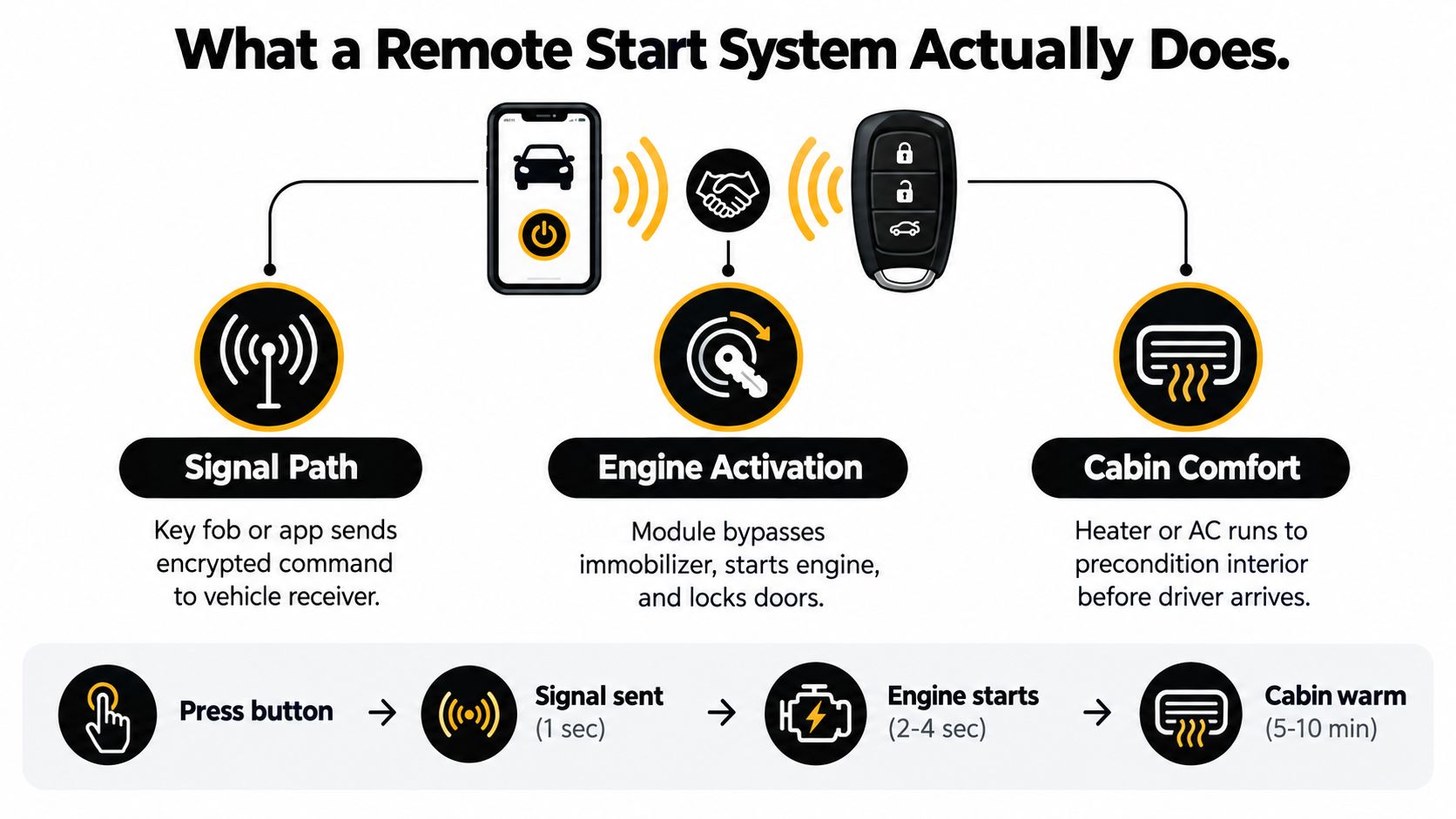
On a cold January morning, the word remote start often brings to mind “starting the car from inside the house.” That is understandable, but it misses the part that matters most. A remote start system is really an electronic permission process. The transmitter, whether that's a factory fob, an aftermarket remote, or a phone app, sends a command. The vehicle then has to decide whether that command is allowed.
A proper system doesn't just crank the engine like someone twisted the key. It checks status, talks to the right modules, and starts the vehicle while keeping the doors locked and the anti-theft behavior intact. That's why remote start is not the same thing as keyless start. Keyless start is the push-button ignition you use when you're already inside the vehicle with an authorized key. Remote start happens before you enter, and it should still require a valid takeover sequence before you can drive away.
The basic handshake
Here's the plain-language version of what happens:
- You send a command from a fob or app.
- The system verifies conditions such as authorized access, vehicle status, and whether the car is in a safe state to start.
- The engine starts and the climate system can run, but the vehicle still isn't in normal driving mode until the correct key is present and the driver completes takeover.
That's why a good installer talks about immobilizers, data communication, brake shutdown, and takeover, not just range.
Practical rule: If a remote start system can start the engine, it has to be designed around the same security logic that prevents unauthorized starting in the first place.
Why modern vehicles changed the job
Remote start isn't new. Its patent history goes back to 1963, when Samuel Fried of Omaha, Nebraska, received the first U.S. patent identified for a remote car starter, and another patent followed in 1971 for Theodore Galvani and Giuseppe Baratelli, showing multiple inventors were developing the concept early on, as summarized in the remote starter patent history overview.
That long history matters because the job has changed. Older vehicles were more mechanical. Modern cars rely on transponder keys, immobilizers, and networked control modules. So when people ask, “Can't you just wire in a starter?” the honest answer is no, not if you want it done correctly. Today's remote start systems have to fit the vehicle's electronic architecture, not fight it.
The Main Ways Drivers Activate Remote Start
Most first-time buyers assume every remote start works the same way. It doesn't. The way you send the start command changes the day-to-day experience more than people expect, especially if you park in a townhouse lot, a long suburban driveway, or a work garage with concrete walls.
Factory key fob activation
This is the cleanest experience when the vehicle already supports it. You usually use the original fob, often with a button sequence rather than a dedicated extra remote. For many drivers, that's appealing because there's nothing extra on the keychain and the system feels native to the vehicle.
The trade-off is that factory systems can be limited by the vehicle's original hardware, app ecosystem, or trim-level restrictions. Sometimes the car already has the capability, but the owner needs activation or a compatible service plan. Other times, the factory fob works fine at home but struggles in a parking structure.
Aftermarket remote fobs
Aftermarket systems usually come in one-way and two-way designs. A one-way remote sends the command and trusts that it worked. A two-way remote sends the command and then reports back with confirmation. That second part is more useful than it sounds, because on a freezing morning you don't want to stare through the window wondering whether the vehicle started.
A good way to think about it is this:
| Activation Method | Typical Range | Confirmation Feedback | Subscription Required |
|---|---|---|---|
| Factory key fob | Short to moderate, depends on OEM design | Usually limited | Usually no, but some connected features may |
| Aftermarket one-way fob | Varies by RF system and surroundings | No start confirmation | No |
| Aftermarket two-way fob | Varies by RF system and surroundings | Yes, status confirmation | No |
| Smartphone app | Depends on network coverage rather than direct RF distance | Usually app-based status feedback | Often yes |
Smartphone app control
Phone control has moved from novelty to common buying question. Market reporting indicates that smartphone-controlled systems represented 38.5% of the remote-start market in 2025, according to remote-start market reporting on smartphone-controlled systems. That makes sense because a phone solves the “my car is too far away for the fob” problem, at least when both the vehicle and the phone have usable connectivity.
The convenience is real, but app-based remote start adds another layer. Your account security now matters too, not just the hardware in the car.
For a Delaware commuter, the choice often comes down to routine. If your car is usually parked right outside your house, a fob may be all you need. If it sits in a hospital lot, an office garage, or an airport deck, app control starts to make more sense.
Factory Versus Aftermarket Systems
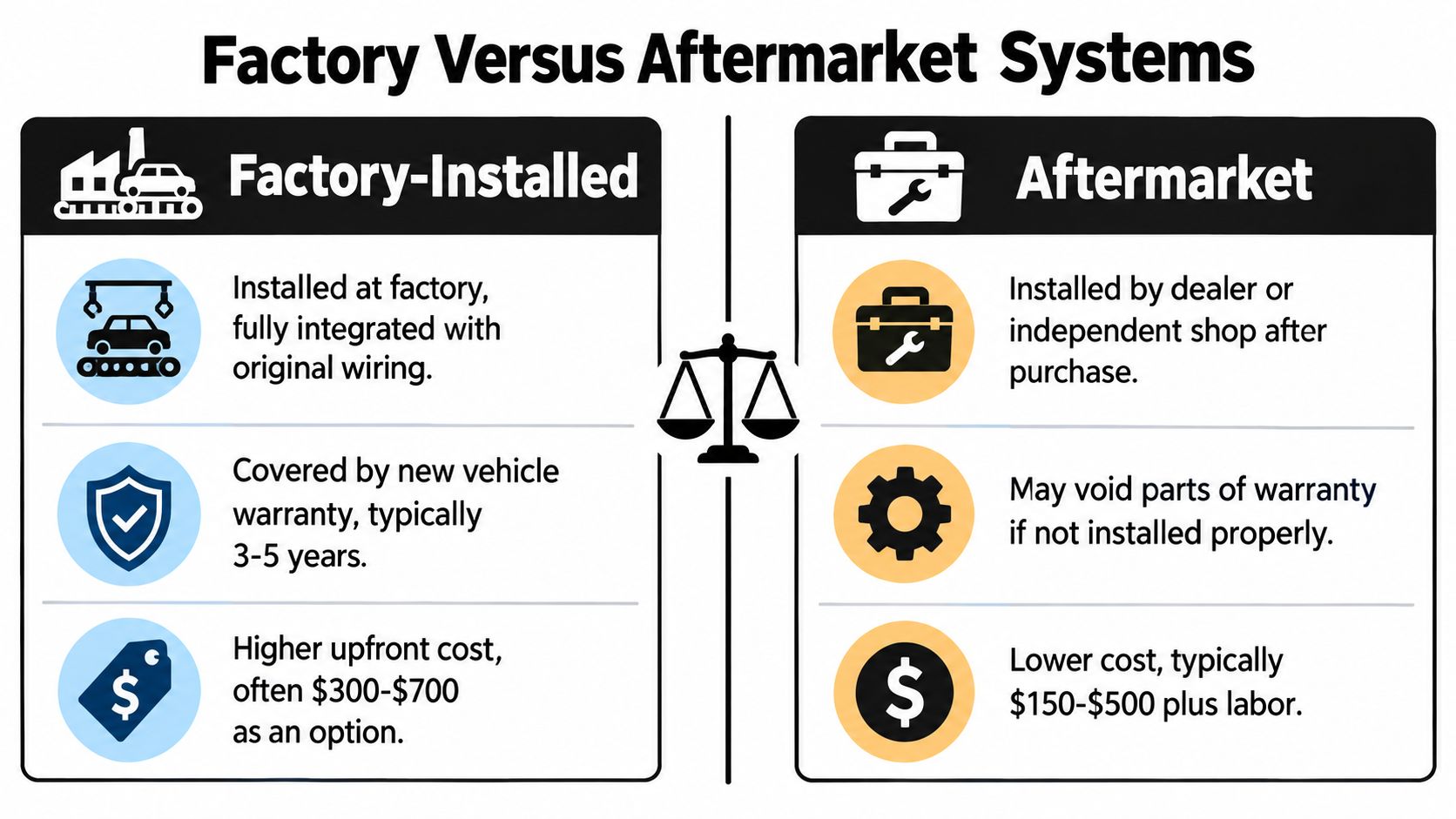
A vehicle parked outside on a cold Bear morning may need more than a comfortable cabin. The remote start system also has to communicate correctly with the vehicle's security and electronics architecture. The first buying choice is whether to use the manufacturer's system or add an aftermarket one. The answer depends on what the vehicle already has, how it secures the ignition, and how you plan to use it.
Remote start has moved from a niche add-on to a common factory feature. Edmunds reporting cited in automotive coverage indicates that remote start appeared on approximately 62% of vehicles sold during the 2008–2018 period, while the feature was described as approaching near-universal availability on new vehicles by the mid-2020s, according to Motor1's coverage citing Edmunds on remote start adoption. As a result, some owners may already have the hardware or software needed for activation.
When factory makes sense
Factory remote start generally offers native integration. The vehicle was designed around its own modules, key strategy, security controls, and user interface. If an SUV already supports remote start through its original fob or an OEM-connected service, activating that capability is often the least invasive option.
It also suits drivers who want the vehicle to operate as the manufacturer designed it. There may be no additional remote, visible add-on hardware, or separate control method to learn. For a newer daily driver, that simplicity can matter more than adding a longer list of features.
When aftermarket is the better fit
Aftermarket systems make sense when factory remote start is unavailable, OEM activation is limited, or the owner wants a different control setup. Options may include a two-way remote, smartphone control, or compatibility for an older model year.
The installation must match the vehicle. Vehicle-specific integration modules allow a properly selected system to communicate with the car's electronics rather than relying on awkward workarounds. That matters on transponder-key vehicles, push-to-start platforms, and models that exchange extensive information over the data bus.
A practical example is iDatalink-based integration on compatible vehicles. Its value is the cleaner communication with existing electronics and the possibility of fewer installation compromises. One local option for vehicle-specific remote start solutions is Audio Jam Inc in Bear, Delaware.
If a shop discusses only “putting a remote starter in” and does not ask about model year, key type, push-button start, or factory security, treat that as a warning sign.
The decision test
Choose factory equipment when the vehicle already supports the features you want and its activation method fits your routine.
Choose aftermarket equipment when you need a retrofit, want different control options, or need a system selected around how and where you park. A suburban driveway, a workplace lot, and a winter parking area can place different demands on the same vehicle. The system should fit the car and the driver's habits, not just the feature list.
Range, Battery, and Security Trade-Offs
The sales conversation around remote start often gets reduced to range. How far can the remote reach? That matters, but it's not the first thing I'd judge a system on. In real use, signal reliability, secure integration, and sensible runtime behavior matter more than a big number on the box.
Range in the real world
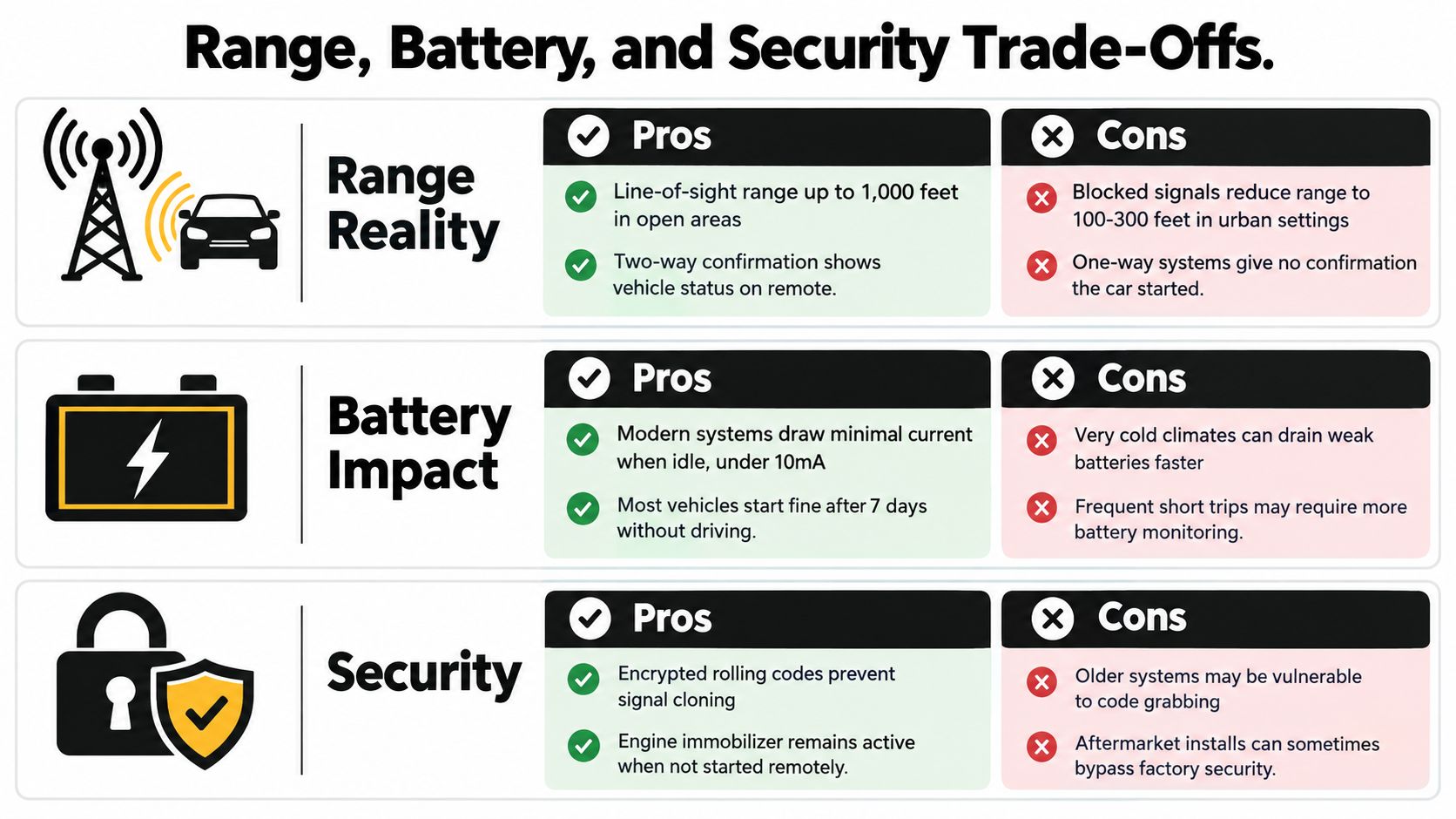
A remote can perform one way in an open lot and another way in a crowded neighborhood, apartment complex, or concrete garage. Walls, metal, nearby vehicles, and building structure all affect what you experience. That's why two-way confirmation is often more useful than chasing headline range. You don't need a heroic claim. You need to know whether your command reached the car.
For suburban Delaware drivers, that usually means asking where the car sits most often. End-of-driveway use is different from office-lot use. A direct-RF remote and a phone-based system solve different problems.
Security is the bigger story
This is the part most comfort-focused guides barely touch. A remote start system sits close to the same security boundary that protects the vehicle from unauthorized use. Academic security testing has shown that weaknesses in key-fob pairing, firmware-update mechanisms, and authentication protocols can allow an attacker to bypass cryptographic protections, pair a modified fob, and start a vehicle remotely, as documented in the academic vehicle security study on remote keyless and start weaknesses.
That doesn't mean every remote start system is unsafe. It means the system has to be selected and installed as part of the immobilizer and authentication architecture, not as a casual accessory.
Look for these protections:
- Factory immobilizer preservation: The remote start should respect the vehicle's original anti-theft logic instead of creating a side door around it.
- Brake and takeover logic: The engine should shut down or deny drive-away if the authorized key state isn't present.
- Secure pairing and updates: Any setup that uses pairing, app access, or firmware should be handled carefully and kept current.
- Limited exposure of programming access: Diagnostic and programming paths shouldn't be left unnecessarily open.
Remote start itself isn't the same as keyless drive authorization. A good system starts the vehicle for preconditioning, then still requires proper authorization before anyone can put it in gear and leave.
Battery and idle habits
A remote start session always has a cost. On a gasoline vehicle, the engine runs while stationary. That uses fuel and puts demand on the electrical system during cold starts. If the battery is already weak, frequent short trips and repeated starts can expose that weakness fast.
That's why longer runtime isn't automatically better. For many drivers, a modest warm-up is enough to clear the glass and take the edge off the cabin. Beyond that, you're often just idling longer without much added benefit.
Installation Paths and Vehicle-Specific Considerations
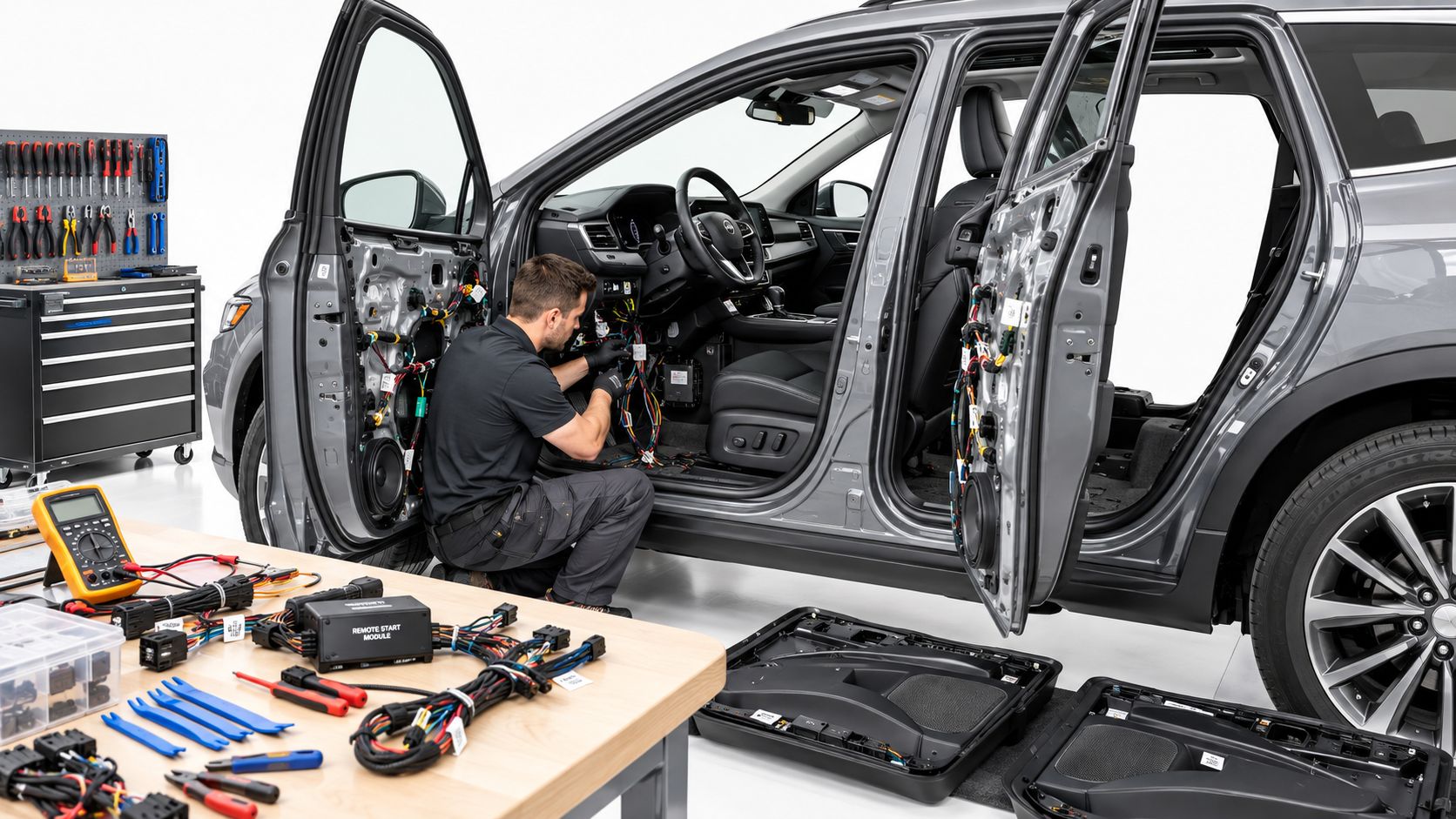
Installation is where clean theory meets real wiring. Two vehicles from the same brand can require very different approaches depending on trim level, key type, push-button ignition, factory alarm behavior, and whether the platform relies heavily on networked modules.
Professional install versus DIY
DIY kits attract people for obvious reasons. They're accessible, and some owners are comfortable with wiring. But remote start on a modern vehicle isn't just about finding ignition wires. It often involves programming, module integration, takeover logic, safety inputs, and vehicle-specific firmware.
A professional installation should include more than “it starts from the remote.” It should also cover:
- Hood-pin safety: The vehicle shouldn't remote-start while someone is working under the hood.
- Brake shutdown behavior: The system needs a clear response when the brake pedal is pressed without proper authorization.
- Door and lock status handling: The vehicle should remain secure during the remote-start cycle.
- Clean integration: Data-bus capable modules can reduce unnecessary cutting and help preserve intended vehicle behavior.
Vehicles that need extra thought
Some vehicles are straightforward. Others are not.
A push-to-start vehicle still needs proper authorization simulation and takeover handling. An older transponder-key car may require a different integration path. A manual transmission vehicle needs special safety logic because the installer has to ensure the car can't start in gear. That's why manual-transmission remote start is a category where shortcuts are unacceptable.
Here's a useful walk-through of the installation mindset in action:
A clean remote start install should feel boring after it's done. No strange warning lights, no odd lock behavior, no hacked-looking wiring, no surprise battery issues.
Hybrids and EVs change the conversation
Electrified vehicles are where many buyers get confused. On a hybrid or EV, the customer may ask for “remote start” when what they really mean is preconditioning. That isn't always the same thing as starting an engine.
A hybrid may have one set of climate and startup behaviors. A battery-electric vehicle may rely on OEM thermal-management logic that an aftermarket starter should not try to imitate in a crude way. On those platforms, the smarter question is often, “How does this vehicle handle cabin heating, battery conditioning, and remote climate scheduling?”
That's why vehicle-specific research before installation matters so much. The best setup is the one that fits the vehicle's actual architecture, not the one with the flashiest box.
Pairing Remote Start With Other Vehicle Upgrades
Remote start systems work better when you think of them as part of a larger electronics plan. In the shop, that's often the difference between a tidy, reliable setup and a car that feels like different gadgets were added one at a time without coordination.
A remote start may share wiring paths, control priorities, or installation labor with other upgrades. If you already plan to add a security alarm, dash cam, blind-spot detection, keyless entry features, or a modern receiver with phone integration, it often makes sense to plan those together instead of treating each one as a separate future problem.
What tends to pair well
Some combinations are especially practical:
- Remote start and security alarm: These systems often overlap in how they monitor doors, ignition status, and authorized access.
- Remote start and smartphone control: If you want one app for lock, entry, and start functions, it's worth planning that from the beginning.
- Remote start and dash cam power management: A good installer can think through standby draw and trigger behavior so the systems don't work against each other.
- Remote start and head unit upgrades: Not because the stereo controls the starter, but because one appointment can address vehicle disassembly, trim handling, and integration planning more efficiently.
Why piecemeal installs can get messy
The problem with one-upgrade-at-a-time thinking is that each new component can force revisiting earlier work. Panels come off again. Wiring gets revisited. Ownership of the system gets blurry when different products were installed by different people at different times.
That doesn't mean every project has to be bundled. It means you should at least map the end goal.
A Jeep owner in Delaware might start by asking for remote start for winter mornings, then realize the same vehicle is also a candidate for alarm integration, off-road lighting controls, and a dash cam. A family SUV owner might pair remote start with blind-spot tech and a CarPlay receiver because comfort, safety, and daily convenience all live in the same dashboard ecosystem.
Good upgrade planning isn't about adding more gear. It's about making sure the vehicle behaves like one coherent system after the work is done.
Practical Tips for Delaware Drivers
Delaware isn't northern Maine, but winter mornings still make remote start systems worthwhile, especially when the car lives outside. Short suburban commutes also change how you should think about runtime. If you're driving only a modest distance to work, school drop-off, or errands, you want the vehicle comfortable and clear, not idling forever before every trip.
A simple buyer checklist
Before approving an install, ask these questions:
- Will this preserve the factory immobilizer logic? If the answer is vague, keep asking.
- How does takeover work? You want a system that requires proper key authorization before driving away.
- What safety inputs are included? Hood-pin and brake shutdown behavior should be part of the discussion.
- Is this vehicle using OEM remote-start capability, a retrofit module, or an app-based interface? Each has different trade-offs.
- For hybrids and EVs, what exactly happens when I trigger it? On electrified vehicles, that question matters more than the label on the box.
Delaware winter use
For gas vehicles, remote start is mostly about defrosting glass and taking the chill out of the cabin. For EVs, the smarter framing is preconditioning. U.S. Department of Energy analysis reports that at 20°F, cabin preconditioning can save up to 20% of battery energy on short, city-like trips, and at 0°F, HVAC demand can contribute to approximately 50% average range loss in battery-electric vehicles, according to the U.S. Department of Energy analysis on cold weather and BEV preconditioning.
For a Delaware EV owner, that means plugged-in preconditioning is usually the smarter goal. For an ICE vehicle, it means setting realistic runtime expectations and making sure the battery is healthy enough for cold-weather use.
What to bring into the showroom
Bring the year, make, model, trim, key type, and whether the car has push-button start. Mention where you park most often and whether you want to use the factory fob, an aftermarket remote, or your phone. If you drive a manual, hybrid, or EV, say that immediately. Those details shape the whole recommendation.
A good remote start system should fit your vehicle and your routine at the same time.
If you want help sorting out factory integration, aftermarket remotes, app control, or vehicle-specific installation questions, Audio Jam Inc offers remote start system sales and installation from its Bear, Delaware location. Bring your vehicle details and how you use the car in winter, and the team can help you compare setups that match the vehicle's electronics and security requirements.