

How Does a Remote Car Starter Work: A Complete Guide

On a frosty Delaware morning, you're still holding your coffee while your car sits outside under a film of ice. You press a button on your key fob, and the engine starts before you step into the cold. The simple action hides a more careful process: the car has to receive your command, confirm it's allowed to act, and check that starting now is safe.
So, how does a remote car starter work? Think of it as a small team inside your vehicle. The remote sends the request, a receiver picks it up, a control module makes the decision, and safety systems help determine whether the engine can start. Following that sequence makes the technology easier to understand, including why a modern installation involves much more than connecting a switch to the starter.
Table of Contents
- Starting Your Car from the Kitchen
- The Core Sequence from Button to Engine
- Key Components Inside the System
- How the Immobilizer and Safety Interlocks Protect You
- Remote Types and Transmission Options
- Real Benefits and Honest Limitations
- Installation, Compatibility, and What to Ask the Shop
Starting Your Car from the Kitchen
You press the start button while looking out the window. The remote sends a coded radio message toward the car, but that message isn't the same as a direct command to turn the engine over. It's more like asking for permission to start: the vehicle's system has to receive and interpret the request, then check whether it can safely carry it out.
Four parts make that possible. The handheld remote sends the command. The receiver listens for it. The control module processes the request and checks the vehicle's status. The safety interlocks provide information about conditions such as the hood, brakes, and transmission.
Those parts work together because the remote starter needs to fit into the car's existing electronics. A modern vehicle may use an immobilizer, which expects an authorized key or electronic credential before it will allow the engine to run. The remote-start system has to respect that security feature, not find a way around it.
A useful everyday analogy is a front desk checking a visitor against a list. The visitor's message gets delivered, but that alone doesn't open the door. The desk verifies the request and checks the rules before letting anyone through. In a vehicle, those rules are safety and security checks, and the control module coordinates them before asking the engine to start.
That's why two installations that look similar from the outside can behave very differently. One may communicate cleanly with the vehicle and respond predictably to the brake or hood switch. Another may have problems because its hardware, wiring, or programming doesn't match the vehicle. The button press is the visible part. The checks underneath the dashboard are what make it work properly.
The Core Sequence from Button to Engine
A remote start begins with a short, digitally encoded radio-frequency message. Most remote keyless systems use radio rather than infrared; common frequencies include 315 MHz in North America and Japan, 433.92 MHz in Europe and many Asian markets, and 868 MHz in parts of Europe, as described in the overview of keyless-entry systems. The exact signal and vehicle integration depend on the system and the car.
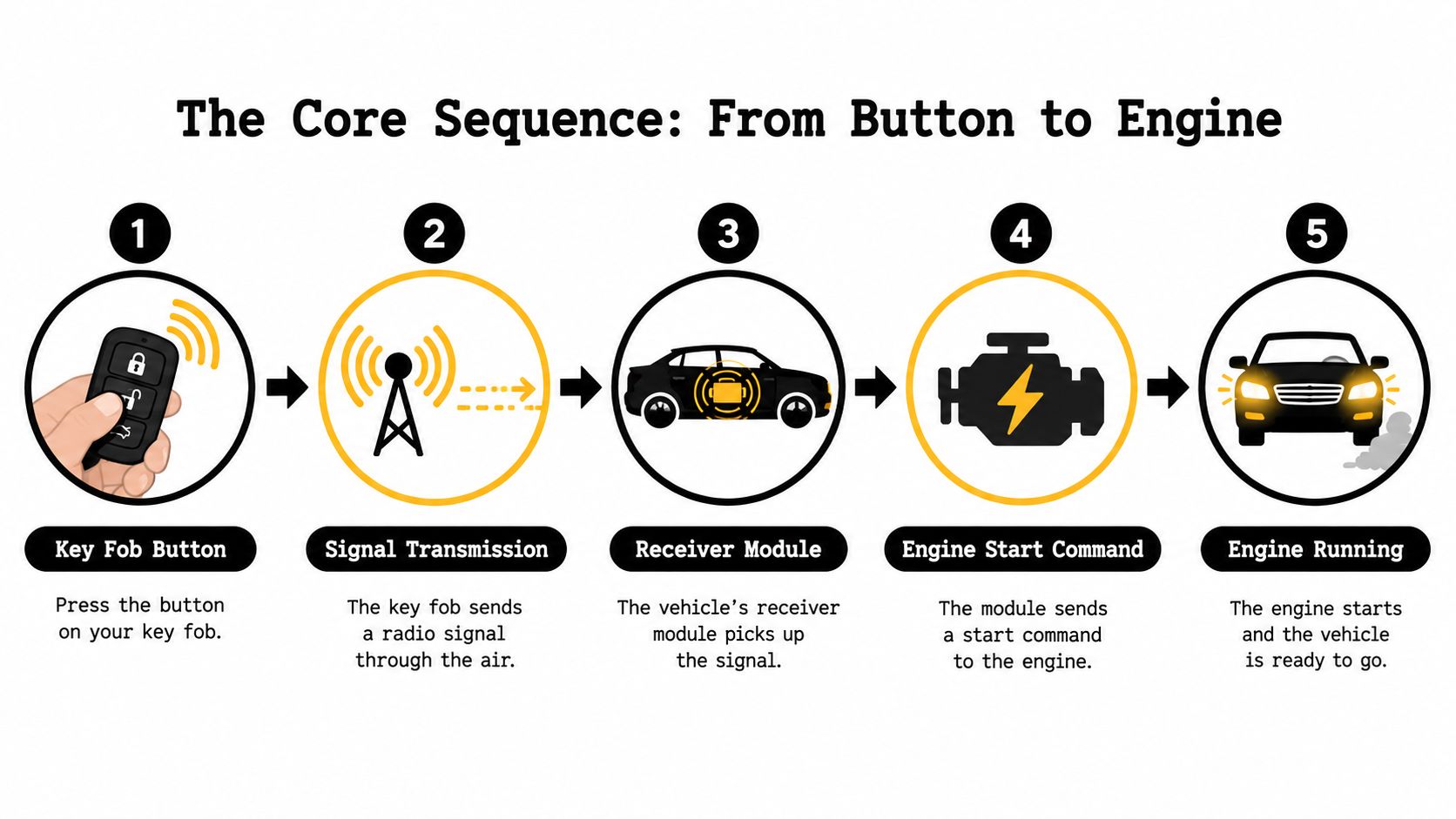
Here's the sequence, from the driver's hand to the engine:
- You press the fob button. The remote creates an encoded start request. It doesn't directly supply power to the starter motor.
- The remote transmits the message. A radio signal travels from the fob toward the vehicle. Distance, obstructions, and antenna setup can affect whether the receiver gets a clear signal.
- The receiver passes the request along. It detects and decodes the message, then sends the command to the control module.
- The control module checks the conditions. It uses inputs from the vehicle to decide whether the start request can proceed. If a required safety condition isn't met, the system should refuse to start.
- The system requests ignition and cranking. Once the checks are satisfied, the controller activates the vehicle's ignition and starter circuits, or communicates the appropriate start request through the vehicle electronics. The engine-management system then handles the engine's operation.
The security-guard analogy fits here: the fob's message is a visitor arriving at the door. The receiver checks that the message is valid, and the controller checks the guest list before allowing the next step. A valid radio signal isn't enough by itself. The system also needs the right vehicle-specific permissions and safe operating conditions.
This is why range alone doesn't tell you whether a system will be dependable. A long-range remote can't compensate for a poorly positioned antenna or incorrect programming. Receiver placement and signal quality matter because the system needs to receive the command clearly before the control module can respond.
For a closer look at the components behind remote-keyless communication, watch this video:
Key Components Inside the System
Once you've followed the command from the fob to the engine, the hardware is easier to picture. The system includes components that send and receive information, make decisions, and connect to vehicle wiring and electronics. Their exact form and placement vary by vehicle and installation.
| Component | Primary function | Typical location |
|---|---|---|
| Remote or transmitter | Sends the start command | Keychain, or a compatible phone app |
| Antenna and receiver | Detects and decodes the radio message | Antenna placed within the vehicle; receiver integrated or mounted nearby |
| Control module | Evaluates the request and manages the start sequence | Installed behind the dashboard or another protected interior panel |
| Bypass or interface module | Helps the system communicate with vehicle security and body electronics | Connected to the vehicle's wiring and data network |
| Wiring harness | Connects system components to vehicle circuits and signals | Routed behind dashboard panels and through vehicle wiring paths |
The remote is the messenger. It gives the vehicle a request, but it doesn't decide whether the engine is allowed to start. A one-way fob sends that request without receiving confirmation. A two-way remote can receive a response from the vehicle, such as an indicator or vibration, so you have feedback that the command was accepted.
The receiver is the listener, while the control module is the decision-maker. Think of the receiver as the person who brings a message to the right desk. The controller then checks the vehicle's inputs and coordinates the next action. Depending on the car, it may need to communicate with electronic control modules through vehicle wiring or data networks rather than use a simple direct connection to each circuit.
Keep in mind: The bypass or interface module is a translator, not a replacement for the car's security system. It helps a compatible remote-start controller request authorization in a way the vehicle can understand.
That distinction matters most when a vehicle has an immobilizer or tightly integrated body electronics. The interface and its programming must match the specific vehicle. Wiring also needs to be routed and connected carefully so the system reads the right inputs and behaves consistently.
Range isn't just a property of the remote. Antenna design and placement, obstructions, receiver location, and system type all play a part. A fob can have a strong signal in open conditions and still perform differently when walls, parked vehicles, or the vehicle's own structure interfere with reception. The practical goal isn't a range number on its own. It's a reliable connection paired with correct vehicle integration.
How the Immobilizer and Safety Interlocks Protect You
A factory immobilizer is one of the main reasons a modern remote-start installation has to be vehicle-specific. The immobilizer prevents the engine from operating unless the vehicle recognizes an authorized transponder or authenticated electronic key. An aftermarket system therefore needs a compatible integration or bypass strategy that preserves the vehicle's security logic, rather than a generic relay intended to make the starter turn. The technical reference on remote-start integration and immobilizers describes this security barrier and the need for an appropriate interface.
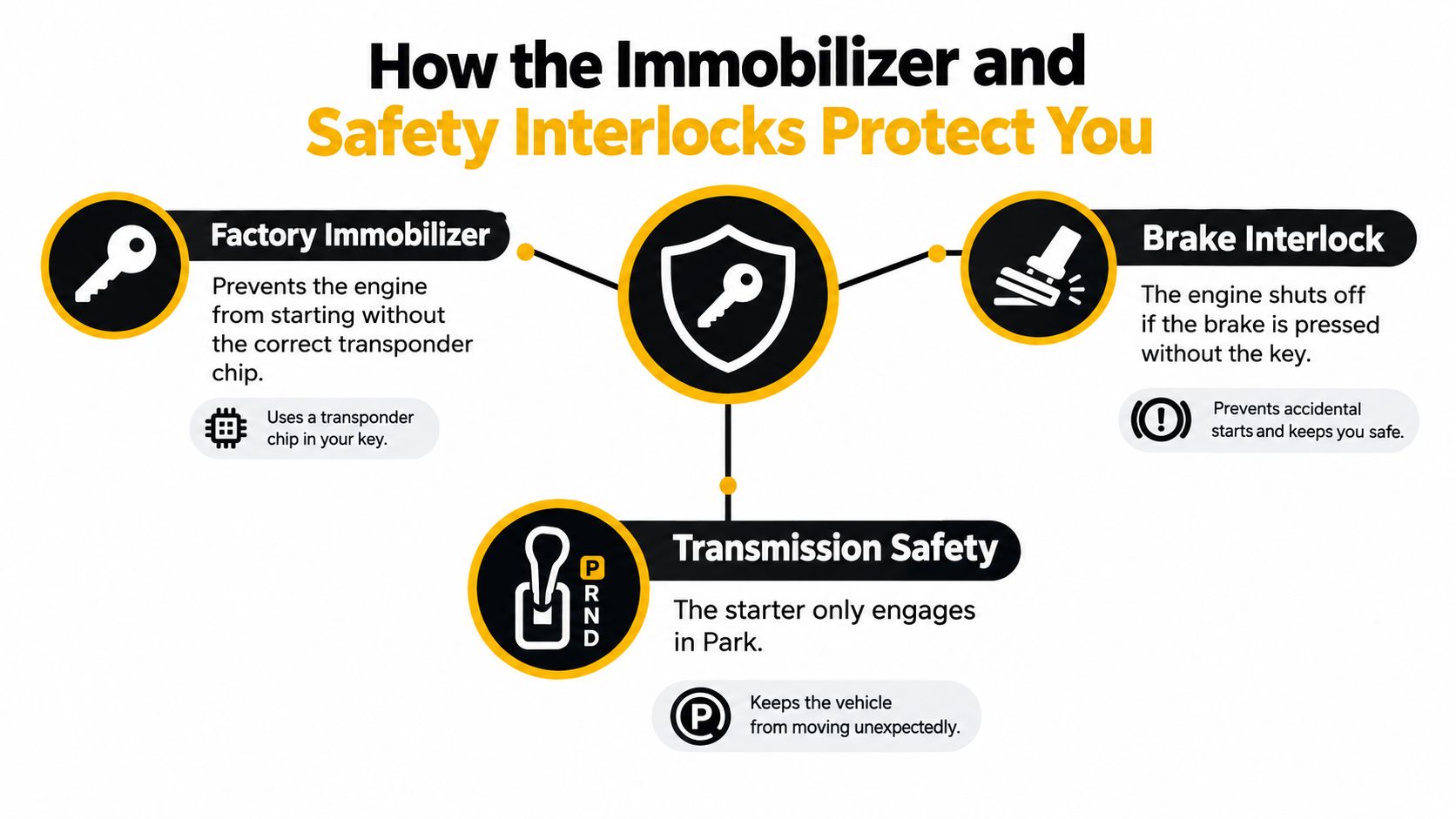
The immobilizer answers a security question: Is the vehicle receiving the authorization it needs to run? The safety interlocks answer a different question: Is it safe for the remote-start system to try? Both matter. A system that can make the engine crank but fails to respect the car's security or safety inputs isn't properly integrated.
Before starting, the controller may check that the transmission is in Park or Neutral, the hood is closed, the brake pedal isn't pressed, and the alarm state permits the request. These checks provide a basic safeguard against starting while the car is being serviced, while someone is trying to take control, or when a required vehicle condition isn't satisfied. The exact inputs and behavior vary by vehicle and system.
The brake check also matters after the engine starts. If someone enters a remotely started vehicle and presses the brake without the authorized key or credential present, a correctly configured system may shut the engine down instead of allowing a drive-away. That behavior helps preserve the handoff from remote operation to normal, authorized driving.
Practical rule: Ask the installer what happens if you press the brake before the vehicle recognizes its authorized key. The answer should describe the actual takeover behavior for your vehicle, not just say that the system is safe.
The hood input is another important interlock. If the hood is open, the system should refuse a remote start, helping prevent the engine from starting while someone is working in the engine compartment. These checks rely on correctly installed and configured inputs; they aren't useful if the system can't reliably tell what the vehicle is doing.
A professional installation treats security and safety as connected, but distinct, parts of the job. The immobilizer authorizes operation, while the interlocks help ensure the vehicle is in an acceptable state before remote cranking begins.
Remote Types and Transmission Options
There are two useful ways to compare remote-start systems: by how they communicate with you and by how they handle the vehicle's transmission. The first affects what feedback you get. The second affects what safety steps the installation and driver need to follow.
One-way remotes send a command without confirming the result. You press the button, but the fob doesn't tell you whether the vehicle received the request or started. A two-way system sends information back, such as a light, vibration, or display message, offering more feedback. That can be handy if you can't see the car from where you're standing.
| Option | What it does | What to consider |
|---|---|---|
| One-way fob | Sends a command to the vehicle | No confirmation comes back to the remote |
| Two-way remote | Sends a command and receives a response | Provides feedback about the vehicle's response |
| Smartphone control | Uses an app to request an operation | Depends on the phone, the app, and the system's communication method |
A phone app can be more convenient than carrying another fob, but it's a different control method, not a guarantee of unlimited or uninterrupted operation. Ask how the system connects to your vehicle and what conditions could prevent the app from completing a request. The same vehicle-side checks still matter regardless of whether the request came from a fob or a phone.
Automatic and manual transmissions
For an automatic, the system needs to verify that the vehicle is in Park or another permitted state. Manual-transmission setups need more than a reminder to leave the shifter in neutral. The car has to establish that the safe condition remains in effect after the driver exits.
A manual-transmission remote starter typically uses a reservation or safety sequence. The driver completes a controlled shutdown, leaves the transmission in neutral, releases the brake, and satisfies the required parking-brake or door-status checks before the system arms. The manual-transmission remote-start safety FAQ describes this type of reservation process.
If the driver doesn't complete the sequence, or if a door opening cancels readiness on that particular system, the vehicle shouldn't be considered armed for remote start. Ask the installer to demonstrate the procedure and explain which actions cancel it. A setup that assumes the car will remain in neutral doesn't solve the actual safety problem.
Real Benefits and Honest Limitations
The everyday appeal is easy to understand. On a cold morning, you can start the car before heading outside. In warm weather, remote start can let the vehicle begin cooling before you get in. It may also help the vehicle's climate system defrost windows, depending on how that system is configured and the conditions outside.
Feedback can be useful, too. A two-way remote may tell you whether the car received your command instead of leaving you to guess from inside the house. Smartphone control may offer another way to request a start if that suits how you use your vehicle. These are comfort and convenience features, not substitutes for checking that the vehicle is safe and ready to drive.
The limits are real. A fob's signal may not reach the vehicle reliably through walls or obstructions, and the receiver's placement and antenna setup can affect performance. Some systems provide no confirmation at all. If you press a one-way remote while the vehicle is out of view, you may not know whether it started until you get closer.
There's also the security question. A remote-start system adds electronic communication and needs to be installed in a way that respects the vehicle's existing protections. The relevant concern isn't that every system is unsafe; it's that security depends on the system's design, programming, and integration. Ask how the system authorizes remote operation and what it does if someone attempts to take over the vehicle without the proper key.
Installation complexity is another limitation, particularly when the vehicle uses an immobilizer or communicates important functions through a data network. A poorly chosen interface or inaccurate programming can lead to unreliable starts or incorrect responses to safety inputs. Manual-transmission vehicles need special attention to the reservation procedure, as explained above.
A well-integrated remote starter can make daily use more comfortable, but it isn't a magic box. Convenience comes from the whole system working together, including the remote, antenna, control module, vehicle interface, and safety inputs.
Installation, Compatibility, and What to Ask the Shop
Compatibility starts with your vehicle, not a general claim about a remote's range. Before choosing a system, have the installer check the vehicle's immobilizer, transmission type, alarm and data-bus requirements, and how the hood and brake inputs will be handled. Those details determine which interface and programming approach fit the car.
Receiver placement and antenna routing matter, but so does the quality of the connection to the vehicle electronics. A technical overview of remote-keyless integration explains how receiver design and vehicle communication are part of the system, beyond the strength of the radio signal alone. A clean installation should account for ignition, immobilizer, alarm, brake, hood, and data connections.
Before authorizing the work, ask:
- Which interface or bypass module is specified for my vehicle, and how does it work with the immobilizer?
- What happens if I press the brake before the authorized key is present?
- How does the system handle my transmission, especially if my vehicle has a manual gearbox?
- Which hood and brake inputs will be connected and tested?
- What support or warranty covers the installation?
Audio Jam's Bear, Delaware showroom offers vehicle installation services, including remote start systems, along with car audio and accessories. Its installers can help you discuss how a remote start would integrate with your particular vehicle before you choose an upgrade.
If you're considering remote start, bring your vehicle details and these questions to Audio Jam Inc in Bear, Delaware. The team offers remote-start installation and can discuss the safety checks, vehicle compatibility, and integration your car needs.