

How Does a Car Alarm Work and Secure Your Vehicle

You press the lock button, walk across the parking lot, and hear a sharp chirp behind you. A moment later, a delivery truck rumbles past, the car rocks slightly, and you wonder whether the alarm will start screaming. Most drivers understand the visible part of the system, the flashing lights and loud siren, but the true work happens silently inside the vehicle.
So, how does a car alarm work? It monitors several electrical and physical conditions, decides whether an event looks harmless or suspicious, and then activates one or more responses. In a well-integrated system, those responses can include a siren, flashing lights, an immobilizer command, a phone notification, and location reporting. The siren gets attention, but the layered system is what makes the vehicle harder to steal and easier to recover.
Table of Contents
- The Evolution of Vehicle Security Systems
- Core Components of a Modern Car Alarm
- How Sensors Detect and Trigger the Alarm
- Solving the False Alarm Problem
- Layered Security and Immobilizer Integration
- Choosing and Maintaining the Right System
- Securing Your Vehicle for the Long Term
The Evolution of Vehicle Security Systems
A car parked outside a home can face several different threats. Someone might pull a door handle, break a window, open the hood, strike the body, or load the vehicle onto a trailer. A basic alarm reacts to one of these events by making noise. A modern security system combines detection with prevention and communication.
That distinction matters because a siren usually deters and alerts, rather than guaranteeing that a thief can't continue. The noise may attract a neighbor, interrupt an opportunistic break-in, or give the owner time to respond. An immobilizer, by contrast, addresses the next question: even if someone gets inside, can the engine start and the vehicle drive away?
The risk remains substantial. More than 1.02 million vehicles were stolen in the United States in 2023, and thefts rose 8.3% year over year, according to reporting linked to the National Insurance Crime Bureau and summarized by this history of car security systems. Those figures help explain why manufacturers and aftermarket installers still treat alarms as useful, even though many vehicles now include electronic keys and factory immobilizers.
From noise to electronic verification
The earliest widely cited milestone dates to 1919, when St. George Evans and Edward Birkenbeuel patented an electric anti-theft system. It used a 3×3 grid of double-contact switches. The ignition routed battery or magneto current through that network, and the wrong switch sequence could immobilize the vehicle while sounding the horn, as described in the history of immobilizer technology.
The important idea wasn't the horn by itself. The system checked whether an authorized electrical state existed before allowing the ignition circuit to proceed. Modern systems use much more advanced electronics, but they still follow that basic principle.
A vehicle security setup therefore has two jobs. First, it should make unauthorized access obvious. Second, it should create an obstacle between unauthorized access and a successful drive-away. Connected features add another layer by notifying the owner and supporting recovery after movement is detected.
Practical rule: Treat the alarm as the vehicle's first warning layer, not as the entire theft strategy.
Core Components of a Modern Car Alarm
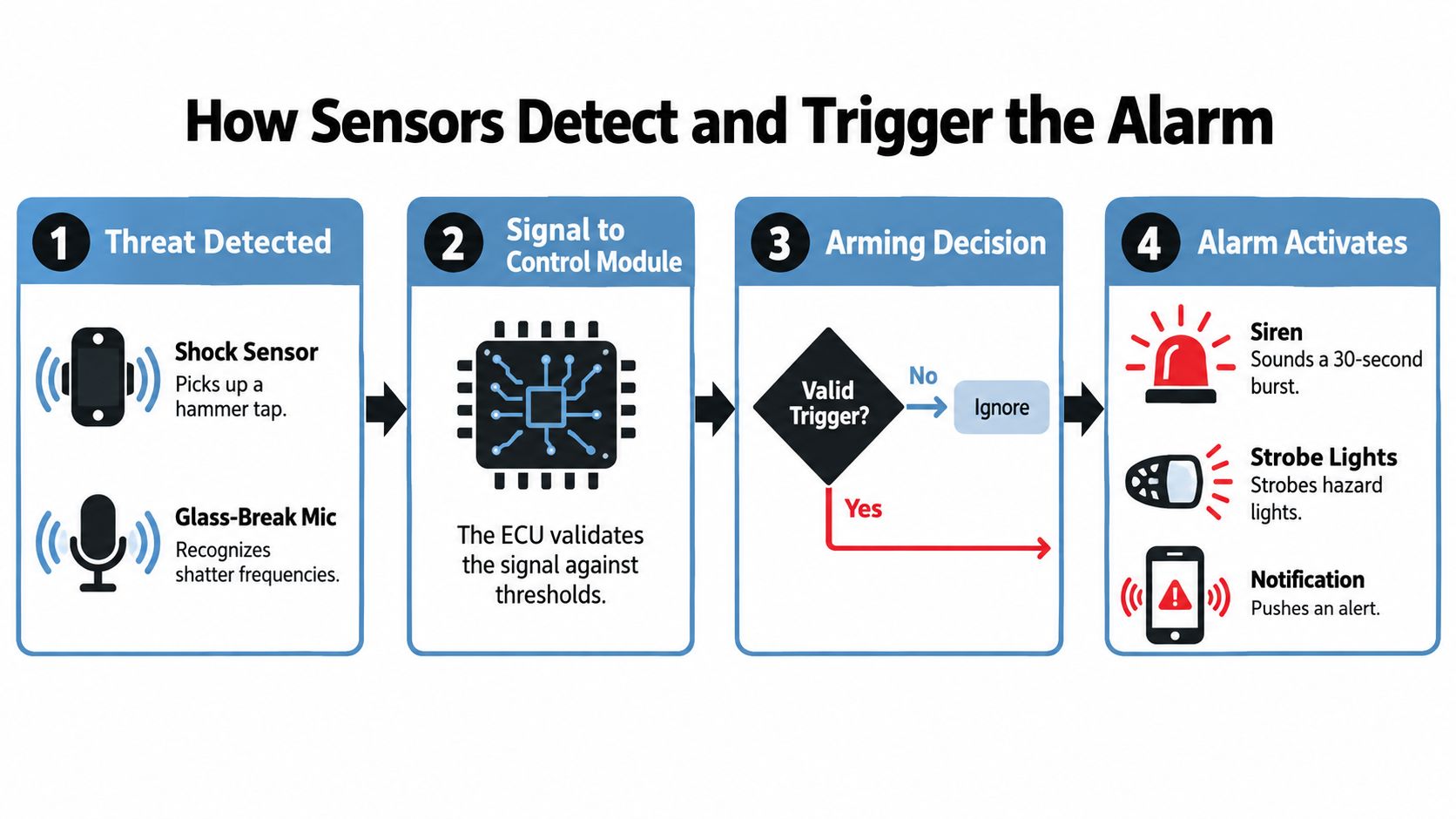
A modern car alarm resembles a small security operation with sensors, a decision-maker, and several response devices. The sensors collect information. The control module evaluates it. The outputs respond according to the type and severity of the event.
The inputs that watch the vehicle
Door, hood, and trunk switches monitor the vehicle's main entry points. Many use a normally closed circuit, meaning the control module expects the circuit to remain complete while the panel is shut. Opening a door or hood changes that electrical state, giving the module a clear reason to investigate.
Shock or impact sensors respond to vibration. A light bump may produce a warning chirp, while a heavier impact can produce a full alarm. The exact response depends on the system's calibration and how the installer connects the sensor to the control module.
Motion, tilt, and glass-break sensors cover situations that ordinary entry switches may miss. A motion sensor can detect movement inside the cabin, a tilt sensor can identify a change in vehicle angle, and a glass-break sensor can listen for sound patterns associated with shattering glass. These sensors don't all work in the same way, which is useful because thieves can approach a vehicle in different ways.
The control module and outputs
The control module acts like a security guard. It receives signals, checks whether the alarm is armed, applies programmed thresholds, and chooses an output. It may energize a siren, sound the vehicle horn, flash the headlights, or activate hazard lights. Some systems also send information through a connected receiver or mobile application.
A radio receiver allows the key fob to arm, disarm, or control supported functions. Many systems also include an auxiliary battery. If a thief disconnects the vehicle's main battery, the alarm can continue monitoring or sounding from its backup power source, depending on the design and condition of that battery.
The wiring and installation matter as much as the feature list. A sensor that isn't mounted securely can misread vibration. A hood switch positioned incorrectly may miss an opening. A poorly integrated immobilizer relay can create starting problems instead of reliable protection.
For a visual explanation of the signal path, this car alarm operation video shows how sensors, control electronics, and alarm outputs fit together.
How Sensors Detect and Trigger the Alarm
The central question isn't just whether a sensor detects movement. The control module must decide whether the input represents a harmless disturbance, a warning condition, or a genuine intrusion.
The normal trigger path
The most common path combines a shock sensor with normally closed switches at entry points. While the system is armed, the control module monitors those circuits and waits for a meaningful change.
Consider a car parked at the curb. A nearby vehicle creates a small vibration, and the shock sensor registers it. The module may treat that as a warning event and produce a brief chirp or light response. If someone hits the car harder, the signal crosses a stronger threshold and the module switches to full alarm mode.
The same logic applies to an entry-point switch. If the hood opens, the hood circuit changes state. If a door is forced open, the door circuit changes state. The module sees a condition that is more specific than general vibration, so it can activate the main alarm response.
From signal to response
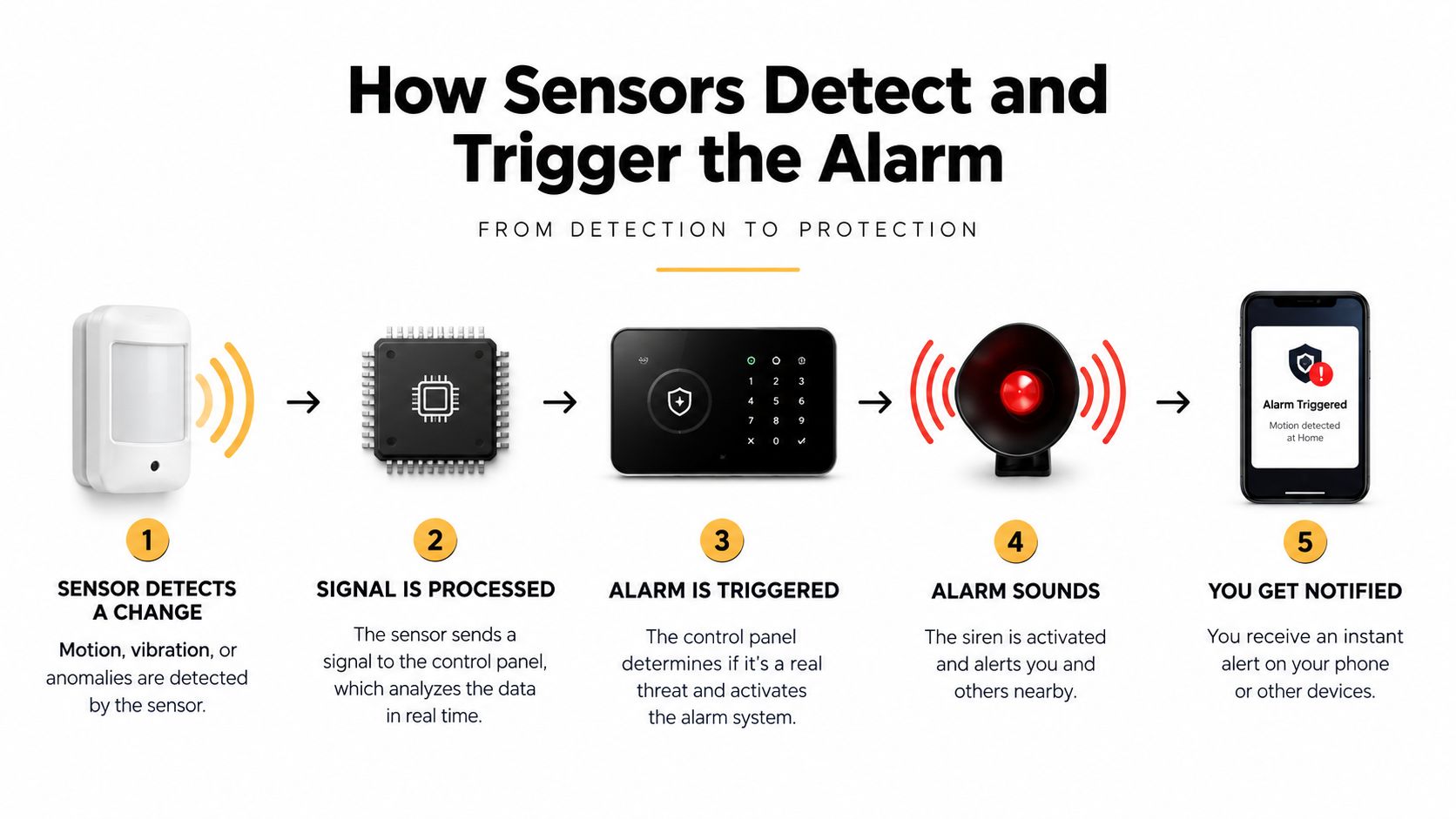
The sequence usually looks like this:
- A sensor detects a change. The event may be vibration, a broken entry circuit, movement, tilt, or glass breakage.
- The sensor sends an electrical signal. The signal travels to the alarm control unit through the vehicle's wiring or an integrated electronic network.
- The control unit checks the system state. It verifies that the alarm is armed and evaluates the signal against programmed thresholds.
- The system chooses a response. A minor disturbance may receive a warning response, while a confirmed intrusion activates the siren, horn, lights, or notifications.
- A security relay may interrupt starting. In systems with immobilization, the controller can cut the starter or fuel pump circuit through a relay, as explained in this technical guide to car alarm trigger circuits.
That final step explains why the alarm and immobilizer should be considered separately. The alarm announces the event. The immobilizer changes whether the vehicle can operate.
Why the system doesn't react identically every time
A sensor can't know a person's intention. It only measures conditions such as movement, vibration, electrical continuity, or sound. The control module therefore relies on thresholds and combinations. A brief vibration by itself may be less convincing than a broken door circuit followed by interior movement.
This approach helps reduce unnecessary activations, but it isn't perfect. Installation quality, sensor placement, weather, vehicle movement, and the condition of switches all affect the result. A warning zone that's set too aggressively can annoy the owner, while a setting that's too conservative may fail to draw attention during a real attempt.
The practical point is simple: an alarm makes a decision from sensor evidence. It doesn't possess human judgment, and its reliability depends on both the hardware and the way the system has been configured.
Solving the False Alarm Problem
A car alarm that activates every time wind shakes a tree is not protecting the vehicle effectively. It may still detect a serious intrusion, but repeated nuisance events train owners and bystanders to ignore the sound. The problem isn't that sensitivity is always bad. The problem is sensitivity without useful interpretation.
Older or basic systems often rely heavily on a single shock sensor. A heavy truck, nearby construction, a closing garage door, or a strong gust can create enough vibration to trigger a warning or full alarm. Poorly adjusted sensors can also react differently after installation because the mounting surface, vehicle body, and cabin conditions affect what the sensor feels.
Better systems compare more than one signal
Modern designs increasingly combine multi-sensor logic, adaptive sensitivity, and software-based filtering. A controller can weigh the strength of a vibration, the duration of the event, and whether another sensor confirms an intrusion. A tilt event paired with a change at the hood circuit is more concerning than a single minor vibration.
Recent coverage describes the industry's movement toward systems that use adaptive sensitivity and AI or machine learning to distinguish likely threats from benign events such as weather or nearby construction. The same market coverage of car security systems says that over 45% of new systems offer real-time smartphone monitoring and 60% of models use adaptive sensitivity. Those figures come from the cited market source, and they should be treated as market reporting rather than a guarantee about every product.
AI doesn't make a sensor infallible. It gives the system more ways to interpret patterns instead of treating every vibration as identical. That can make connected notifications more useful because the owner receives fewer alerts that have no practical meaning.
Sensitivity should match the vehicle's surroundings
A car kept in a quiet private driveway may need a different configuration from one parked beside a busy road. An off-road vehicle may experience more ordinary body movement than a commuter car. A convertible, truck, or vehicle with a modified suspension can also produce different vibration patterns.
Ask an installer to test each zone rather than only turning sensitivity to its highest setting. Test the doors, hood, trunk, impact sensor, tilt sensor, and remote controls separately. If the alarm activates without an obvious cause, check the hood and door switches first, then inspect sensor mounting, wiring, and battery condition.
A reliable alarm isn't the loudest alarm. It's the one that responds consistently to real tampering and stays quiet during ordinary vehicle movement.
Layered Security and Immobilizer Integration
The most useful way to understand vehicle security is as a sequence of barriers. The alarm detects an event. The immobilizer blocks unauthorized starting. A connected system can notify the owner. Telematics can provide location information if the vehicle moves.
That sequence changes the value of the siren. The siren still matters because it creates attention and may discourage a quick break-in, but it no longer carries the whole responsibility. A thief who enters the cabin may still face an immobilizer that prevents the engine from starting. If the vehicle moves, the owner may receive an alert and use connected location tools to support recovery.
The immobilizer's role
The early 1919 anti-theft design described by this account of immobilizer history already combined two actions. It could sound the horn and prevent the ignition circuit from proceeding when the correct sequence wasn't present.
Later systems moved toward coded electronic authorization. General Motors introduced the mass-market VATS immobilizer on the Corvette in 1986, and Ford introduced PATS in 1996, using a radio-frequency transponder chip in the key head. Immobilizers became standard in major markets, including the European Union in 1998 and Australia in 2001, according to the same historical source.
The transponder doesn't act like a remote-control button. The vehicle's security electronics check for an authorized code before allowing the relevant starting sequence. If the alarm detects a break-in but the authorization remains absent, an integrated system can keep the starter or fuel system disabled.
Detection, prevention, and recovery
These layers address different moments in a theft attempt:
| Security layer | Primary job | Example response |
|---|---|---|
| Entry sensors | Detect access or tampering | Door, hood, and trunk circuit changes |
| Impact and motion sensors | Detect physical disturbance | Warning chirp or alarm activation |
| Siren and lights | Draw attention | Audible and visual warning |
| Immobilizer | Prevent drive-away | Interrupts an authorized starting path |
| Smartphone connection | Inform the owner | Sends a security notification |
| Telematics and GPS | Support recovery | Reports vehicle location or movement |
A car alarm, immobilizer, and transponder key don't provide identical protection. An alarm can react to tampering, an immobilizer can block operation, and telematics can continue to provide information after the vehicle has moved. Combining them closes gaps that any single device leaves open.
Choosing and Maintaining the Right System
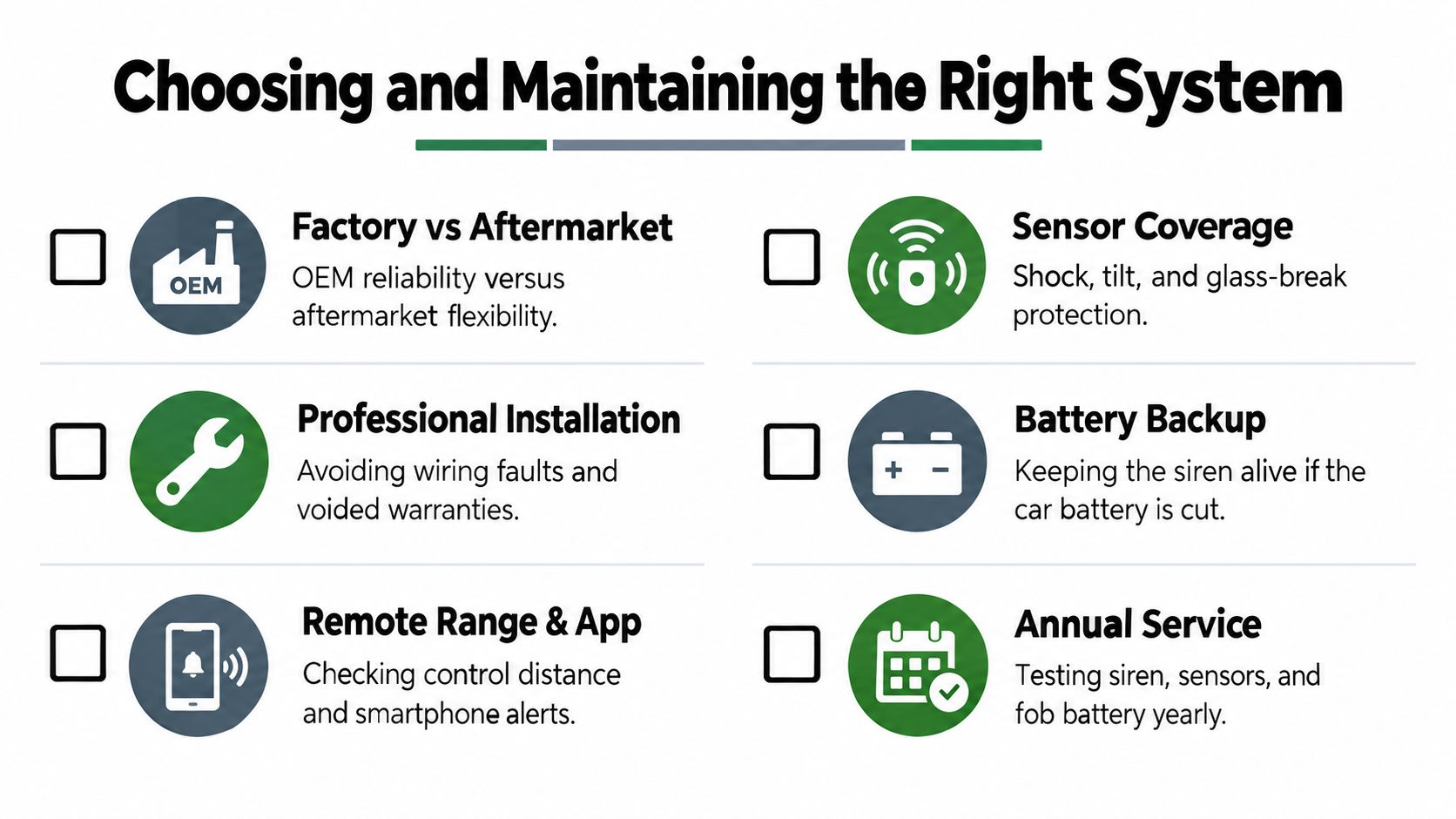
Start with the vehicle, the parking environment, and the response you expect after an alert. A factory system may integrate smoothly with the original key, body electronics, and dashboard. An aftermarket system can add features such as expanded sensor coverage, remote controls, smartphone access, or security integration, but compatibility and installation quality deserve close attention.
Match features to the real risk
A daily commuter parked in public spaces may value door, hood, trunk, shock, and glass-break coverage. A truck or Jeep used on uneven ground may benefit from carefully adjusted tilt and impact detection. A marine, motorcycle, or UTV owner needs equipment and installation methods suited to a more exposed environment.
Use this checklist when comparing systems:
- Sensor coverage: Confirm which zones are monitored. Don't assume a system includes tilt, glass-break, or interior motion detection because it has a siren.
- Immobilizer integration: Ask whether the system can work with the vehicle's existing authorization electronics without creating starting or remote-start conflicts.
- Battery backup: Verify whether the alarm has auxiliary power and how the backup battery is tested.
- Remote access: Check whether the fob provides one-way or two-way communication and whether smartphone alerts are supported.
- Telematics: If recovery matters, look for connected location reporting and movement alerts rather than relying on sound alone.
- Installation method: Choose an installer who can explain where sensors, relays, and control modules will be placed and how the factory wiring will be protected.
Keep the system dependable
Test the remote fob and replace its battery when its range becomes inconsistent. Inspect the hood and trunk switches if the alarm reports an open panel when everything appears closed. Have the technician retest impact and tilt zones after suspension, body, battery, or electrical work.
Don't increase sensitivity just because the system missed one event. A technician should check sensor mounting, thresholds, wiring, and the control module's programming. Ask whether the system's software or firmware can be updated, especially when smartphone access or remote-start functions are involved.
Professional installation is particularly important when the alarm communicates with factory electronics, starter circuits, remote start, or connected accessories. A clean integration makes troubleshooting easier and reduces the chance that a security feature will interfere with normal vehicle operation.
Securing Your Vehicle for the Long Term
A car alarm is not a set-it-and-forget-it noise-maker. It is a working electrical system with sensors, switches, a control module, outputs, backup power, and sometimes a connection to an app or tracking platform. Each part needs to remain compatible, powered, and correctly adjusted.
The strongest approach uses layered protection. Entry and impact sensors provide early detection. The siren and lights create immediate deterrence. An immobilizer makes unauthorized starting more difficult. Smartphone notifications and telematics extend protection beyond the parking space by giving the owner information about suspicious activity and vehicle movement.
Connected security is also changing what owners expect from an alarm. Features such as remote access, geofencing, and real-time location reporting shift the focus from hearing a siren to understanding what happened and where the vehicle is. They don't replace sensible parking habits or regular maintenance, but they can make the response more informed.
Before upgrading, document how your current system behaves. Note which sensors activate, whether the fob works consistently, whether notifications arrive, and whether the vehicle starts normally after disarming. Take that information to a qualified installer and ask for a system that fits the vehicle, the parking environment, and the protection gaps you really need.
Audio Jam Inc offers professionally installed car alarm systems, remote start and security integration, dash cams, blind spot detection, and GPS accessories for cars, trucks, SUVs, and specialty vehicles. To discuss a properly configured layered security setup, visit Audio Jam Inc and explore the available products and installation services.