

4 Ohm vs 2 Ohm Speakers: How to Choose the Right One

You're probably here because you've got a real decision in front of you, not a theory question. Maybe you're replacing factory door speakers, maybe you're buying a sub, or maybe you already own an amp and you're trying to figure out whether to order the 2 ohm version or the 4 ohm version.
A lot of installs go sideways here. Someone buys the “louder” option, wires it up, and then wonders why the amp runs hot, clips early, or drops into protect on bass notes. The problem usually isn't the speaker brand. It's that the speaker impedance, amp stability, wiring plan, and enclosure goal were never matched as one system.
That's the way to look at 4 ohm vs 2 ohm speakers. It's not a loud-versus-safe coin flip. It's a system-design choice.
Table of Contents
- Why Impedance Matters Before You Pick a Speaker
- What Speaker Impedance Really Means
- How 2 Ohm and 4 Ohm Behave Under Power
- Wiring Speakers to Hit a Target Impedance
- Matching Impedance to Your System and Use Case
- Why Louder Is Not Always Better in a Daily Driver
- Troubleshooting Impedance and Amplifier Problems
- Choosing the Right Impedance for Your Build
Why Impedance Matters Before You Pick a Speaker
A shop-floor version of this happens all the time. A customer wants the loudest sub for the money, grabs a 2 ohm model because somebody told him lower ohms means more output, and hooks it to an amp that was only happy at 4 ohms. A few days later, the amp starts shutting down on hard bass hits. Nothing “mystical” happened. The load was wrong for the amplifier.
The number on the box isn't a quality score. It's the electrical load the speaker presents to the amp. Lower impedance means the amplifier has to supply more current at the same voltage. In real car-audio terms, 2-ohm loads draw about twice the current of 4-ohm loads at the same voltage, and one engineering example shows 28.28 volts into 2 ohms equals 14.14 amps and 400 watts RMS, versus 7.07 amps and 200 watts RMS into 4 ohms when the amplifier is designed to support it, as explained by RMS to Watts in its speaker impedance breakdown.
What that means in the car
That extra current can be useful. It can also punish weak gear fast.
- More current draw: The amp's output section works harder.
- More heat: Heat is what exposes weak wiring, poor grounding, and marginal amp design.
- More risk if mismatched: If the amp isn't stable at the lower load, it may overheat, clip sooner, or shut down.
Practical rule: Pick the amplifier's stable load first, then choose the speaker or wiring scheme that lands at or above that number.
The common DIY mistake
A lot of DIY installs fail before the first song plays because the buyer shops by sub size, peak power marketing, or brand name and ignores impedance until the end. That's backwards. Impedance affects what wiring options you have, what the amp can survive, and how much real power reaches the voice coil without distortion.
If you get this one spec right early, the rest of the build gets easier. If you get it wrong, you spend the next week chasing protect mode, clipping, and hot power wire.
What Speaker Impedance Really Means
Impedance gets oversimplified all the time. People talk about a speaker like it's just a resistor with a fixed number stamped on it. It isn't.
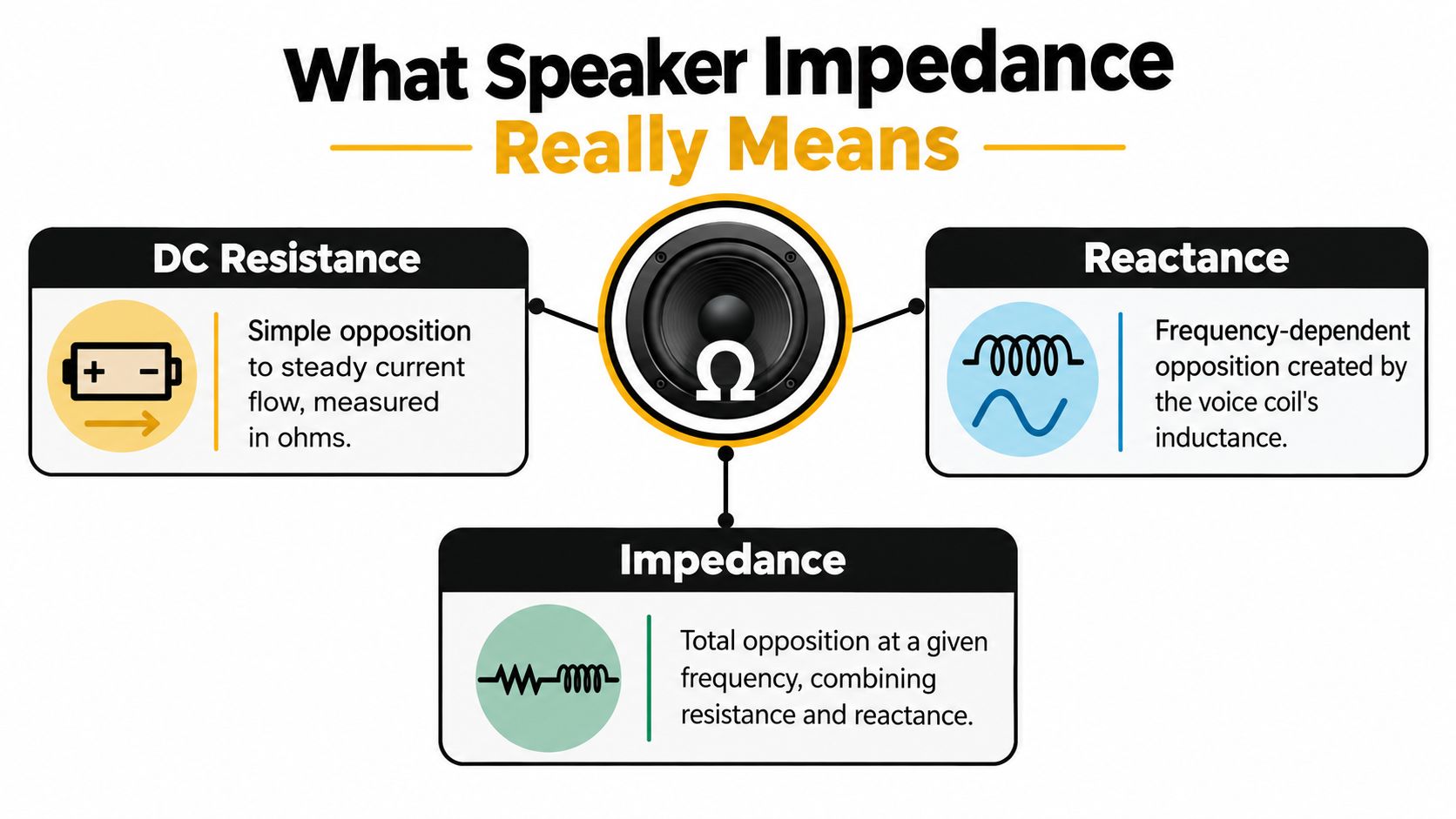
A speaker has resistance, which is the basic opposition to current flow, and it also has reactive behavior from the moving parts and the voice coil. That's why the amp doesn't see one flat number across the whole frequency range.
Resistance is only part of the story
If you put a multimeter on a speaker, you're measuring DC resistance, not the full AC impedance curve. That's why a nominal 4 ohm speaker usually won't read exactly 4 on the meter.
According to Sound Certified's explanation of speaker impedance measurements, a 4-ohm speaker typically measures about 3.1 to 4.0 ohms, while a 2-ohm speaker usually measures about 1.2 to 2.0 ohms. The load changes with frequency because loudspeaker impedance includes resistance plus reactive components from inductance and capacitance.
A simple way to picture it
Think of it like a garden hose.
- Resistance is the hose diameter.
- Reactance is the changing restriction, like a bend or kink that affects flow differently under different conditions.
- Impedance is the total load the pump feels.
That matters because music isn't steady DC. It's constantly changing AC signal. Bass, midrange, and treble don't all load the amp the same way.
Why the number is called nominal
Speaker impedance has long been standardized as a nominal value, not a fixed resistance. Audio engineering references cite an IEC rule that says the minimum impedance should stay at least 80% of nominal, so a 4-ohm speaker shouldn't dip below 3.2 ohms and an 8-ohm speaker shouldn't dip below 6.4 ohms, as discussed by Audioholics in its loudspeaker impedance article.
The ohm rating on the label is a category for system matching. It is not a promise that the speaker sits on one exact number all the time.
Why installers care
On the bench, this changes how you diagnose problems. In the car, it changes how the amplifier behaves under load. The amp doesn't “see” a static 2 or 4 ohms from the first note to the last. It sees a curve. That curve affects current demand, heat buildup, and how much control the amp keeps over the speaker.
How 2 Ohm and 4 Ohm Behave Under Power
Once you understand that impedance is a load, comparison gets easier. A 2 ohm speaker asks more from the amplifier. If the amplifier was built for that, you can get more power out of the same vehicle voltage. If it wasn't, you get heat, clipping, and shutdowns.
Here's the fast side-by-side view.
2 Ohm vs 4 Ohm Load Comparison
| Parameter | 4 Ohm Load | 2 Ohm Load |
|---|---|---|
| Current draw | Lower current demand at the same voltage | Higher current demand at the same voltage |
| Power potential | Lower power from the same amp voltage | Higher power when amp is designed for it |
| Amplifier stress | Easier on output stage and thermal load | Harder on output stage, more heat risk |
| Typical use | Factory-style systems, full-range speakers, conservative builds | SPL-focused sub setups, power-limited systems chasing more output |
| Reliability margin | Usually broader | Depends heavily on amp stability |
Current and power
The cleanest way to understand 4 ohm vs 2 ohm speakers is with current. At the same amplifier voltage, lower impedance pulls more current. In practical car-audio use, that means more output is possible, but only if the amplifier is stable there.
MTX's speaker impedance guide explains the core tradeoff clearly: a 2-ohm speaker presents a lower impedance load than a 4-ohm speaker, so at the same amplifier voltage it draws more current and can produce more output power, but the amplifier must be stable at that lower load or it may overheat, clip sooner, or shut down under stress.
Stress on the amplifier
Bench-racing turns into real-world install work here. A lot of budget and factory amplifiers look fine at moderate volume, then fold when bass-heavy material hits and current demand spikes.
Watch for these patterns:
- Protect mode on bass notes: The amp can't sustain the load.
- Hot heatsink fast: Current demand is too high for the amp's thermal design or mounting location.
- Clipping at lower volume than expected: The amp is running out of clean headroom sooner.
A 2 ohm speaker isn't automatically a problem. A 2 ohm speaker on the wrong amp is the problem.
Sensitivity still matters
This part gets skipped in a lot of explainers. Impedance alone doesn't tell you how loud the system will feel in the seat. Sensitivity matters too. Two speakers with different efficiencies can behave very differently even if they share the same impedance.
BOSS Audio's discussion of 2 ohm versus 4 ohm choices points out that many consumer explainers reduce the whole conversation to “2 ohm is louder” and “4 ohm is safer,” while the more practical question is whether the amplifier can sustain the extra current without clipping, overheating, or giving up reliability in real driving conditions.
Quick wiring reality for subwoofers
Sub impedance gets interesting once you add multiple coils.
- Dual 2 ohm voice coils: series wiring gives 4 ohms, parallel wiring gives 1 ohm
- Dual 4 ohm voice coils: series wiring gives 8 ohms, parallel wiring gives 2 ohms
That's why the same subwoofer line often comes in different coil configurations. The driver doesn't just need to fit the box. It needs to land on a final load your amp wants to see.
Wiring Speakers to Hit a Target Impedance
A lot of good gear gets installed badly. The math isn't hard, but the wiring has to match the plan. If your target load is wrong, the amp doesn't care that the speaker itself was a good choice.
Final Impedance by Wiring Configuration
| Configuration | Drivers | Final Load |
|---|---|---|
| Series | Two single 4 ohm speakers | 8 ohms |
| Parallel | Two single 4 ohm speakers | 2 ohms |
| DVC series | One dual 4 ohm sub, coils in series | 8 ohms |
| DVC parallel | One dual 4 ohm sub, coils in parallel | 2 ohms |
| DVC series | One dual 2 ohm sub, coils in series | 4 ohms |
| DVC parallel | One dual 2 ohm sub, coils in parallel | 1 ohm |
Series wiring
Series adds the loads together. Positive from the amp goes to the first speaker. The negative of that speaker links to the positive of the next. The final negative returns to the amp.
For example:
- Two single 4 ohm subs in series land at 8 ohms
- One dual 4 ohm sub with coils in series also lands at 8 ohms
Series is useful when the amp needs to see a higher load, or when you'd rather give up some output for stability and cooler operation.
Parallel wiring
Parallel lowers the total load. All positives tie together, and all negatives tie together.
Examples:
- Two single 4 ohm subs in parallel land at 2 ohms
- One dual 4 ohm sub with coils in parallel lands at 2 ohms
This is common when a monoblock makes stronger power at lower impedance and is rated to run there.
Where people make mistakes
The wiring errors are usually simple:
- Polarity mistakes: One speaker ends up out of phase and output gets weird or weak.
- Half-finished parallel wiring: Somebody ties positives together but mishandles the return path.
- Mixing speaker types carelessly: Full-range channels and sub channels don't always get treated the same way.
Shop habit: Before powering the system, measure the load with a multimeter as a sanity check. You're checking DC resistance, not the full impedance curve, but it will still tell you if you accidentally built a near-short or landed far away from the nominal target.
A practical full-range example
In some builds, four door speakers get divided into left and right pairs so each amp channel sees a stable load the amp is rated to handle. That can work well if the amplifier, passive crossovers, and wiring plan were chosen together. It goes bad when someone copies a subwoofer wiring mindset onto mids and highs without accounting for crossover behavior or amp channel limits.
The clean install is the one that hits the target load on paper, confirms it at the terminals, and then gets gain set correctly before the first hard listening session.
Matching Impedance to Your System and Use Case
A customer pulls in with a stock head unit, four tired door speakers, and plans for “something louder.” Another rolls up with a monoblock, a custom box, and a goal that starts with bass and ends with license-plate rattle. Those two vehicles should not get the same impedance recommendation.
Impedance is a system choice. It has to match the amp's stable operating range, the speaker's sensitivity, and the enclosure or mounting space the driver will work in.
Factory replacement and mild upgrades
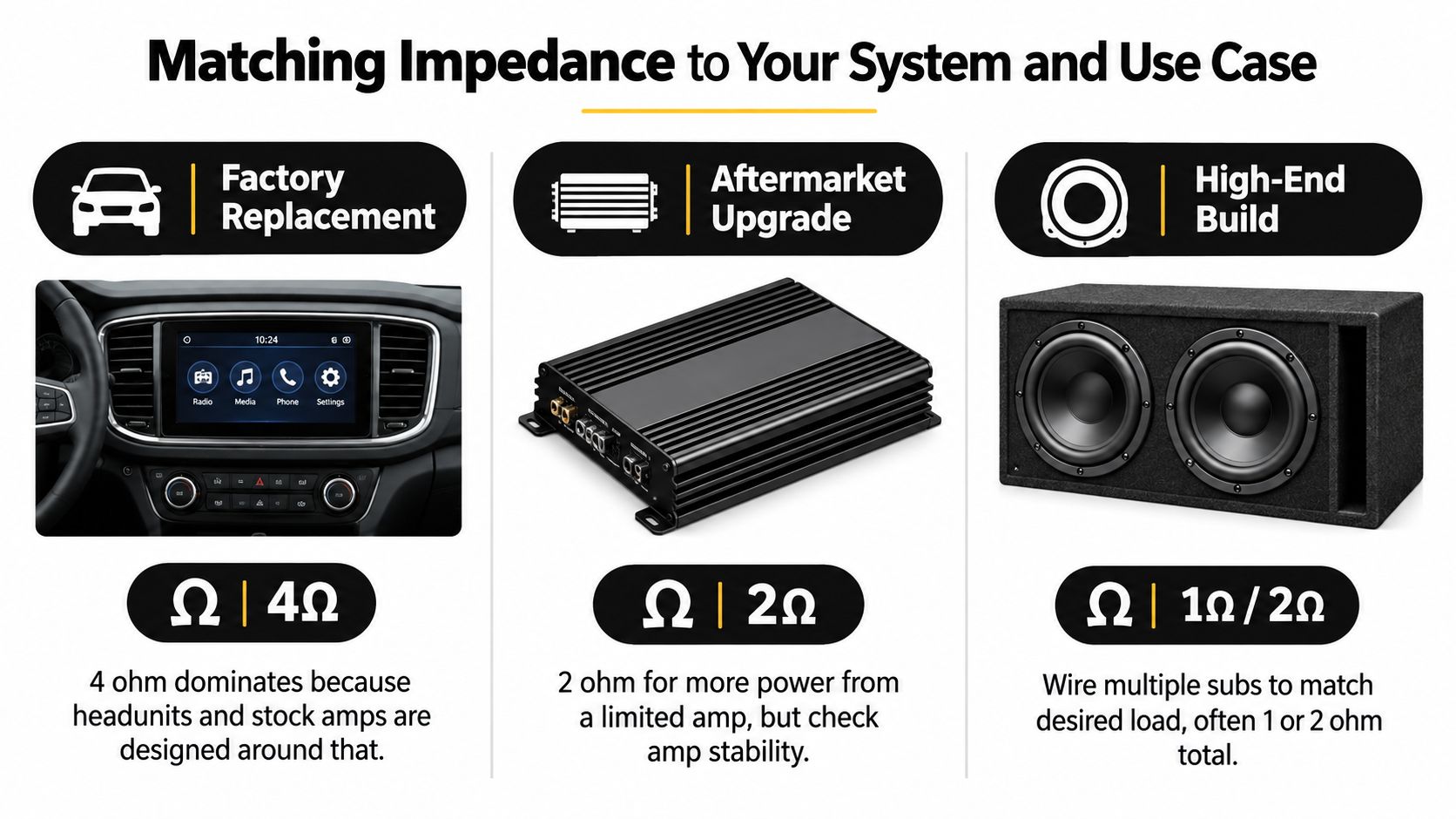
For factory replacement speakers and basic aftermarket installs, 4 ohm usually makes the cleanest sense. Stock radios and many OEM amps are happier there, and door speakers tend to benefit more from clean signal and sane gain structure than from pushing the lowest load you can get away with.
That answer fits daily drivers well. It keeps the install simple, leaves more thermal margin in the amp, and usually avoids the “it plays louder for ten minutes, then gets harsh” problem.
Subwoofer upgrades and limited vehicle voltage
Subwoofer systems are different. Car audio runs on limited vehicle voltage, so installers often use lower impedance to get more output from an amplifier that was built to make its power there.
In practice, 2 ohm shows up most often on sub stages, especially when the amp is rated for it and the voice coil configuration was chosen with that target in mind. If you're shopping this category, retailers such as Audio Jam Inc carry impedance-specific speakers, subwoofers, and amplifiers, which matters because the right result often starts with buying the correct coil layout before the install begins.
Sensitivity and enclosure matter just as much
This is the part a lot of quick explainers skip. A less efficient sub at 2 ohms in a bad box can lose to a more efficient sub at 4 ohms in the right enclosure every day of the week.
Sealed versus ported, box volume, tuning frequency, available trunk space, and cabin gain all change what you hear from the seat. So does speaker sensitivity. If a driver needs more power to wake up, lower impedance alone will not save the setup.
Sound Certified's discussion of speaker impedance options makes the same practical point. The audible gain from 2 ohm can be modest in a daily driver unless the amp, wiring, and enclosure were all chosen to support it.
For a visual walk-through of how these choices fit different builds, this video does a good job of showing the system-level thinking behind the decision.
Use-case shortcut
- Factory radio or stock amp: stay with 4 ohm full-range speakers in most cases
- Aftermarket sub amp rated for lower loads: 2 ohm can be the right target
- Marine, powersports, or hot enclosed installs: thermal headroom and reliability usually matter more than chasing minimum impedance
- SPL-focused build: choose voice coils, box design, and wiring around the amplifier's minimum stable load
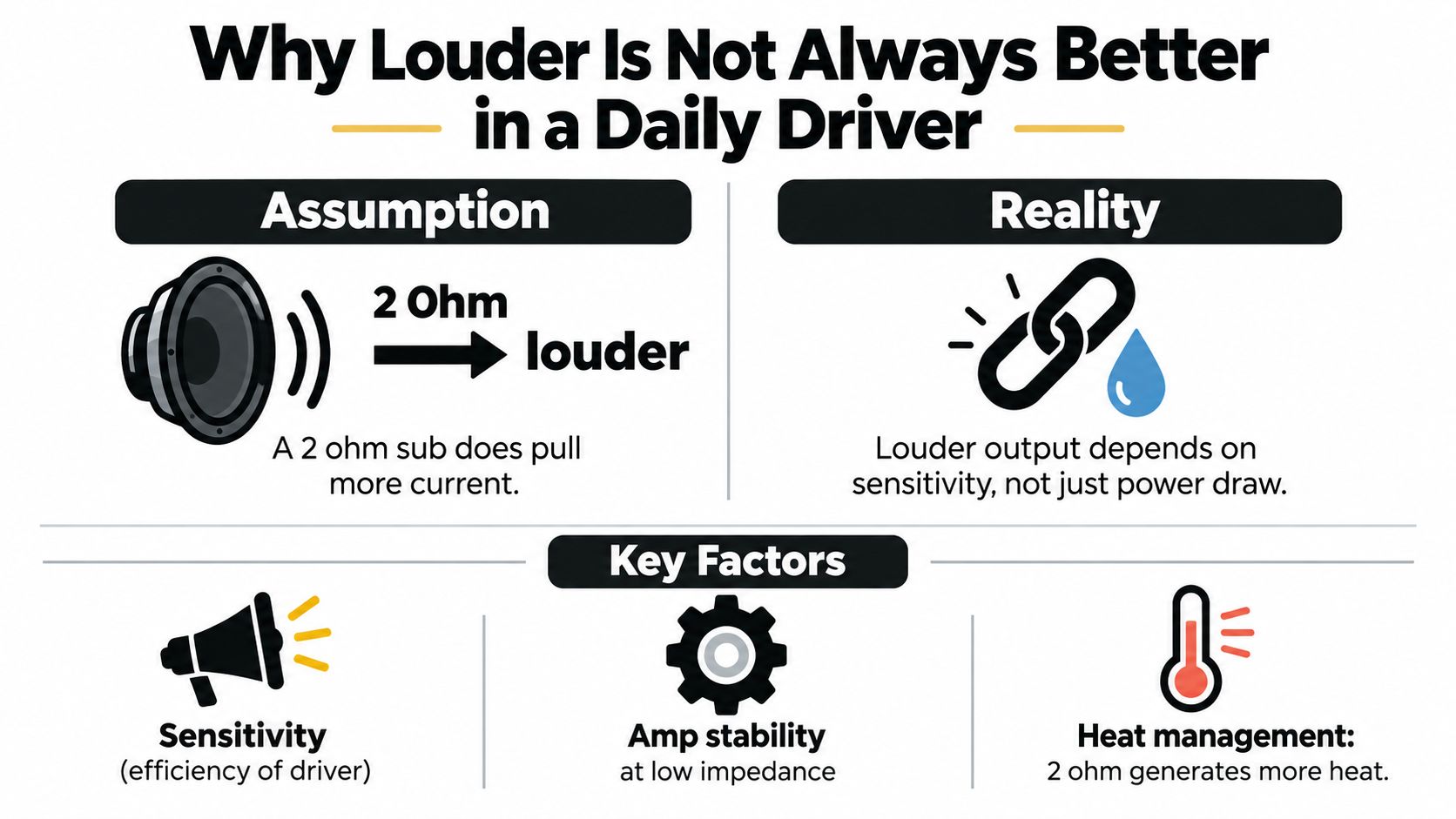
Why Louder Is Not Always Better in a Daily Driver
A lot of buyers assume 2 ohm automatically means noticeably louder, and in the lab that lower load can let a capable amp produce more power. In the car, though, daily listening isn't decided by one spec.
Cabin noise, tuning, speaker placement, and the kind of music you play all affect what you hear from the driver's seat.
Daily-driver priorities are different
Most drivers don't need every possible watt squeezed from the amp. They want bass that's full, vocals that stay clean, and a system that still works in August traffic with the A/C on and the trunk packed.
That's where 4 ohm setups often make sense. They're easier on the amp, easier on the charging system, and easier to tune cleanly in normal use.
Lower impedance isn't the whole loudness story
A 2 ohm load can increase current demand and raise output potential, but output gain can be small unless the amp was designed for that load and the rest of the setup supports it. That underexplained gap is one of the better takeaways from the earlier BOSS Audio source: lower impedance can raise heat and current draw, while actual benefit depends heavily on amplifier stability and the rest of the system.
What usually decides whether a daily system sounds satisfying?
- Speaker sensitivity: How efficiently the driver turns power into output
- Enclosure tuning: A well-matched sealed or ported box matters more than most buyers expect
- Headroom: An amp running comfortably often sounds better than an amp being pushed to its limit
A cooler, cleaner 4 ohm system can beat a stressed 2 ohm system every day of the week in a commuter car.
Where 2 ohm is worth it
If the goal is stronger bass from a properly matched monoblock, 2 ohm can be the sweet spot. It gives the amp room to make more output from the limited electrical environment of a vehicle, especially on sub duty. But that doesn't automatically make it the right answer for door speakers or for stock-amplified systems.
The mistake is chasing the lowest number just because it sounds aggressive on paper. Daily drivers reward balanced system design more than they reward bragging rights.
Troubleshooting Impedance and Amplifier Problems
When the load is wrong, the system usually tells on itself. You just have to know what symptom points where.
Most amplifier complaints people blame on “bad speakers” are really load, wiring, gain, or electrical support issues. Start there first.
Check the speaker with a meter
A digital multimeter is your first sanity check. Measure the speaker's DC resistance at the terminals with the system off and disconnected if possible. You are not measuring the full impedance curve, but you can confirm whether the speaker is roughly where it should be or whether something is badly wrong.
If the reading is near zero, that's a serious red flag. If the reading is in the normal DC range for the nominal rating, the speaker itself is at least in the ballpark.
Symptoms that point to a load problem
These are the big ones installers see:
- Amp shuts down only at higher volume: The load or gain structure is pushing the amp too hard.
- Protect mode on bass-heavy songs: Current demand rises where the amp is weakest.
- Heatsink gets too hot to trust: The amp is working harder than it should.
- Headlights dim badly on hits: The electrical system is being leaned on hard.
- Clipping gets worse as you turn it up: The amplifier is out of clean headroom.
What to inspect before blaming the speaker
Go through the simple stuff in order.
- Recheck the wiring math. Parallel mistakes happen constantly.
- Inspect for shorts or damaged leads. One stray strand can cause real trouble.
- Verify gain setting. Too much gain can look like a speaker problem when it's really amplifier clipping.
- Check grounds and power delivery. Weak grounding and voltage drop make low-impedance systems act worse than they should.
If a 2-ohm-rated monoblock is wired below what it can safely handle, it may fold back power, overheat, or fail. If you put a 4 ohm sub on an amp that can run lower, the system usually just makes less output. It doesn't automatically become unsafe.
What works in practice
When diagnosing a troubled setup, simplify it. Disconnect extra variables, confirm the final load, and test with known-good wiring. If the amp behaves at a higher load and misbehaves at a lower one, you've learned something useful quickly.
A clean troubleshooting process saves gear. Randomly swapping parts usually doesn't.
Choosing the Right Impedance for Your Build
A customer walks in wanting “the loudest setup possible,” and the first thing I check is not the speaker brand. I check the amplifier, the wiring options, and the kind of vehicle it's going into. Impedance is a system decision. If you choose it in isolation, you can end up with a setup that looks strong on paper and disappoints once it is installed.
The right answer starts with how the whole system will be used.
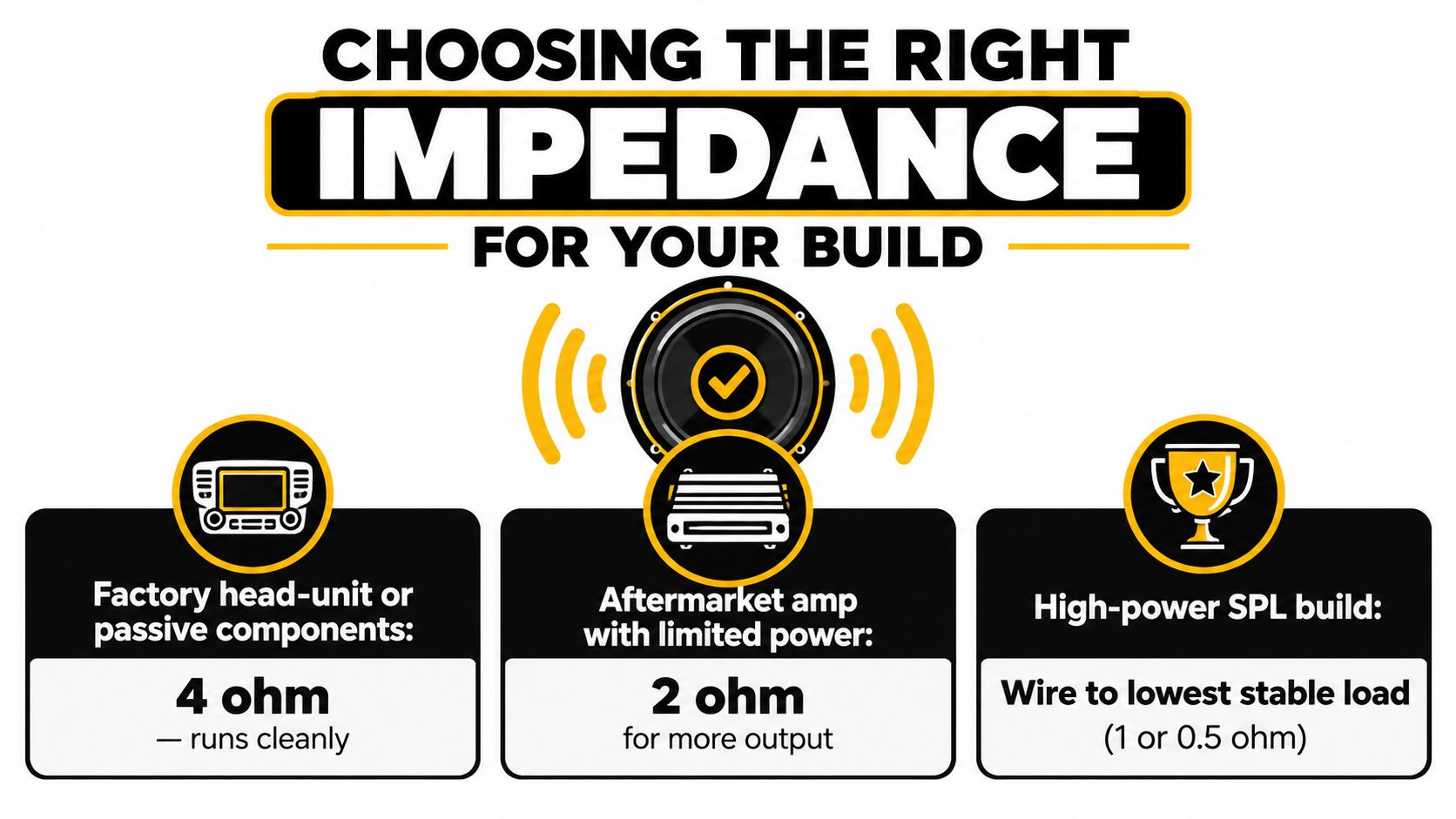
For factory head-unit replacements and passive component sets, 4 ohm is usually the smart call. It fits what factory and entry-level aftermarket gear is built to handle, and it gives more room for clean, reliable daily use. In real cars, that often matters more than chasing a small output gain.
For an add-on subwoofer system, 2 ohm often makes sense if the monoblock is rated to deliver clean power there. That setup can get better use out of the amp's available power, but only if the electrical system, box design, and final wiring load all make sense together. A 2 ohm sub on the wrong amp is not an upgrade.
For hardcore SPL builds, impedance gets chosen around the amplifier's stable operating range, the subwoofer's coil layout, and the enclosure's job. Output in those systems comes from the full plan working together. Amp stability, cone control, box rise, and electrical support matter more than a simple “lower ohms equals louder” shortcut.
I still recommend 4 ohm more often than a lot of shoppers expect.
- Daily-driver full-range speakers: easier to keep clean at volume
- Marine and powersports systems: more thermal breathing room in rough conditions
- Stock or modest aftermarket amps: less strain, fewer shutdown surprises
I recommend 2 ohm when the build was planned around it.
- Subwoofer systems with a monoblock designed for a 2 ohm load
- Vehicles trying to get solid bass output from limited charging-system headroom
- Builds where voice-coil choice and wiring were selected to reach a specific final load
The practical move is simple. Pull up the amplifier model, verify the minimum stable load, then choose the speaker version and wiring scheme that stays at or above that number. After that, check sensitivity and enclosure requirements, because those two factors often shape real-world results more than shoppers expect.
That approach keeps the choice grounded in system design instead of internet myths.
If you want help sorting out speaker impedance, amp matching, subwoofer wiring, or choosing the right full-range upgrade for your vehicle, Audio Jam Inc handles car audio sales and installation with real-world system matching in mind. You can browse gear, compare fitment options, or talk through a build with Audio Jam Inc before you buy parts that don't belong together.